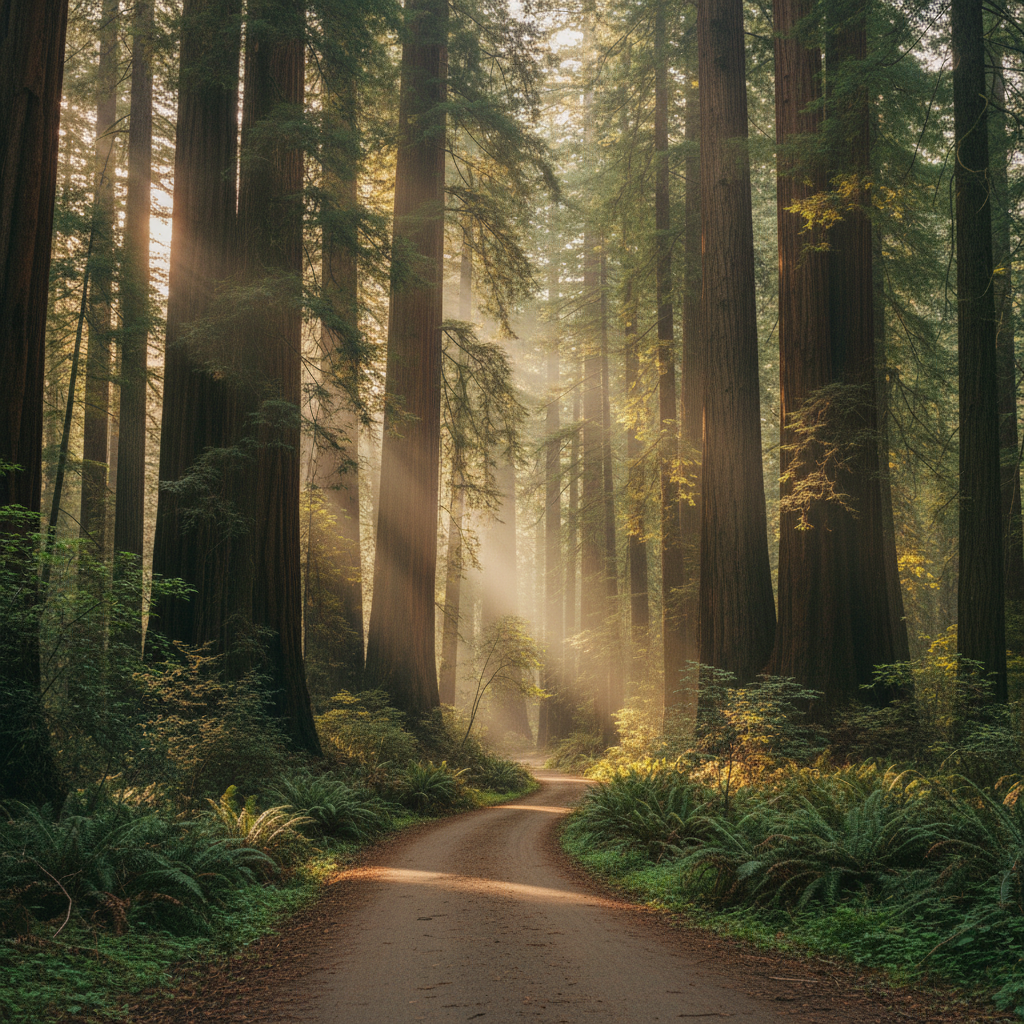
A massive state park protecting the world's largest contiguous old-growth redwood forest along the scenic Avenue of the Giants.
Humboldt Redwoods State Park preserves over 53,000 acres of Northern California temperate rainforest, including the 17,000-acre Rockefeller Forest, the largest remaining contiguous old-growth coastal redwood (Sequoia sempervirens) canopy on Earth. Long before the park was established, the basin of the South Fork of the Eel River was the ancestral territory of the Sinkyone, Mattole, Lassik, Wailaki, and Wiyot peoples, who utilized low-intensity surface fires to manage and care for the oak woodlands and redwood flats. In 1921, the Save the Redwoods League founded the park, purchasing initial tracts from the Pacific Lumber Company to halt the rapid spread of commercial logging. The park's expansion was heavily aided by the California Federation of Women's Clubs, who raised funds to protect what is now the Federation Grove, and John D. Rockefeller, Jr., who donated two million dollars between 1927 and 1929 to secure the nearly 10,000-acre forest that now bears his name.
The park is traversed by the 32-mile Avenue of the Giants, a scenic route that winds alongside the South Fork of the Eel River. Among the most significant sites along this corridor is the Founders Grove, a highly visited alluvial flat featuring the Founders Tree, which stands at 346 feet tall, and the fallen Dyerville Giant. Once a national champion coast redwood estimated to be up to 1,600 years old, the Dyerville Giant measured 362 feet tall and 17 feet in diameter before it was toppled by a spring storm on March 24, 1991, creating an impact so massive that a nearby resident mistook it for a train crash. Just west of the Avenue of the Giants, the Rockefeller Loop Trail provides access to the Giant Tree, a towering specimen measuring 354 feet in height and nearly 17 feet in width. Further north along the avenue, the California Federation of Women's Clubs Grove features the Federation Hearthstone, a unique four-sided stone fireplace designed in 1933 by renowned architect Julia Morgan to honor the early female conservationists who campaigned for decades to protect these trees.
For those looking to stay overnight beneath the dense canopy, the park offers more than 250 developed campsites spread across several locations. Albee Creek Campground, located in a former homestead orchard along Bull Creek, offers a mix of redwood-shaded sites and open prairies, while the Burlington Campground, situated next to the park's visitor center, provides year-round camping amidst second-growth giants. Hikers can explore over 100 miles of trails, including the Bull Creek Flats Trail, which winds through the heart of the old-growth forest, and the multi-use paths along the Mattole Road. While some park infrastructure has faced challenges, such as the seasonal flooding of the Eel River and the erosion of the Federation Grove parking lot, the park remains a premier destination for experiencing the ancient redwood ecosystem on foot, where the forest floor is carpeted with sword ferns and delicate redwood sorrel.
To see a rare biological anomaly, look for the small, bushy albino redwood growing just behind a large redwood in the California Federation of Women's Clubs Grove. While there, examine the four-sided stone Hearthstone designed by Julia Morgan in 1933.