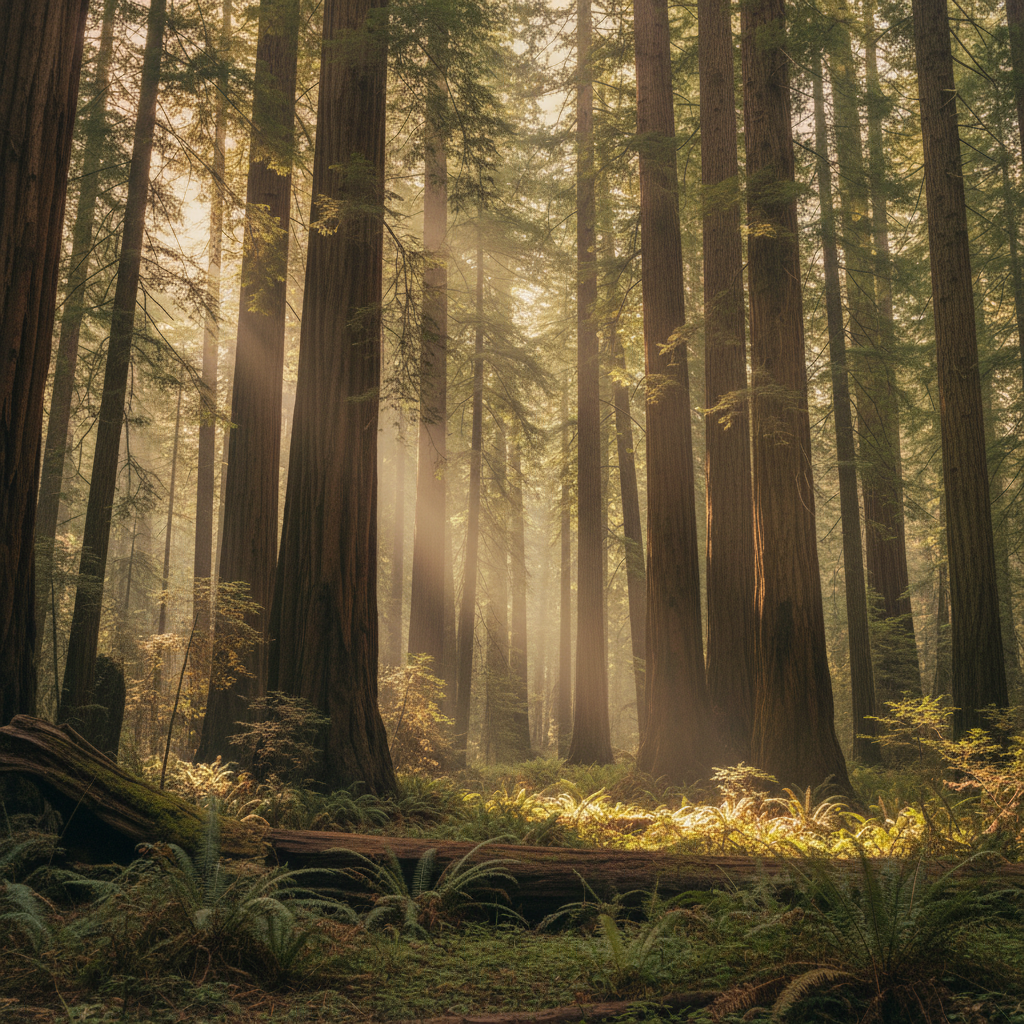
An ancient, old-growth coast redwood sanctuary along California's last major undammed river.
Jedediah Smith Redwoods State Park protects approximately 10,430 acres of primeval wilderness at the northernmost edge of California, preserving about seven percent of the planet's remaining old-growth coast redwoods (Sequoia sempervirens). Established on June 3, 1929, the park began with a 44-acre donation of old-growth forest by Clara W. Stout in memory of her late husband, lumberman Frank D. Stout, creating what is now known as Stout Memorial Grove. The park honors Jedediah Strong Smith, the pioneering American explorer who became the first non-Native to travel overland from the Mississippi River to the Pacific coast in the 1820s. Long before Smith's arrival, the Tolowa Dee-ni' people resided along these riverbanks, constructing subterranean homes from hand-split redwood planks and navigating the waters in dugout canoes. Today, the park is cooperatively managed alongside Del Norte Coast Redwoods, Prairie Creek Redwoods, and Redwood National Park, forming a massive sanctuary that is both a World Heritage Site and an International Biosphere Reserve.
Flowing directly through the heart of the park is the wild and scenic Smith River, California's last major undammed river system. Fed by heavy winter rains that can exceed 100 inches annually, the river runs with an emerald clarity, carving through ancient bedrock and supporting vital runs of chinook salmon and steelhead trout. The coastal fog that rolls off the Pacific Ocean and creeps inland along the river corridor provides crucial moisture for the redwoods during the dry summer months, allowing some specimens to exceed 300 feet in height and 500 to 1,000 years in age. Traveling through this dense canopy is best experienced along Howland Hill Road, a narrow, unpaved ten-mile former stagecoach route that winds so closely to the massive trunks that vehicles must navigate with deliberate care. This dirt road offers an intimate, slow-speed passage through the primeval understory, which is thick with sword ferns, huckleberry, rhododendrons, and maples draped in moss.
Exploration of the park's interior reveals some of the most impressive old-growth groves in existence. The Stout Memorial Grove Trail offers a flat, 0.6-mile loop winding beneath colossal trees, including the massive Stout Tree, where the absence of a heavy understory creates an open, cathedral-like atmosphere. For a deeper wilderness immersion, the 5.5-mile round-trip Boy Scout Tree Trail leads hikers along an unmaintained path through lush fern glades to a magnificent double-trunked redwood and the nearby cascade of Fern Falls. Along the banks of the river, the Jedediah Smith Campground provides 89 campsites, with several premium spots situated on a shaded riverside terrace. During the summer, park staff install a seasonal pedestrian footbridge over the Smith River, allowing campers to walk directly from the campground to Stout Grove without driving, offering a seamless connection between the rushing waters and the silent, ancient forest.
Drive Howland Hill Road from east to west in the late afternoon, when the low-angle sun pierces the redwood canopy to illuminate the dust and fog. If visiting in summer, take advantage of the seasonal footbridge near the campground to walk straight into Stout Grove, bypassing the narrow dirt parking lot entirely.