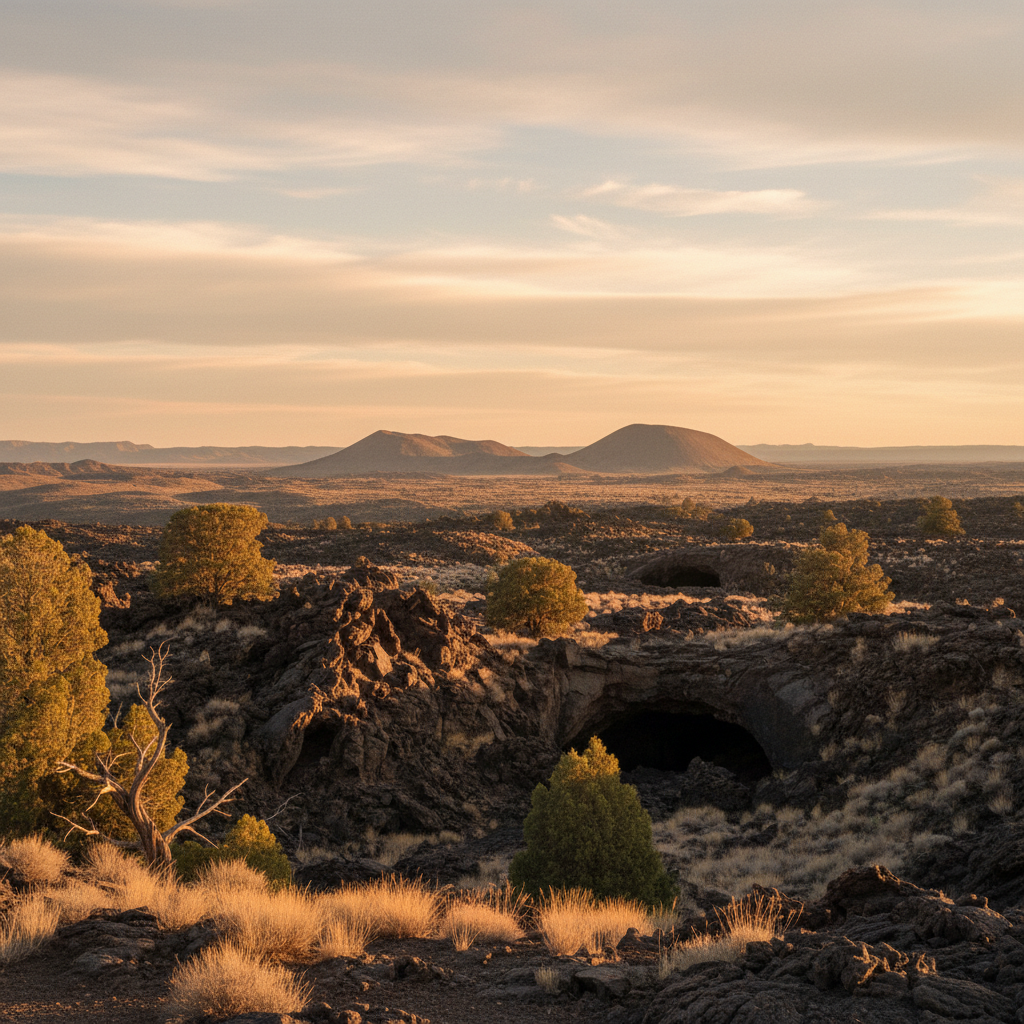
Explore a vast subterranean labyrinth of ancient lava tubes beneath the high desert of northeastern California, where volcanic geology meets the historic strongholds of the Modoc people.
Lava Beds National Monument preserves a stark, volcanic landscape on the northern flank of the Medicine Lake shield volcano, the largest volcano by area in the Cascade Range. Spanning over 46,000 acres in northeastern California, this high desert plateau is defined by ancient basaltic flows that erupted primarily from Mammoth Crater and nearby vents thousands of years ago. As the outer crust of these molten rivers cooled and hardened, the liquid basalt beneath drained away, leaving behind an intricate subterranean network of more than 700 lava tube caves. Above ground, the dry terrain is dominated by gray-green sagebrush, western juniper, and jagged volcanic fields, while below lies one of the most concentrated collections of lava tubes in North America.
Exploring this underground world requires a free cave permit from the visitor center, where rangers screen visitors to protect local bat populations from white-nose syndrome. Once cleared, adventurers can borrow heavy-duty flashlights and explore 27 developed caves, each with its own distinct character. Mushpot Cave, located just behind the visitor center, is the only illuminated cavern in the monument, featuring paved paths and interpretive exhibits detailing the region's volcanic origin. For those seeking a wilder experience, Skull Cave plunges into a multi-level abyss where a floor of year-round ice remains frozen even in the heat of summer. Golden Dome Cave features ceilings coated in hydrophobic bacteria that shimmer like gold under headlamp beams, while the labyrinthine passages of Catacombs Cave demand tight crawls and precise navigation through more than 6,900 feet of complex basaltic chambers.
The surface of the monument is equally layered with deep cultural history. At Petroglyph Point, along the former shoreline of Tule Lake, a massive cliff of volcanic tuff displays one of the largest collections of Native American rock art in California, carved by the ancestors of the Modoc people. Further south, the jagged basalt trenches of Captain Jack's Stronghold served as a natural fortress during the Modoc War of 1872 to 1873. Here, a band of roughly 50 Modoc warriors led by Kintpuash, also known as Captain Jack, successfully resisted the U.S. Army for several months by utilizing the complex topography of the lava flows. To fully grasp the scale of this dramatic landscape, visitors can hike the steep trail up Schonchin Butte, a 500-foot-tall cinder cone, where an active fire lookout built by the Civilian Conservation Corps in the 1930s offers panoramic views of the entire volcanic basin.
Stop by the visitor center first to obtain your mandatory cave permit and screen your gear for white-nose syndrome. Bring a sturdy flashlight (not a cell phone), a helmet, and a warm jacket, as subterranean temperatures remain around 55 degrees Fahrenheit year-round, even when the high desert above swelters.