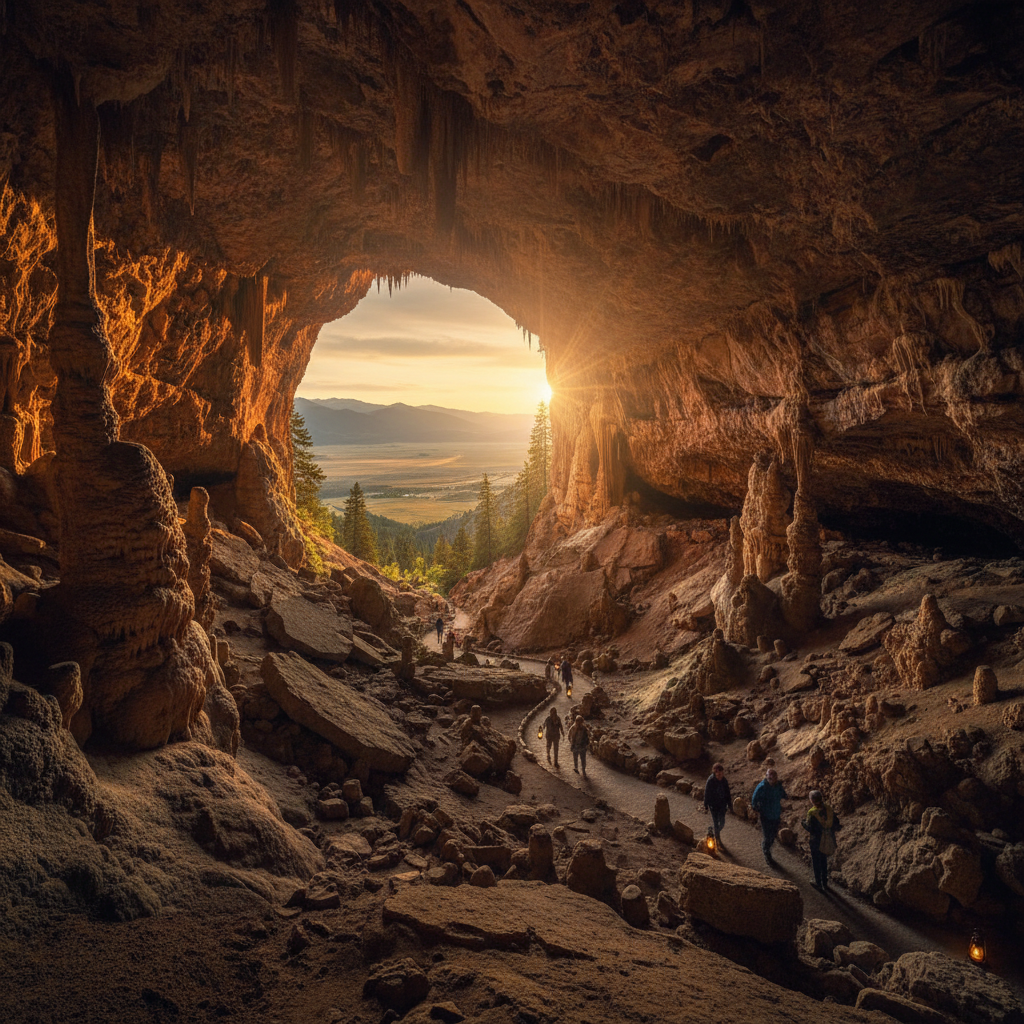
Lewis and Clark missed these massive caverns by miles, but the name stuck. Montana's first state park.
Lewis & Clark Caverns State Park preserves a massive, highly decorated limestone cave system overlooking the Jefferson River valley, where the Corps of Discovery camped in late July 1805. While Meriwether Lewis and William Clark never actually saw the caverns, they passed just a few miles away, unaware of the vast subterranean labyrinth beneath the Madison Limestone. The caverns formed within the Mission Canyon Limestone, a 330-million-year-old formation deposited by ancient seas and uplifted during the Laramide Orogeny around 70 million years ago. Over millennia, acidic groundwater dissolved the rock, carving out deep chambers that were later decorated with a dense concentration of stalactites, stalagmites, columns, helictites, and delicate draperies. Local hunters Tom Williams and Bert Pannell first spotted steam rising from the cave's natural entrance in November 1892, eventually returning with ropes and candles in 1898 to explore the dark, quiet chambers.
By 1901, Williams partnered with local miner Dan Morrison to develop the site for commercial tourism, opening it as Limespur Cave, which also became known as Morrison Cave. Morrison constructed a grueling trail system that included roughly 2,000 wooden steps and a spiral staircase over a 90-foot drop. A land dispute with the Northern Pacific Railway eventually stripped Morrison of his claim, and the railway deeded the land to the federal government. President Theodore Roosevelt designated the site as a national monument in 1908, but without federal funding, the caverns languished. In 1937, the federal government transferred the site to the state, making it Montana's very first state park. Much of the infrastructure visitors use today was built by the Civilian Conservation Corps (CCC) between 1935 and 1940. Around 200 young CCC workers painstakingly carved 600 stone steps, blasted a 538-foot exit tunnel, installed handrails, and built the park's enduring stone visitor centers.
Today, the park offers two primary subterranean routes from May through September. The Classic Cave Tour is a physically demanding, two-mile journey that requires visitors to bend, duck, and slide down the famous Beaver Slide, a smooth natural rock chute, while navigating through chambers like the Cathedral Room. For those seeking an easier path, the Paradise Tour is a wheelchair-accessible, one-mile route that bypasses the steepest stairs to lead directly into the grand, highly decorated Paradise Room. Deep within the cave's dark recesses, a maternity colony of Townsend's big-eared bats roosts each summer to raise their pups, one of the few such documented colonies in southwest Montana. Above ground, the park spans over 3,000 acres of arid hills, featuring ten miles of hiking trails like the Cave Gulch and Limespur loops, a campground, and the Limespur Café, which serves burgers and ice cream in a nod to the park's original 1900 moniker.
Bring a light jacket or sweatshirt, as the cave maintains a consistent temperature of about 48 degrees Fahrenheit year-round, and wear shoes with excellent traction to handle the wet limestone steps. If you opt for the Classic Cave Tour, be prepared to slide down the Beaver Slide, a smooth natural rock chute, so wear durable pants you do not mind getting dirty. Book tour tickets online well in advance during the peak summer season, as walk-up tickets are rarely available.