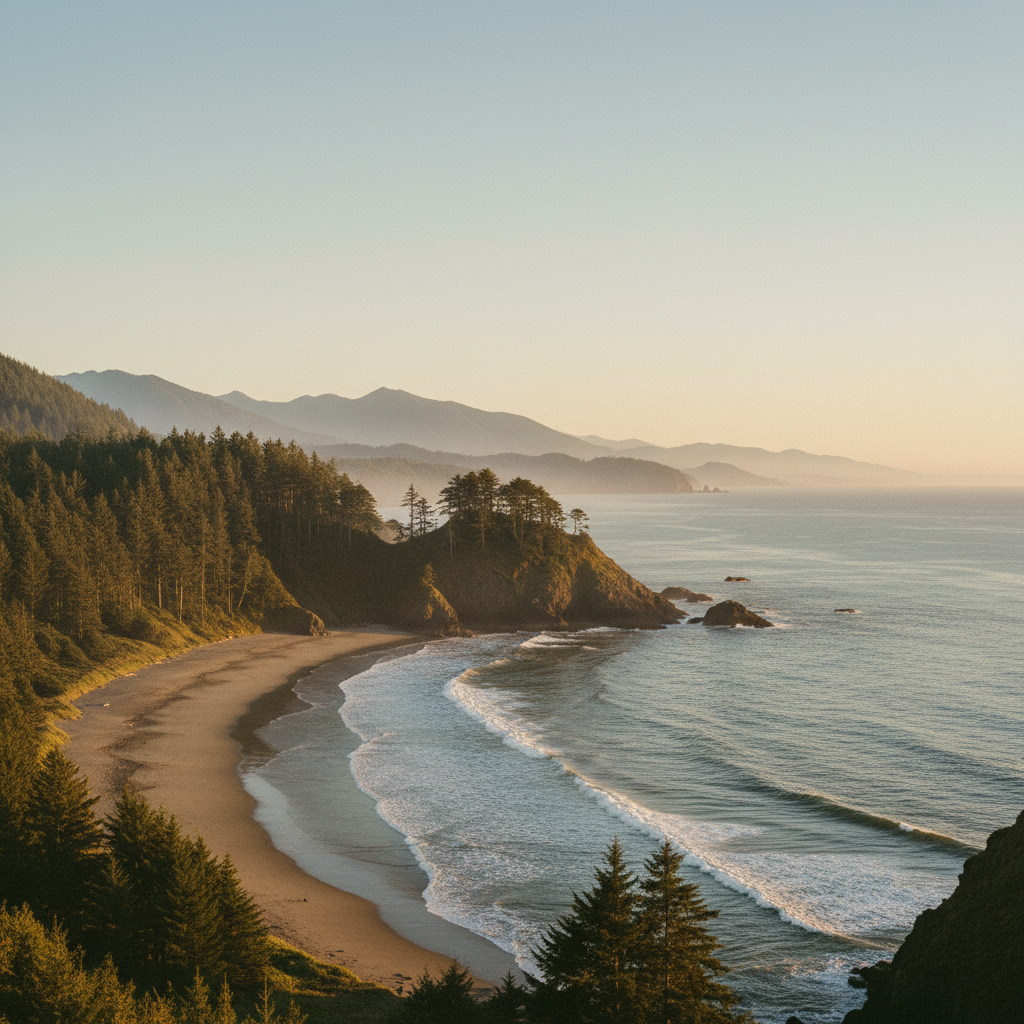
A 2,448-acre coastal sanctuary on the northern Oregon Coast, where ancient Sitka spruce forests meet the surf of Smugglers Cove and the towering cliffs of Cape Falcon.
Oswald West State Park encompasses 2,448 acres of dense temperate rainforest and rugged shoreline along the northern Oregon Coast, stretching between Arch Cape and Neahkahnie Mountain. Originally established as Short Sand Beach State Park in 1931, the preserve was renamed in 1958 to honor Oswald West, the 14th governor of Oregon, who famously secured public access to the state's entire coastline by declaring the beaches a public highway in 1913. The land was painstakingly assembled in the 1930s and 1940s by Samuel Boardman, Oregon's first state parks superintendent, who envisioned a protected corridor where the old-growth forest meets the sea. Today, visitors park in gravel lots along Highway 101 and descend into a deep, mossy canopy of ancient Sitka spruce, western hemlock, and western red cedar. The main trail follows the path of Short Sand Creek and Necarney Creek, winding through a lush understory of sword ferns, salal, and salmonberry. This short, half-mile walk acts as a sensory transition, where the roar of the highway fades and is replaced by the rhythmic rumble of the Pacific.
The trail emerges at Short Sand Beach, a quarter-mile-long crescent of dark sand tucked into Smugglers Cove. Flanked by the basalt headlands of Cape Falcon to the north and the towering bulk of Neahkahnie Mountain to the south, the cove is highly sheltered from the harsh northwest winds that scour more exposed parts of the coast. This unique geography makes "Shorty's," as it is known to locals, one of the premier surfing destinations in the Pacific Northwest. Consistent, clean beach breaks roll over a forgiving sandy bottom, attracting surfers and boogie boarders year-round, who brave the cold waters in thick neoprene. The headlands themselves are remnants of Miocene-era basalt lava flows that poured across the region millions of years ago, sculpted by millennia of relentless wave action into dramatic sea cliffs and tide pools. Just offshore lies the Cape Falcon Marine Reserve, established in 2016, which protects a two-mile stretch of ocean from fishing and harvesting, allowing kelp forests, sea stars, and diverse marine life to thrive undisturbed.
For those looking to explore beyond the sand, the park serves as a major hub for hikers, with a network of trails including a portion of the Oregon Coast Trail. The hike to Cape Falcon leads north from the main creek crossing, climbing gently through coastal forest to a windswept promontory that looks out over the ocean toward Falcon Cove and Cannon Beach. Along this trail, hikers pass a stone memorial dedicated to Matt Kramer, the Oregon journalist whose influential writing helped build public support for the landmark 1967 Oregon Beach Bill. To the south, the trail up Neahkahnie Mountain climbs steeply to a summit of 1,680 feet, offering an expansive view of the Nehalem Spit and the coastline stretching south. This mountain holds deep cultural significance for the Tillamook and Clatsop people, who regarded it as a sacred place of spirits and harvested resources from both the rich forest and the intertidal zones for generations.
Park in the main gravel lots along Highway 101 early in the morning, especially on summer weekends, to secure a spot before the surfers arrive. For a full day, pack a picnic and a wetsuit, hike the coastal trail to Cape Falcon to see the Matt Kramer memorial, and spend the afternoon exploring the tide pools on the north end of Short Sand Beach.