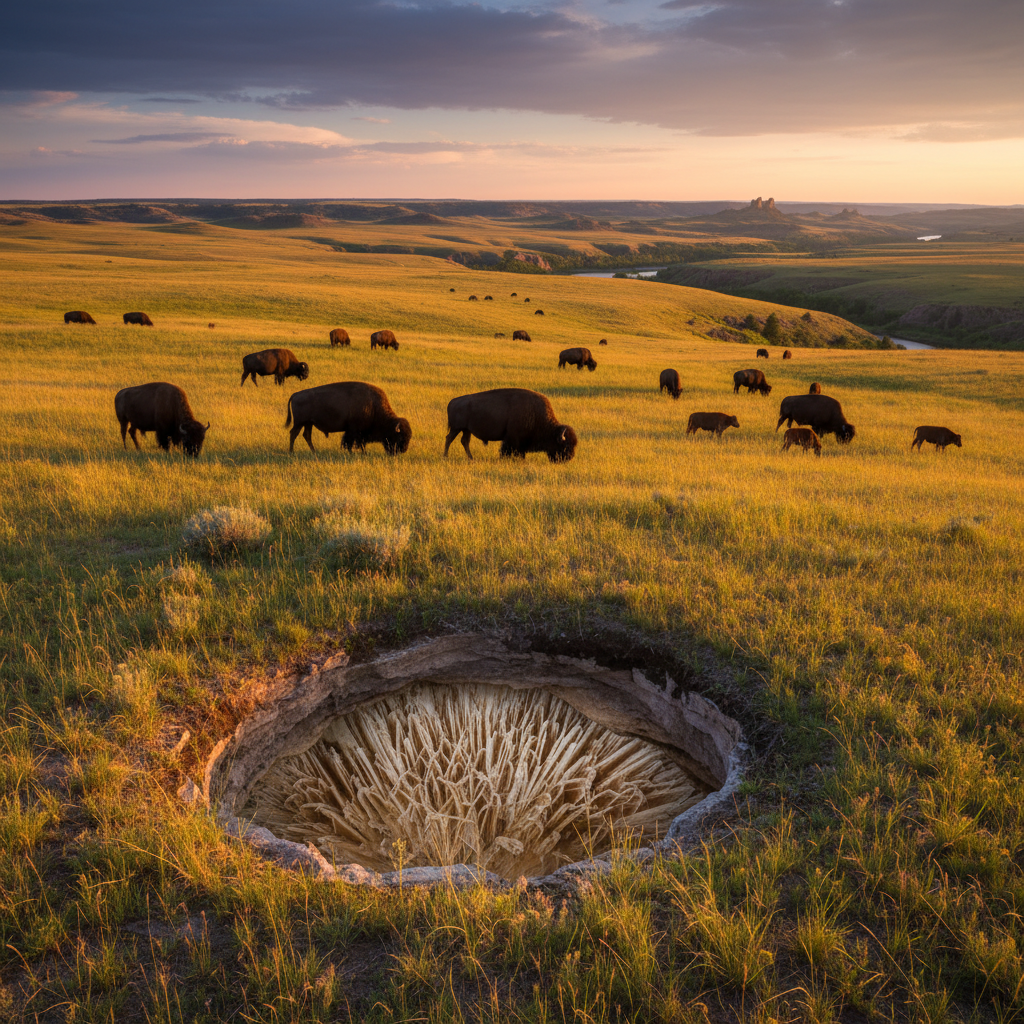
The world's sixth-longest cave system, where rare boxwork formations lie beneath a rolling South Dakota prairie home to free-roaming bison.
Wind Cave National Park preserves a profound threshold where the subterranean depths of the Black Hills meet the sweeping expanse of the South Dakota prairie. For the Lakota people, this site is known as Washúŋ Niyá (Breathing Cave) or Maka Oniye (Breathing Earth), the sacred portal of their emergence story where humanity and the bison first stepped onto the surface of the earth. The cave's natural entrance, a modest opening only a few inches wide, physically breathes: a powerful current of air rushes inward or sighs outward to equalize the barometric pressure between the cave's massive underground chambers and the atmosphere above. In 1881, this whistling breath famously blew the hat off settler Tom Bingham, leading to the first documented Euro-American discovery. By 1890, a young explorer named Alvin McDonald began systematically mapping the passages by candlelight, keeping a meticulous diary of his discoveries and eventually writing that he had given up the idea of ever finding the end of this seemingly infinite maze.
Established by President Theodore Roosevelt in 1903 as the world’s first national park dedicated to protecting a cave, the park encompasses more than 168 miles of surveyed passages, making it the sixth-longest cave system on Earth. Unlike typical cavern systems defined by dripping stalactites, Wind Cave is celebrated for its dry, intricate formations, most notably boxwork. Approximately 95 percent of the world’s discovered boxwork is found here: a delicate, honeycomb-like grid of calcite fins that formed millions of years ago when acidic water dissolved the surrounding limestone, leaving behind the harder mineral veins. Visitors descend into this silent, 54-degree Fahrenheit environment via an elevator system that was completely rebuilt and modernized in early 2025. Ranger-led tours are the only way to experience these depths. The popular Garden of Eden Tour navigates 150 steps to showcase dense clusters of boxwork and cave popcorn, while the more strenuous Fairgrounds Tour requires climbing 450 steps through larger rooms like the Post Office and the Elks Room. For a more historic experience, the Candlelight Tour allows visitors to explore unlit passages using hand-held bucket lanterns, mirroring the conditions of McDonald's early explorations.
Above this subterranean labyrinth lies a vibrant, sun-drenched sanctuary of 33,970 acres of native mixed-grass prairie, one of the largest remaining tracts in North America. This rolling grassland is home to a legendary herd of several hundred bison, descendants of 14 animals reintroduced from the Bronx Zoo in 1914 to help save the species from extinction. Today, this herd is recognized as one of the few genetically pure, free-roaming public herds on the continent. While driving along the park's scenic roads, visitors frequently encounter these massive beasts alongside pronghorn, elk, and active prairie dog towns where the small rodents keep watch with sharp, high-pitched chirps. To experience the transition from forest to grassland, hikers can follow the Rankin Ridge Trail to the park's highest point for panoramic views of the Black Hills, or wander the quiet path of the Wind Cave Canyon Trail, where limestone cliffs echo with the calls of cliff swallows and great horned owls.
Reserve your cave tour tickets up to three days in advance on Recreation.gov, as same-day tickets at the visitor center often sell out by mid-morning. Wear a light jacket and sturdy closed-toe shoes: the cave remains a constant 54 degrees Fahrenheit year-round, and the tour paths can be damp and slick.