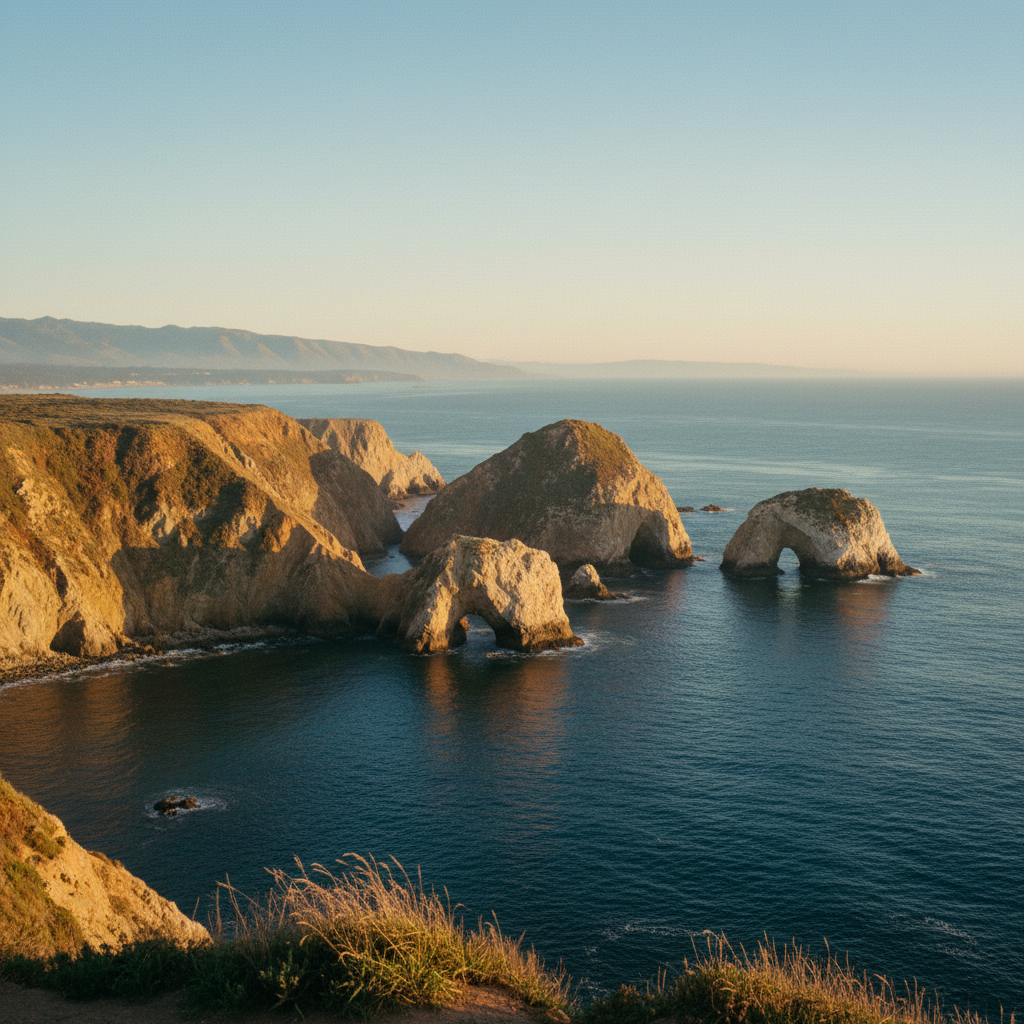
Salt spray whips the air around Anacapa Island, a rugged volcanic outpost of sheer cliffs, nesting seabirds, and historic beacons.
Anacapa Island, known to the indigenous Chumash as 'Anyapakh, meaning "mirage," is a narrow chain of three volcanic islets (East, Middle, and West Anacapa) located roughly eleven miles off the coast of Ventura County, California. Part of Channel Islands National Park, this rugged, 699-acre volcanic outpost is defined by precipitous cliffs that drop steeply into the Pacific Ocean. The island's geography is highly dynamic: at high tide, shallow water separates the three islets, while low tide reveals narrow land bridges connecting them. Access to the island is strictly regulated, with only East Anacapa and a small, seasonal cobblestone beach at Frenchy's Cove, known historically to the Chumash as pasnene luqtikay, open to the general public. Visitors arrive via concessionaire boats from Ventura Harbor or Channel Islands Harbor in Oxnard, disembarking at the Landing Cove on East Anacapa, where they must climb a steel-rung ladder to a concrete dock and then ascend a steep, 157-step metal staircase to reach the island's flat plateau.
At the easternmost tip of the island stands the historic Anacapa Island Light Station, constructed in 1932 by the U.S. Lighthouse Bureau. This 40-foot cylindrical concrete tower, painted white with black trim, was the last major manned light station built on the West Coast of the United States. It was commissioned to guide vessels through the treacherous Santa Barbara Channel, a passage notorious for thick fog and strong currents that had claimed numerous ships, including the sidewheel steamer SS Winfield Scott in 1853. Today, the lighthouse is automated and solar-powered, but its original third-order, lead-crystal Fresnel lens is preserved and displayed at the small visitor center nearby, which occupies one of the historic Spanish Colonial Revival-style Coast Guard buildings. Just offshore from the lighthouse lies Arch Rock, a dramatic 40-foot natural volcanic arch that serves as the iconic symbol of Channel Islands National Park.
The terrestrial environment of Anacapa is defined by its stark exposure and unique ecology. Lacking any natural source of fresh water, the island requires absolute self-reliance from those who visit or camp. The primitive campground on East Anacapa features seven exposed campsites, each equipped with a picnic table and an animal-proof food storage box, but no shade or running water. From April through mid-August, the island becomes a massive rookery for Western Gulls, which nest in thousands across the plateau, filling the air with constant noise, strong odors, and protective territorial behavior. During late winter and early spring, the landscape is dominated by the yellow blooms of giant coreopsis, a relative of the sunflower that thrives in the salty air. For those seeking expansive views, a half-mile trail leads west to Inspiration Point, offering a dramatic vista over Middle and West Anacapa islets, where the largest breeding colony of California brown pelicans in the United States resides on the protected western cliffs.
Pack at least one gallon of water per person per day, as there is no fresh water on the island, and be prepared to haul all your gear up the 157-step Landing Cove staircase.