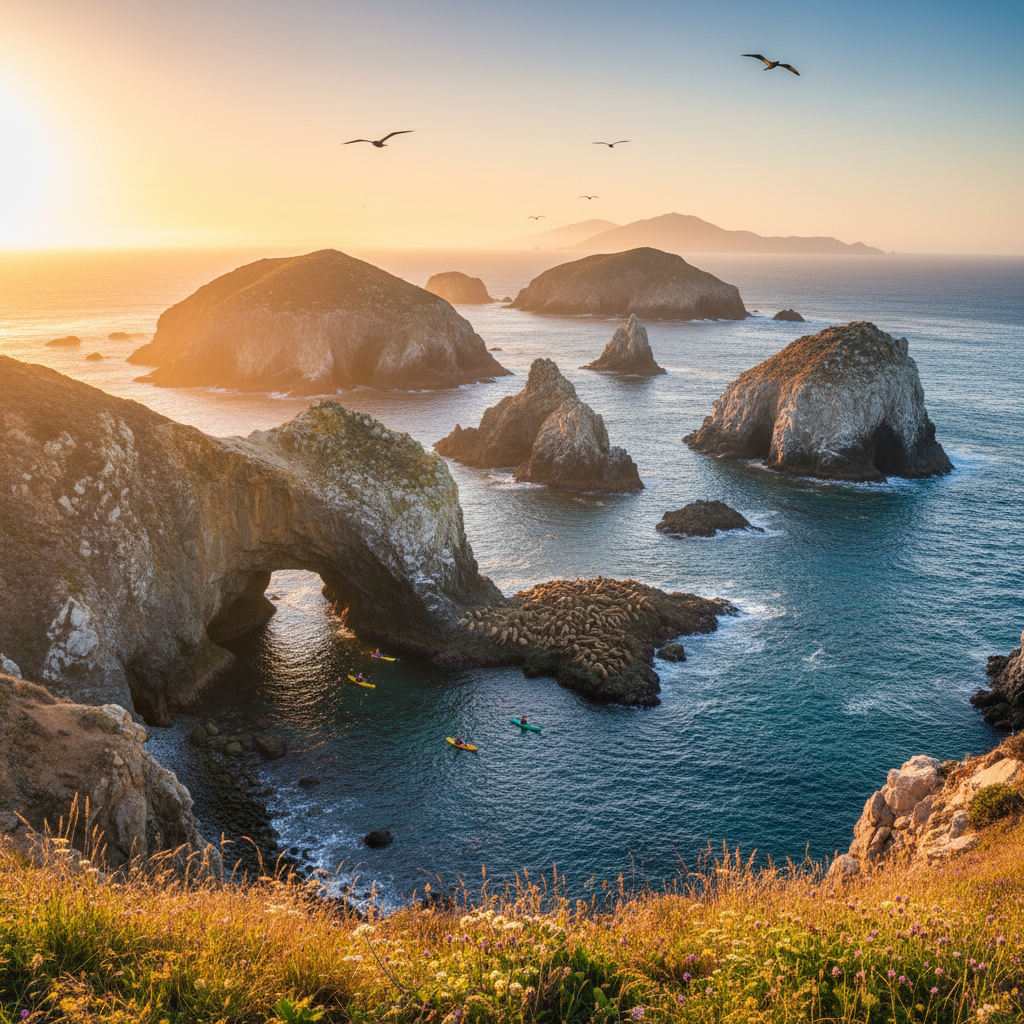
California's Galápagos: five islands with species found nowhere else, featuring sea caves, kelp forests, and deep solitude.
Channel Islands National Park, established in 1980, protects five distinct islands off the coast of Southern California: Anacapa, Santa Cruz, Santa Rosa, San Miguel, and Santa Barbara. This isolated archipelago, often called the Galápagos of North America, spans over 249,000 acres, half of which are marine environments. The islands are accessible only by boat or small plane, preserving a rugged, wind-swept landscape that stands in stark contrast to the nearby mainland metropolis. Because these landmasses were never connected to the California coast, they developed unique ecosystems where evolutionary isolation allowed endemic flora and fauna to flourish. Visitors cross the Santa Barbara Channel to reach these shores, leaving behind the urban hum of Ventura and Santa Barbara for a world defined by craggy cliffs, marine terraces, and vast Pacific horizons.
The ecological significance of Channel Islands National Park lies in its remarkable biodiversity, home to over 145 endemic species found nowhere else on Earth. On the larger islands like Santa Cruz and Santa Rosa, the miniature island fox roams through the chaparral, having evolved through island dwarfism to a fraction of the size of its mainland ancestor. Conversely, the vibrant blue island scrub-jay, found exclusively on Santa Cruz, exhibits island gigantism, growing significantly larger than its mainland relatives. Under the water, the park protects dense forests of giant kelp that support a complex marine food web, including the bright orange garibaldi, leopard sharks, harbor seals, and massive black sea bass. The waters also serve as a vital migratory corridor for blue, humpback, and gray whales. Geologically, the islands are composed of volcanic rocks and sedimentary layers sculpted by millions of years of tectonic activity, wind, and waves, creating dramatic features like the towering sea arch of Arch Rock on Anacapa.
Human history on these islands stretches back more than 13,000 years, anchored by the deep maritime heritage of the Chumash and Tongva peoples. The northern islands of Limuw (Santa Cruz), Wi'ma (Santa Rosa), Tuqan (San Miguel), and Anyapakh (Anacapa) were the ancestral homeland of the Island Chumash, who built a sophisticated society centered on ocean-going canoes called tomols. These vessels, constructed from redwood drift logs and sealed with pine pitch and asphaltum, allowed the Chumash to navigate the treacherous channel waters, trading shell bead money for mainland resources. Archaeological sites, including some of the oldest human remains discovered in North America at Arlington Springs on Santa Rosa, document this enduring connection. Santa Barbara Island, the southernmost in the park, was traditionally utilized by the Tongva people, who similarly navigated and traded throughout the southern bight. Today, the park preserves these sacred cultural landscapes, working with tribal descendants to honor and interpret their ancestral home.
Exploring the park requires careful preparation, as there are no services, stores, or lodgings on the islands, offering a true wilderness experience. On Santa Cruz, sea kayakers can navigate into Painted Cave, one of the largest and deepest sea caves in the world, where the ocean swell echoes against colorful, mineral-stained volcanic walls. Hikers can trek across the island's interior grasslands and oak woodlands, or explore the wind-carved sandstone of Lobo Canyon on Santa Rosa. Anacapa offers a shorter, dramatic walk to Inspiration Point, where three islets align in a spectacular chain, and a historic 1932 lighthouse still stands watch. For divers and snorkelers, the emerald kelp forests provide an otherworldly underwater experience, akin to walking through a marine cathedral. Camping is available on all five islands, requiring visitors to carry in all of their own water, food, and supplies, and to pack out all trash, ensuring that this pristine sanctuary remains untamed for generations to come.
Book your ferry tickets with Island Packers, the park's official concessionaire, well in advance, especially for summer weekends. For a first-time visit, Santa Cruz Island (Scorpion Anchorage) offers the most accessible hiking, sea kayaking, and snorkeling, along with potable water and a shaded campground. If you plan to camp, secure your National Park Service campsite reservation before booking your boat transportation.