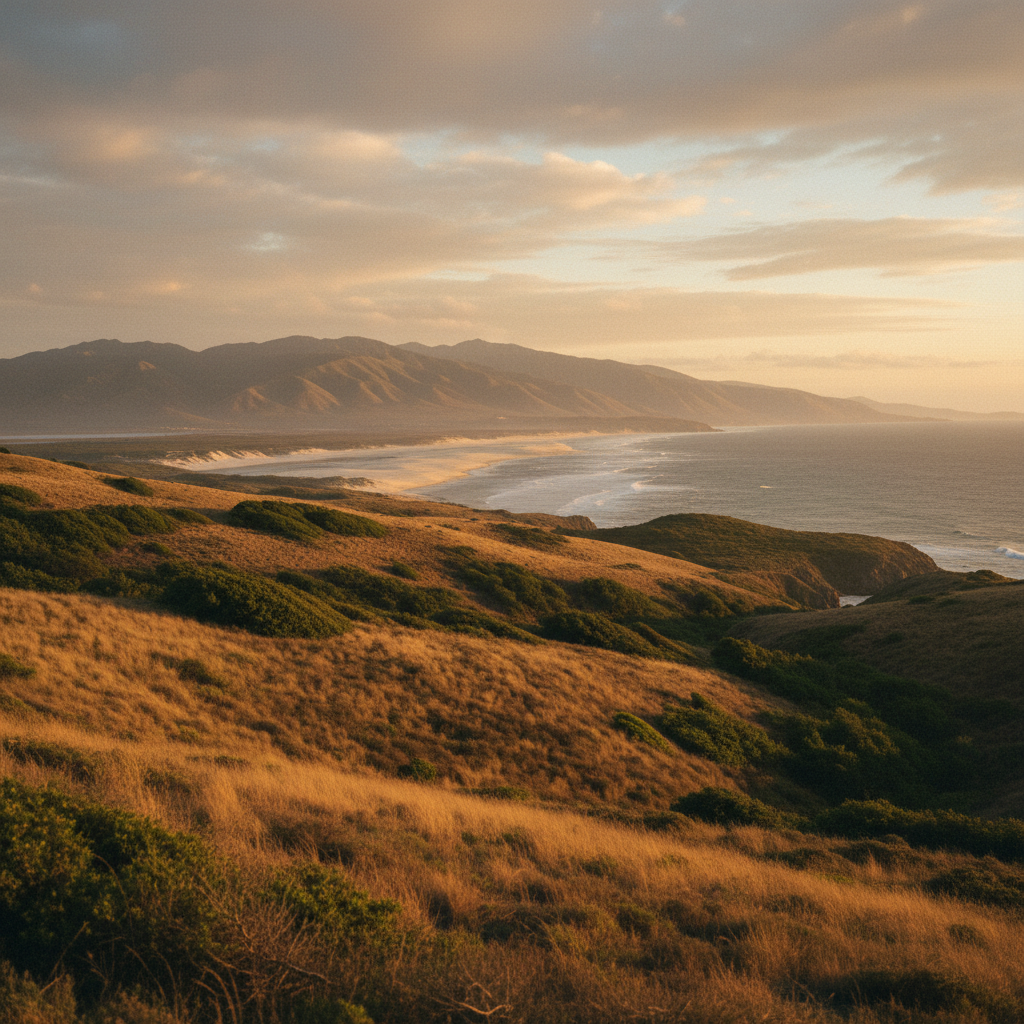
Windswept and wild, California's second-largest island holds 13,000 years of human history, rare Torrey pine groves, and rugged sandstone canyons carved by the Pacific.
Santa Rosa Island, known as Wi'ma in the Cruzeño Chumash language, is a windswept expanse of 53,195 acres located roughly 26 miles off the coast of Santa Barbara. The traditional Chumash name translates to 'driftwood,' a reference to the prized redwood logs that drifted down from northern California rivers and washed onto the island's shores, providing the essential material for building the ocean-going plank canoes known as tomols. This island holds some of the deepest archaeological secrets in North America. In 1959, archaeologist Phil Orr discovered a pair of human femurs eroding from the canyon wall at Arlington Springs, buried 37 feet below the surface. Radiocarbon dating eventually revealed these remains, known as the Arlington Springs Man, to be approximately 13,000 years old, making them some of the oldest human bones ever found on the continent. This discovery strongly supports the coastal migration theory of the first Americans. Long before humans arrived, the island was part of a Pleistocene super-island called Santa Rosae, which was home to the pygmy mammoth (Mammuthus exilis). In 1994, paleontologists unearthed the world's most complete pygmy mammoth skeleton on the island's northern coast, offering a window into an era when these four-to-six-foot-tall beasts roamed the coastal grasslands.
The modern history of the island is deeply intertwined with California's ranching heritage. In 1901, the Vail & Vickers company purchased Santa Rosa Island and established a legendary cattle ranching operation that spanned nearly a century. Unlike typical cow-calf operations, this was a stocker ranch where young Hereford cattle were shipped from the mainland to graze and fatten on the island's rich grasses before being sent to market on the custom-built cattle boat, the Vaquero. The historic ranch complex at Bechers Bay remains a remarkably preserved monument to this era, complete with the main ranch house built in 1855, old wooden barns, schoolhouses, and corrals where vaqueros once gathered. The Vail family also introduced non-native Rocky Mountain elk and Kaibab mule deer to the island for sport hunting starting around 1910. This private empire began its transition to public land in 1986, when the National Park Service purchased the island for 30 million dollars to include it in Channel Islands National Park. Cattle ranching officially ended in 1998, and the commercial hunting of elk and deer was phased out entirely in 2011, allowing the native landscape to begin its long process of recovery.
Today, the island is celebrated for its remarkable biodiversity and rare endemic species. Most famous among these is the Santa Rosa Island subspecies of the Torrey pine (Pinus torreyana var. insularis). This incredibly rare conifer exists in only two places on Earth: a mainland remnant in La Jolla and two small, isolated groves on the northeastern bluffs of Santa Rosa Island. These trees are survivors of a Pleistocene forest, their trunks twisted and gnarled by the relentless marine winds, their heavy cones and long needles adapted to capture moisture from the thick coastal fog. The island is also home to the endemic island fox (Urocyon littoralis santarosae), a cat-sized native carnivore that has successfully recovered from near-extinction caused by golden eagle predation in the late 1990s. Visitors who land at Bechers Bay can hike through the dramatic sandstone formations of Lobo Canyon, where wind and water have carved intricate pocket caves and slot canyons, or climb to the island's highest point, Vail Peak, which rises 1,589 feet above the churning Pacific. Walking the empty sands of Water Canyon Beach or listening to the wind howl through the Torrey pines offers a raw, unfiltered encounter with a California that has largely vanished elsewhere.
Pack a high-quality windbreaker and secure your gear: the island's notorious coastal winds can gust over forty miles per hour, especially around the exposed bluffs of the Torrey Pines trail.