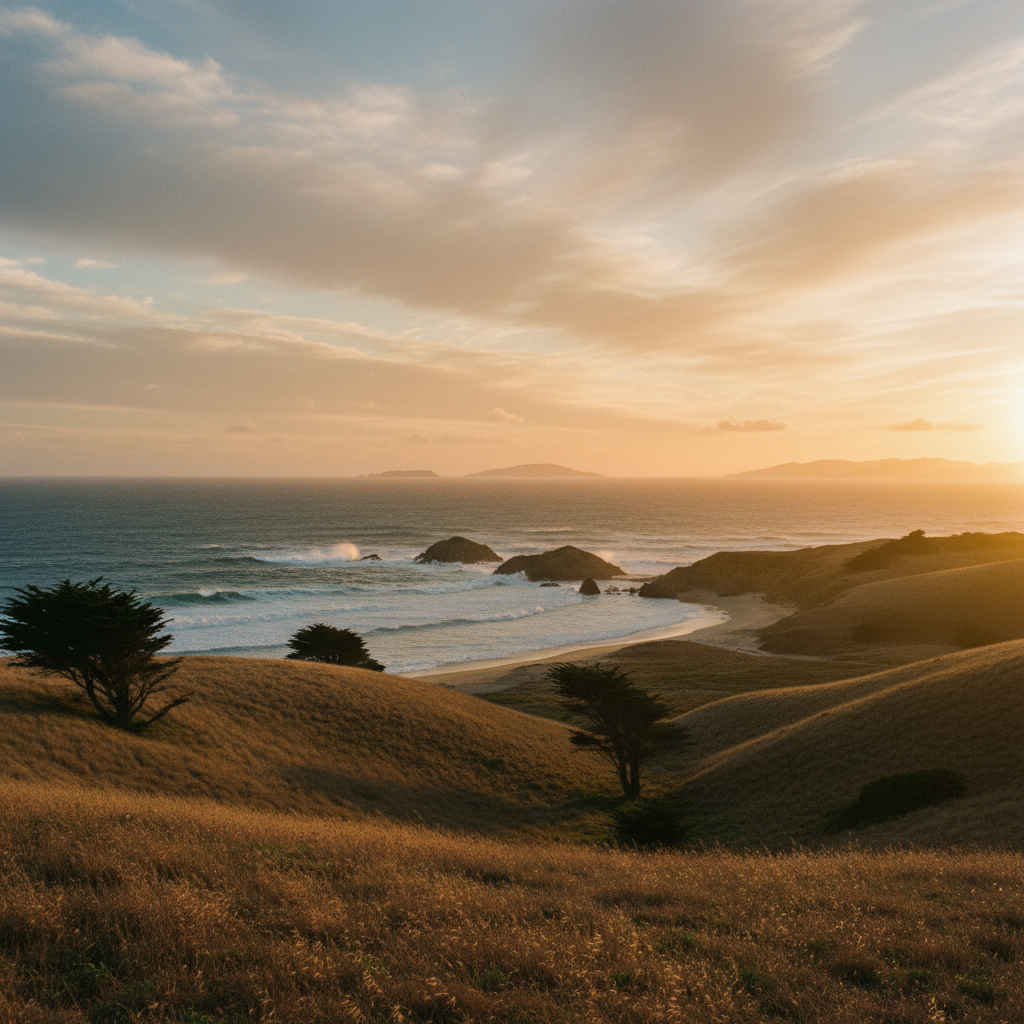
San Miguel Island is a windswept maritime sanctuary where the raw force of the Pacific shapes a rugged landscape home to tens of thousands of breeding seals and sea lions.
San Miguel Island, the westernmost outpost of Channel Islands National Park, does not ease visitors into its presence. Stepping off a Zodiac or skiff onto the wet, wind-whipped sand of Cuyler Harbor, the immediate sensation is one of profound exposure. The wind is a constant, physical force, carrying the cold sting of the open Pacific and the sharp, briny scent of giant kelp. Towering, wind-scoured bluffs of pale sandstone rim the crescent bay, where the ocean swells crash with a rhythmic, heavy thud. There are no trees to break the gale, only low-lying coastal sage, giant coreopsis, and dudleya clinging to the dunes. It feels less like Southern California and more like an outpost in the sub-Antarctic, a place defined by its raw, elemental boundaries where the continent finally surrenders to the deep water. Prince Island, a steep volcanic islet just off the northeastern coast, stands as a jagged sentinel guarding the harbor, while the waters below conceal a marine wilderness dominated by cold, nutrient-rich currents.
For thousands of years, the Chumash people lived on this island, which they called Tuqan, navigating the treacherous waters in their redwood plank canoes, or tomols. Archeological research at Daisy Cave, a rock shelter on the island's rocky coast, has revealed fish bones and woven fibers dating back over 11,500 years, representing some of the earliest evidence of maritime human adaptation in the Americas. In 1542, Spanish explorer Juan Rodriguez Cabrillo set foot on the island, only to die here a few months later from an infection following a broken limb. He is believed to be buried in an unmarked grave on the island, commemorated today by a stone monument on the bluffs above Cuyler Harbor. Centuries later, the island became a sheep ranch, a hard-scrabble kingdom managed by Herbert Lester and his wife Elise from 1930 to 1942. Lester, who wore epaulets and styled himself the "King of San Miguel," raised his two daughters, Marianne and Betsy, in a sprawling ranch house built from shipwreck timber, including wood salvaged from the lumber schooner J.M. Coleman, which ran aground at Point Bennett in 1905. Though the ranch house burned down in 1967, its stone foundations and a lone fig tree remain.
Geologically and ecologically, San Miguel Island is a landscape of extremes. It is home to the caliche forest, an eerie expanse of ghostly, calcified sand-castings formed up to 17,000 years ago when calcium carbonate reacted with the organic acids of ancient pine and cypress roots. Today, wind erosion has exposed these fragile mineral chimneys, which rise like white fingers from the sand. At Point Bennett, on the island's western tip, the cold California Current collides with warmer southern waters, creating an incredibly rich marine environment. Here, up to thirty thousand pinnipeds, including northern elephant seals, California sea lions, northern fur seals, harbor seals, Guadalupe fur seals, and Steller sea lions, crowd the beaches in one of the largest wildlife congregations on earth. Because the island is still owned by the U.S. Navy and was used as a bombing range from World War II to the 1970s, the potential for unexploded ordnance means that all hiking beyond the immediate Cuyler Harbor beach, Cabrillo Monument, and Lester Ranch ruins must be led by a National Park Service ranger. The sixteen-mile round-trip trek to Point Bennett takes hikers across the island's grassy spine, past the rounded peaks of San Miguel Hill and Green Mountain, culminating in an overlook where the deafening chorus of barks, grunts, and roars rises from the beaches below.
Bring all your own water (at least one gallon per person per day) as there is no potable source on the island, and be prepared to haul your gear up a steep, one-mile trail with a 400-foot elevation gain to reach the campground. A windproof jacket, tight-fitting beanie, and sunglasses are essential gear to protect against the relentless, sand-carrying gales that sweep across the exposed marine terrace.