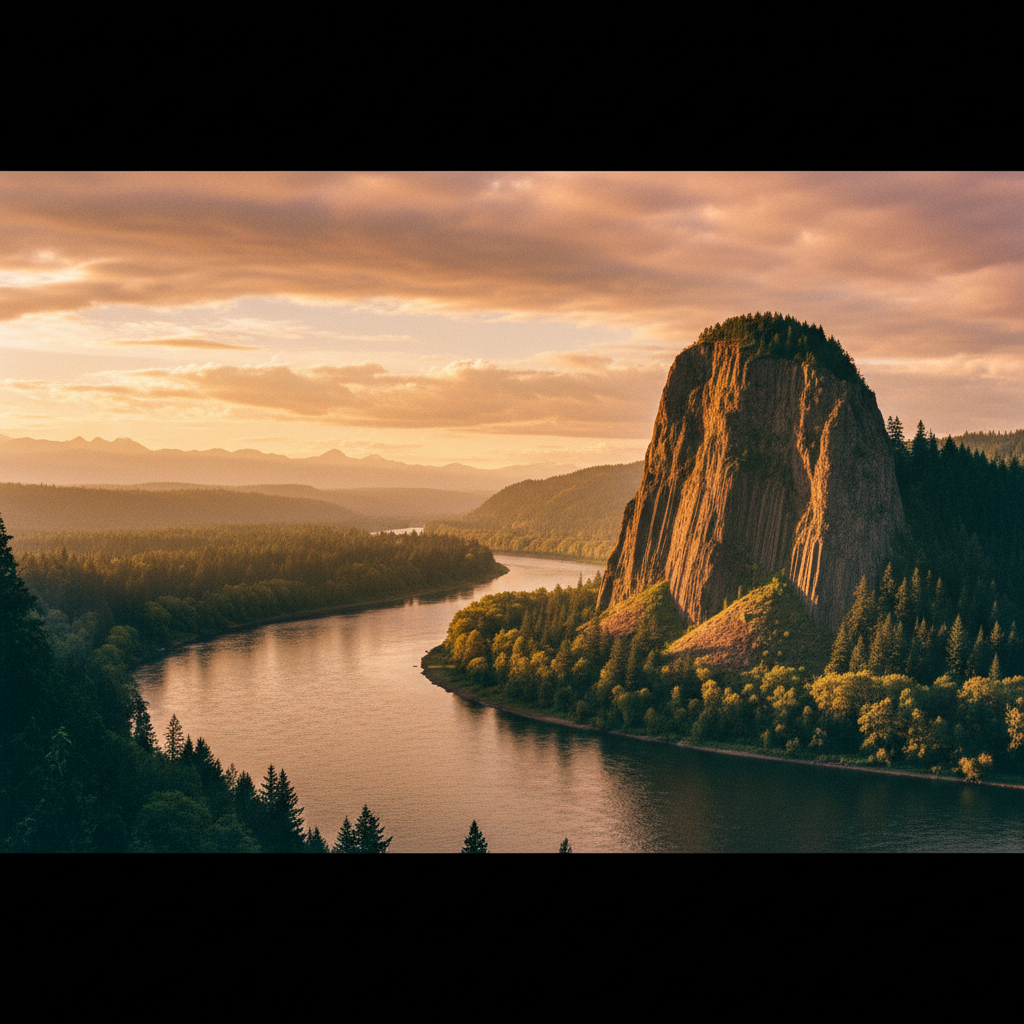
An 848-foot volcanic monolith in the Columbia River Gorge, featuring a historic cliffside trail with 52 switchbacks and miles of forested backcountry.
Beacon Rock State Park centers on a colossal, 848-foot basalt monolith that rises directly from the north bank of the Columbia River. Long before it was charted by colonizers, the Cascade people knew this geological giant as Che-che-op-tin, translating to the navel of the world. This massive dark pillar is actually the exposed core of an extinct cinder cone volcano that erupted roughly 57,000 years ago during the Pleistocene epoch. It belongs to the Boring Volcanic Field, a localized cluster of volcanic vents stretching across the Portland-Vancouver basin. When the cataclysmic Missoula Floods tore through the Columbia River Gorge around 15,000 years ago, the raging waters scoured away the volcano's soft outer ash and cinder, leaving behind this sheer, vertical plug of resilient basalt. On October 31, 1805, the Lewis and Clark Expedition arrived at its base, where Captain William Clark originally dubbed it "Beaten Rock" before correcting the name to Beacon Rock on their return journey in 1806. It was here that the expedition first recorded the subtle rise and fall of ocean tides, marking their proximity to the Pacific.
In the early 20th century, the monolith faced destruction when the United States Army Corps of Engineers proposed blasting the rock to build a jetty at the mouth of the Columbia River. To halt this plan, a prominent geologist, botanist, and mining engineer named Henry J. Biddle purchased the rock in 1915 for a single dollar. Biddle's sole purpose was to preserve the landmark and construct an accessible path to its summit. Between 1916 and 1918, Biddle and his son designed and built an ingenious cliffside trail, a true engineering triumph of its era. This narrow, handrail-protected path scales the sheer rock face via 52 tight switchbacks, crossing 17 viaducts and 22 bridges that cling directly to the vertical basalt. Following Biddle's death in 1928, his children honored his conservation legacy by donating the property to the State of Washington, which officially established the 4,464-acre state park in 1935. During the Great Depression, crews from the Civilian Conservation Corps expanded the park's infrastructure, constructing campgrounds, picnic shelters, and improving the original trail.
Today, the 1.8-mile round-trip hike to the summit of Beacon Rock remains one of the most thrilling short walks in the Pacific Northwest. Ascending the narrow catwalks offers an intimate look at the columnar basalt formations and the hardy lichens that cling to the stone, while the wind whips off the river. From the 848-foot summit, the panorama reveals the wide expanse of the Columbia River, the Bonneville Dam to the east, and the forested slopes of the Oregon Cascades. Beyond the monolith itself, the state park features more than 26 miles of multi-use trails. Hikers seeking a more strenuous challenge can head up the Hamilton Mountain Trail, which climbs 2,445 feet through deep Douglas-fir forests to viewpoints of Hardy Falls and the dramatic Rodney Falls, where water plunges into a rocky cavern known as the Pool of the Winds. For a gentler experience, the ADA-accessible Doetsch Walking Path winds through the lower meadows near the river shoreline, passing the historical site of an Indigenous village documented in Lewis and Clark's journals.
Arrive before 9:00 AM on summer weekends to secure a parking spot at the trailhead, which requires a Washington State Discover Pass. For an added adventure, continue past the rock to the Hamilton Mountain trailhead and hike up to the Pool of the Winds, where Rodney Falls plunges into a mist-filled basalt chamber.