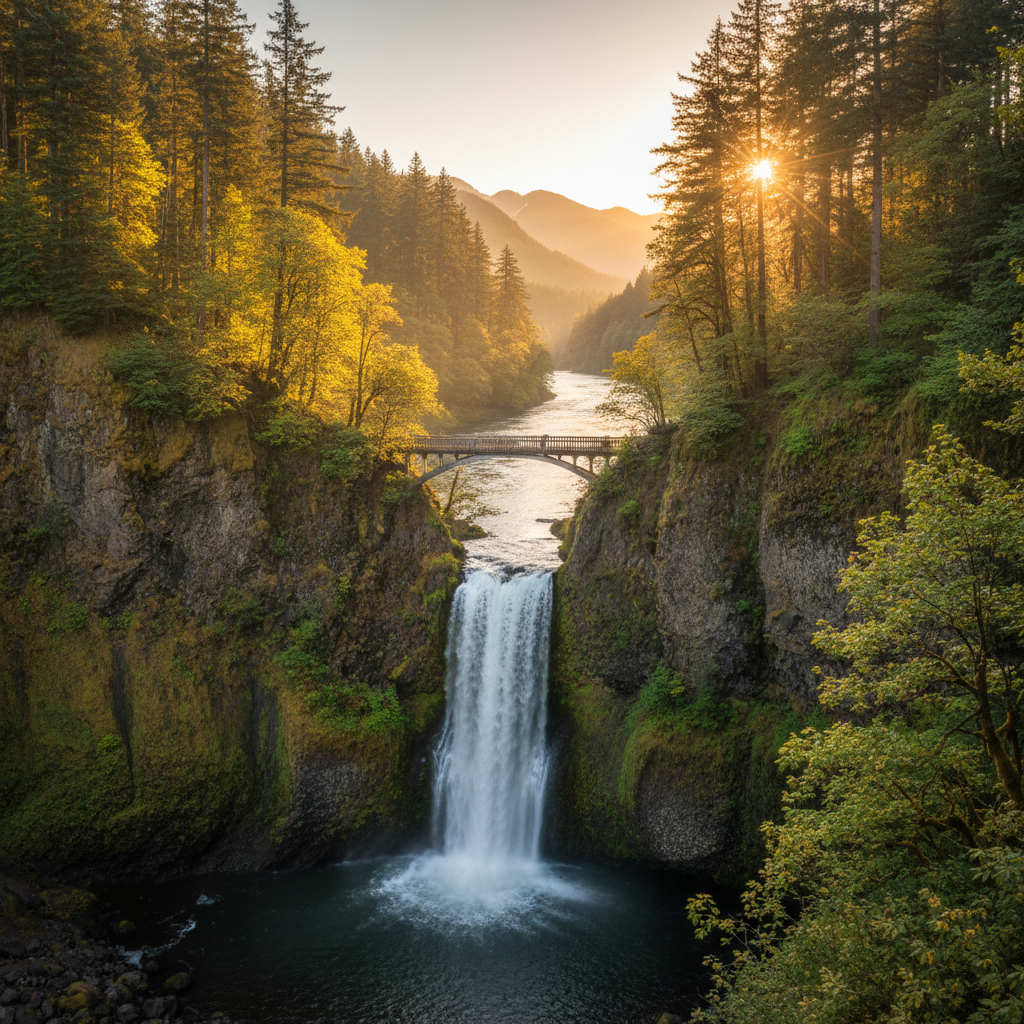
Multnomah Falls drops 620 feet in two dramatic tiers, casting a perpetual mountain mist over a historic 1925 stone lodge, a legendary concrete footbridge, and the dark basalt cliffs of the Columbia River Gorge.
Multnomah Falls plunges a total of 620 feet down the basalt cliffs of the Columbia River Gorge, making it the tallest waterfall in Oregon and a towering monument of the Pacific Northwest. Sourced by underground springs flowing from Larch Mountain, the waterfall drops in two distinct, dramatic stages: an upper leap of 542 feet that lands in a deep plunge pool, followed by a gradual nine-foot transition, and a final 69-foot drop into a lower basalt basin. The sheer physical force of this descent creates a perpetual, cool downdraft, carrying a fine mist that drops the local temperature by several degrees and coats the surrounding mosses, ferns, and dark volcanic rock in a constant sheen of moisture. Visitors standing at the stone viewing platform at the base are immediately greeted by the deep, resonant rumble of the water, a sound that vibrates through the bedrock and completely dominates the immediate landscape.
The geology of this vertical drop is a record of massive volcanic activity and cataclysmic erosion. Millions of years ago, thick layers of Columbia River basalt, primarily Grande Ronde basalt, were deposited by massive lava flows that covered the region. Around 15,000 years ago, the catastrophic Missoula Floods tore through the gorge, carving out the main canyon and leaving tributary streams like Multnomah Creek stranded high above as hanging valleys. Long before modern infrastructure arrived, this site held deep spiritual significance for the Multnomah people, who tell of a young maiden who sacrificed her life from the cliffside to save her tribe from a devastating sickness, prompting the Great Spirit to create the falls as a monument to her spirit. In 1914, early road builder Samuel C. Lancaster and lumber baron Simon Benson envisioned a way to allow travelers to experience the chasm firsthand. Benson funded the construction of Benson Bridge, a 45-foot-long reinforced-concrete deck arch designed by Karl P. Billner and built by the Pacific Bridge Company. Spanning the lower falls 105 feet above the basin, this elegant bridge provides a vantage point directly over the lower drop.
To truly experience the scale of the falls, a steep paved trail climbs past the Benson Bridge and ascends through eleven tight switchbacks carved into the cliffside, flanked by Douglas fir, bigleaf maple, and damp basalt walls. The trail climbs roughly 600 feet to a timber viewing platform projecting directly over the lip of the upper falls, where you can watch the creek commit to its long plunge while the wide, silver expanse of the Columbia River stretches out to the northern horizon. Back at the trailhead, the historic Multnomah Falls Lodge provides a warm, stone-and-timber sanctuary. Built in 1925 by the Waale-Shattuck Company for $40,000, the Cascadian-style lodge was designed by renowned Portland architect Albert E. Doyle, using every type of rock naturally found in the gorge. Today, the lodge houses a full-service restaurant, an interpretive center, and a gift shop, serving as a historic anchor for the millions of travelers who stop to witness this spectacular geological wonder.
To bypass summer crowds and avoid seasonal timed-use parking permits, take the Columbia Gorge Express shuttle from Portland or Rooster Rock State Park. If driving, aim to arrive before 8:30 AM to secure a spot in the I-84 parking lot. For a quieter, richer hike, skip the standard out-and-back route and take the 5.4-mile Wahkeena-Multnomah loop, which connects several other forest cascades.