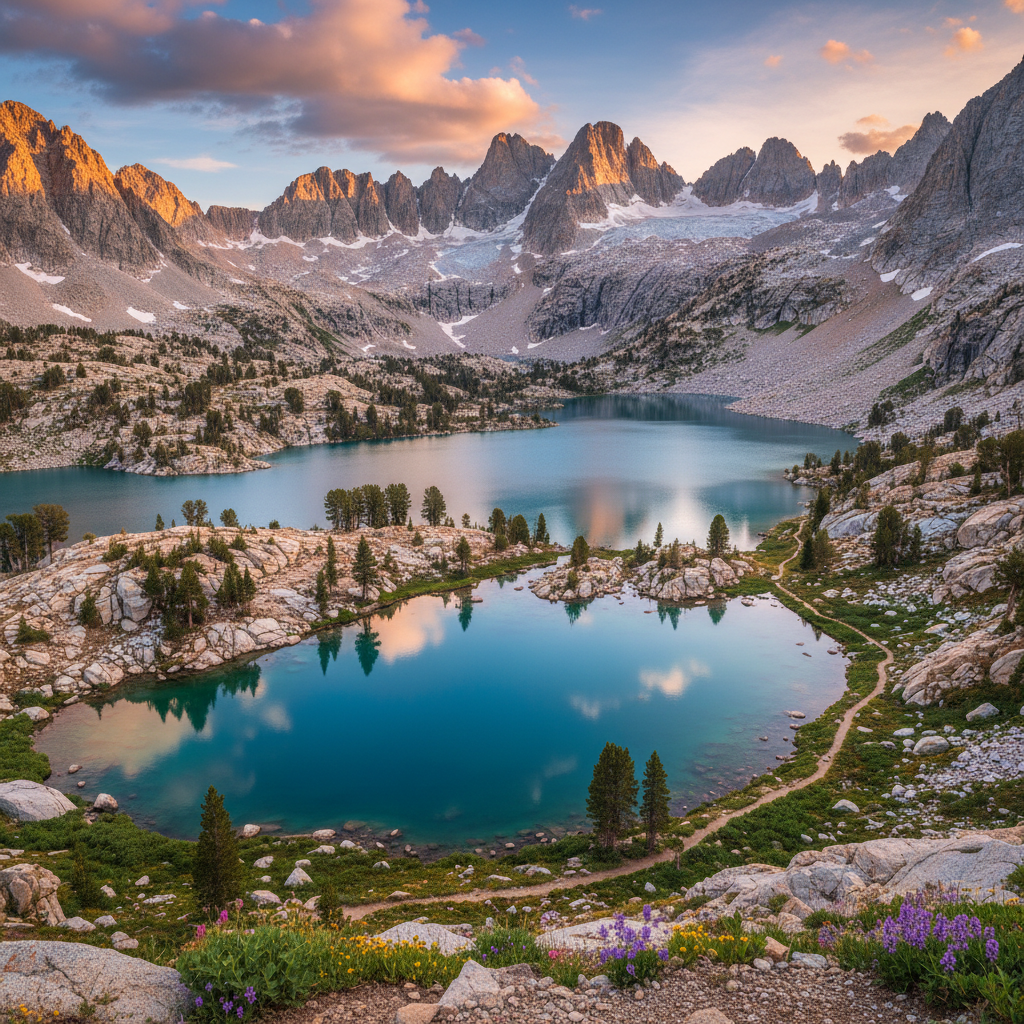
A chain of seven glacially-fed turquoise lakes below Temple Crag and the Palisades.
The Big Pine Lakes are a series of high-alpine basins fed by the Palisade Glacier, the southernmost glacier in North America. Located in the John Muir Wilderness within Inyo National Forest, these lakes sit on the ancestral lands of the Nüümü (Owens Valley Paiute), who know the broader valley below as Payahuunadü, meaning "the land of flowing water". The journey to the lakes begins at the end of Glacier Lodge Road, roughly 11 miles west of the town of Big Pine. Starting at an elevation of 8,300 feet, the trail follows the rushing North Fork of Big Pine Creek, climbing steadily through groves of Jeffrey pine, water birch, and quaking aspen. The path is a constant negotiation with gravity, gaining roughly 2,000 feet of elevation over the first 4.5 miles before reaching the first of the glacial basins.
Along the ascent, about 3.5 miles from the trailhead, hikers encounter a remarkable piece of wilderness history: the Lon Chaney Cabin. Built in 1929 as a summer retreat for the legendary silent film actor known as "the man of a thousand faces," the 1,288-square-foot cabin was designed by Paul Revere Williams, the pioneering African-American architect who went on to design homes for Hollywood's elite. Constructed from two-foot-thick local granite fieldstone with a green corrugated roof, the cabin now serves as a wilderness ranger station. While the interior is locked to the public, its wide stone porch provides a perfect resting spot beside the creek before the final push to the lakes. Above the cabin, the trail crosses the 10,000-foot threshold, where the forest thins and the dramatic granite architecture of the High Sierra takes over.
The transition to the lakes themselves is marked by a sudden, dramatic shift in color. First, Second, and Third Lakes are filled with an opaque, brilliant turquoise water that looks almost artificial. This striking hue is a physical record of the high peaks above: the Palisade Glacier grinds the underlying granite into a fine powder known as glacial flour, which remains suspended in the meltwater and scatters light in the green and blue wavelengths. Towering directly behind Second Lake is the dark, gothic spire of Temple Crag, its jagged ridges rising to 12,973 feet. For those with the stamina to continue, the trail loops past Fourth, Fifth, Sixth, and Seventh Lakes, where the crowds thin and the terrain becomes increasingly rugged. Camping in the basin requires a wilderness permit from the Inyo National Forest, allowing backpackers to witness the granite of the Palisade Crest glow gold at sunset and wake to the crisp, thin air of the high wilderness.
Begin the hike at first light to tackle the exposed, sun-baked switchbacks of the first three miles in the morning shadow of the canyon walls. If backpacking, secure a North Fork permit months in advance, and carry a hard-sided bear canister, as persistent chipmunks and black bears will quickly raid any food left hanging or uncontained.