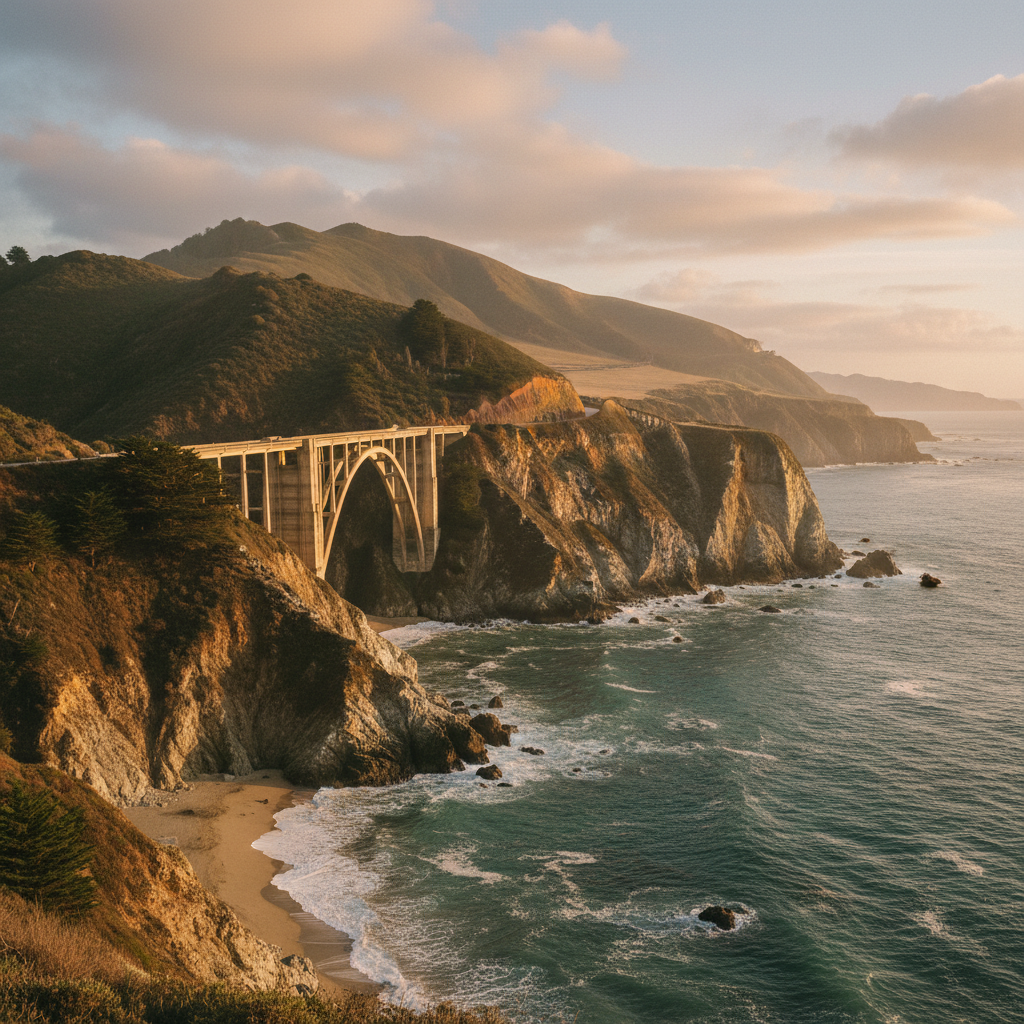
The reinforced concrete arch of Bixby Bridge spans a deep coastal canyon, a monument of 1930s engineering suspended high above the crashing Pacific surf.
Bixby Creek Bridge stands as one of the most significant engineering feats of the early twentieth century along the California coast. Completed in October 1932, this reinforced concrete open-spandrel arch bridge spans 714 feet from end to end, suspended 260 feet above the mouth of Bixby Creek where it meets the Pacific Ocean. Designed by F.W. Panhorst and engineered under the direction of C.H. Purcell, the structure was built to bypass the treacherous, eleven-mile inland detour of the Old Coast Road, which frequently became impassable during winter storms and left local homesteaders isolated. The bridge features a 330-foot main arch span, flanked by decorative vertical buttresses that, while structurally unnecessary, were added to provide visual weight and classical balance to the soaring design.
Constructing the bridge in such a remote, rugged location required immense physical labor and material resources, especially during the height of the Great Depression. Before any concrete could be poured, crews from the Ward Engineering Company had to construct a massive, intricate falsework using 300,000 board feet of Douglas fir timber, essentially building a wooden replica of the bridge to support the wet concrete. Workers excavated 4,700 cubic yards of earth and rock from the steep canyon walls to anchor the foundations. The final structure consumed 600,000 pounds of reinforcing steel and 45,000 sacks of cement. State engineers deliberately chose reinforced concrete over steel to minimize long-term maintenance costs, knowing that the salt-laden marine air would rapidly corrode steel girders. Additionally, the natural gray of the concrete was selected to harmonize with the color of the surrounding Santa Lucia clay-shale cliffs.
Built for just under $200,000, the bridge was completed under budget and stood as the highest single-span concrete arch bridge in the world at its dedication. In the late 1990s, the California Department of Transportation completed a $20 million seismic retrofit, carefully preserving the historic facade while reinforcing the deck and columns to withstand major earthquakes. Though modern highway standards classify its 24-foot width as functionally narrow, the bridge remains a fully operational, iconic link on State Route 1. Standing on the coastal bluffs nearby, one can appreciate how the clean, geometric lines of the arch contrast with the chaotic erosion of the cliffs, serving as a monument to human ingenuity in a wild landscape.
To photograph the bridge with the best lighting, arrive during the late afternoon or golden hour when the setting sun illuminates the western face of the concrete arch. Park at the designated gravel pullout on the northwest side of the bridge, but exercise extreme caution as this area is highly congested and lacks pedestrian barriers. For a unique historical perspective, take a short walk or drive down the unpaved Old Coast Road just east of the bridge to see the canyon and the structure from the inland side where early homesteaders once traveled.