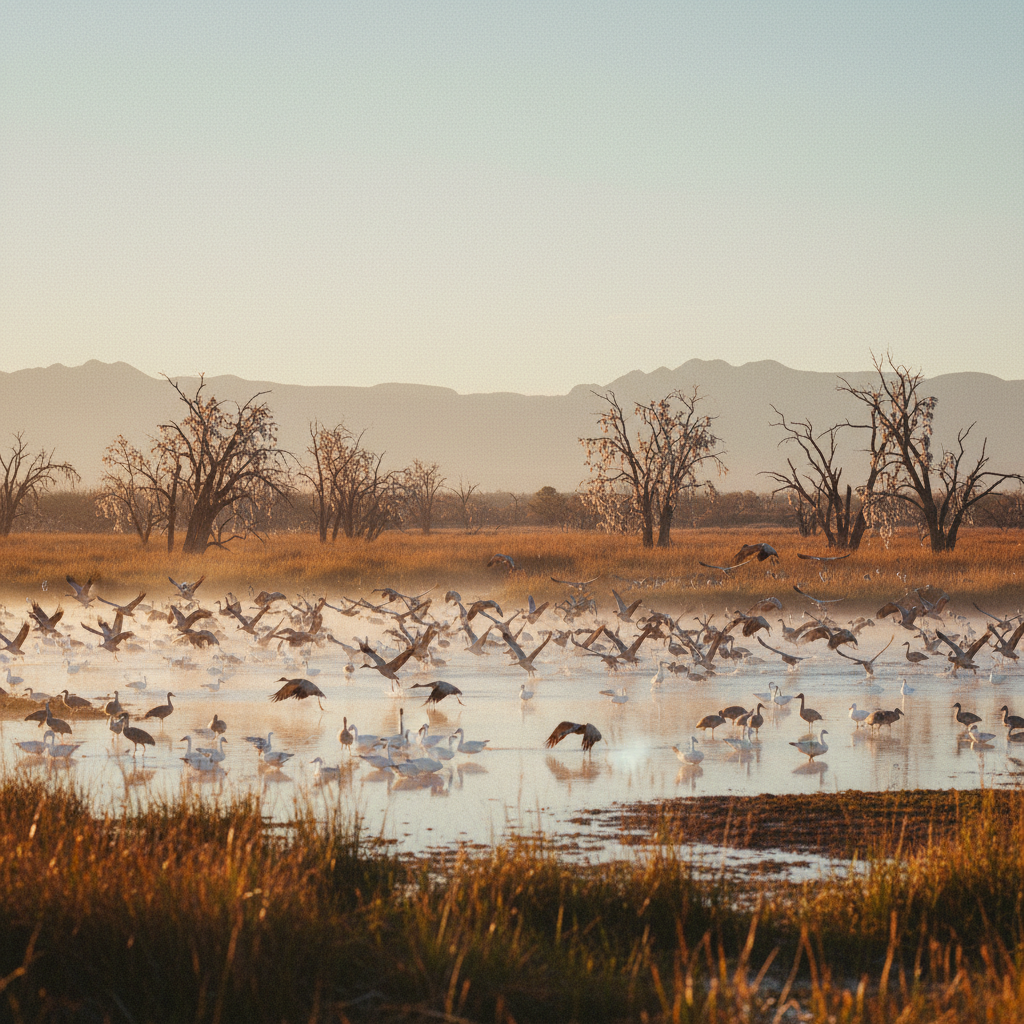
Watch tens of thousands of sandhill cranes and snow geese erupt from the wetlands at dawn against the backdrop of the Chupadera Mountains.
Bosque del Apache National Wildlife Refuge protects 57,331 acres of riparian wetlands, agricultural fields, and Chihuahuan desert along the Rio Grande floodplain in southern New Mexico. Established in 1939 by executive order of President Franklin D. Roosevelt, the refuge was created as a sanctuary and breeding ground for migratory birds, particularly the greater sandhill crane, whose wintering population had dwindled to just 17 individuals in 1941. The name, Spanish for "woodland of the Apache," recalls the Apache bands that camped in the dense cottonwood forests, or bosques, lining the river, though the land's human history stretches back much further. Over 700 years ago, Piro Puebloans farmed these fertile soils, leaving behind archaeological sites that are preserved within the refuge boundaries today. Flanked by the rugged Chupadera Mountains to the west and the San Pascual Mountains to the east, this active oasis serves as a critical stopover on the Central Flyway, hosting hundreds of thousands of birds annually.
The winter spectacle, running from late October through February, is defined by the daily rhythms of tens of thousands of sandhill cranes and snow geese. Managing this massive concentration of wildlife requires a highly coordinated, active agricultural program. Refuge staff work with local cooperative farmers to cultivate crops like corn and alfalfa, which are left standing to provide essential winter forage. At the same time, a complex network of canals and water control structures diverts water from the Rio Grande to seasonally flood the managed impoundments, mimicking the natural flood cycles of the historic river. At dawn, the quiet of the freezing desert night is shattered at the Flight Deck during the famous "blast off," when thousands of snow geese suddenly erupt from the water in a deafening flurry of white wings to feed in the nearby farm fields. As dusk approaches, the focus shifts to the Crane Ponds, where sandhill cranes glide in on massive wings, their ancient, rattling bugles echoing against the orange and violet twilight.
While the winter migration draws the largest crowds, the refuge reveals a quieter, equally compelling character during the spring and summer months. As the wintering waterfowl depart for northern breeding grounds, the seasonal tour roads open up, exposing mudflats and shallow pools that attract migrating shorebirds, including American avocets, black-necked stilts, and secretive bitterns. The cottonwood and willow bosques flush with vibrant green, providing nesting habitat for yellow-billed cuckoos, southwestern willow flycatchers, and summer tanagers. On the dry desert uplands that make up more than half of the refuge's acreage, visitors can spot Chihuahuan desert specialists such as Gambel's quail, greater roadrunners, and black-throated sparrows darting through creosote and mesquite. The 12-mile gravel Auto Tour Loop, which is bisected into a North Loop and South Loop, remains open year-round from one hour before sunrise to one hour after sunset, offering a self-guided route where vehicles serve as excellent mobile viewing blinds.
For the iconic morning blast-off, arrive at the Flight Deck at least 45 minutes before sunrise, particularly on winter weekends when crowds gather. The pre-dawn desert cold is piercing, so pack heavy layers, hand warmers, and a thermos of hot coffee. After the morning flight, drive the North Loop (Farm Loop) clockwise to keep the low sun at your back, which provides the best front-lighting for bird photography.