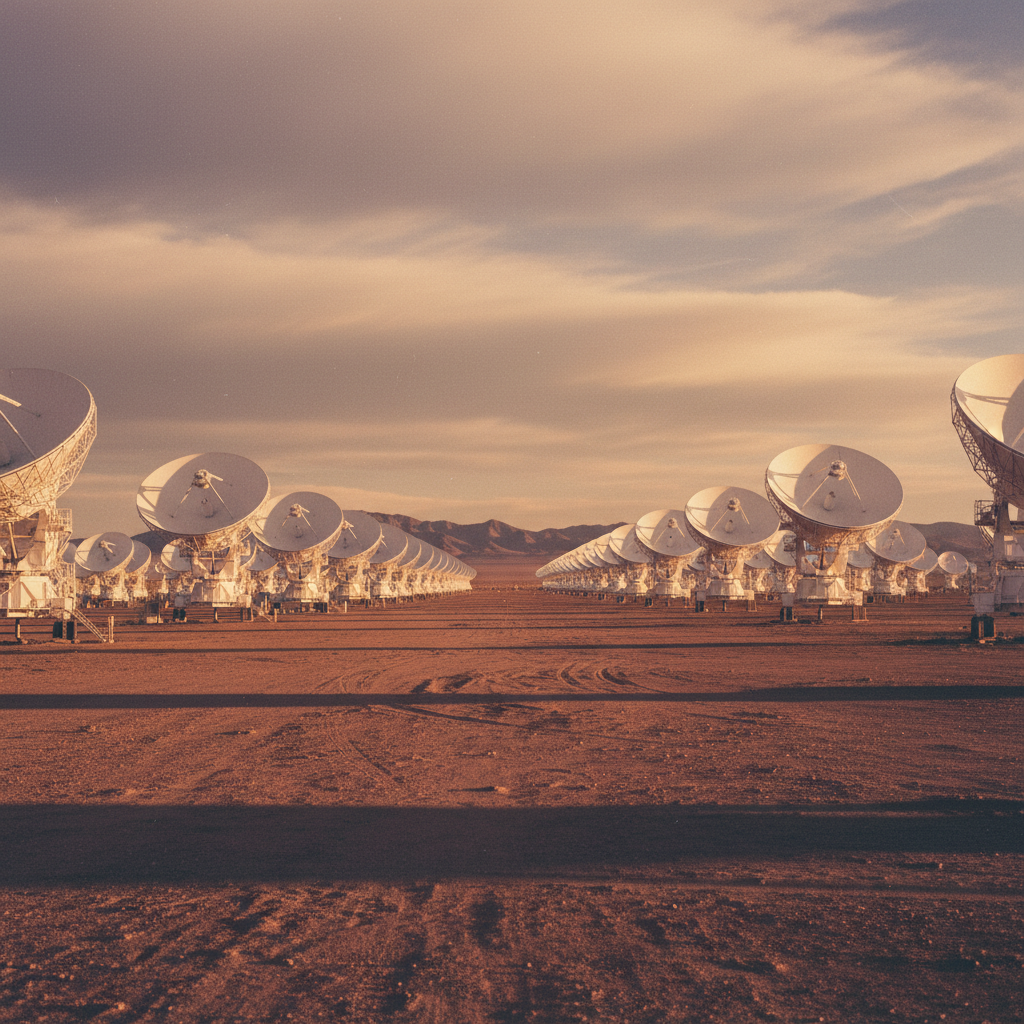
Twenty-seven massive radio dishes sweep the desert skies from the high Plains of San Agustin, forming a colossal astronomical gateway to the deep cosmos.
The Karl G. Jansky Very Large Array stands as one of the world's premier radio astronomy observatories, positioned 7,000 feet above sea level on the high, arid Plains of San Agustin. Authorized by Congress in 1972 and fully operational by 1981, this scientific marvel comprises twenty-eight massive radio antennas, though only twenty-seven are active at any given time while one rotates through a dedicated maintenance cycle. Each individual dish measures 82 feet (25 meters) in diameter and weighs a staggering 230 tons. Operating as a single, colossal astronomical instrument, the array captures invisible radio waves to study black holes, young stars, and distant galaxies. In 2012, a massive technical overhaul replaced the original 1970s copper wiring with nearly 3,000 miles of state-of-the-art fiber-optic cables, pairing the dishes with a custom supercomputer and renaming the facility to honor Karl G. Jansky, the physicist who first discovered radio waves emanating from the Milky Way in 1931.
The physical layout of the array is designed for dynamic versatility, with the antennas arranged along a Y-shaped double-track railway system. Every three to four months, a specialized locomotive-like machine shifts the dishes into one of four distinct configurations, labeled A through D, to alter the telescope's focus. In the expansive A configuration, the antennas are moved to their maximum spacing, stretching up to 22.6 miles across the desert floor to provide incredibly sharp resolution of highly concentrated cosmic sources. Conversely, the D configuration draws all twenty-seven dishes into a tight, dramatic cluster spanning just over half a mile, which allows astronomers to map larger, more diffuse structures in the deep sky. This mechanical choreography transforms the landscape, offering returning visitors a completely different visual experience depending on the season and the active scientific cycle.
For travelers exploring this remote corner of New Mexico, the self-guided walking tour begins at the visitor center, where a twenty-minute documentary narrated by actress Jodie Foster provides essential context on radio interferometry. The outdoor trail leads past several educational installations, including the Bracewell Radio Sundial, interactive whisper dishes that demonstrate how parabolic curves focus sound waves, and an Aeolian wind harp that translates the high-desert breeze into haunting acoustic tones. The paved path culminates at the base of a towering 230-ton antenna, allowing visitors to stand directly beneath the steel lattice and hear the low hum of the motors as the dish slowly slews to track an unseen target in the cosmos. The facility operates daily from 9:00 AM to 4:00 PM, and because of the sensitive nature of the radio equipment, visitors are required to turn off all cell phones or switch them to airplane mode to prevent interference with the incoming cosmic signals.
To photograph the dishes clustered tightly together, consult the online configuration schedule and plan your visit during the 'D configuration' cycle. Because the visitor site closes strictly at 4:00 PM daily, you will not be able to remain on the walking path for sunset, but you can capture excellent late-afternoon light on the dishes from public pull-offs along U.S. Route 60 just outside the facility boundary.