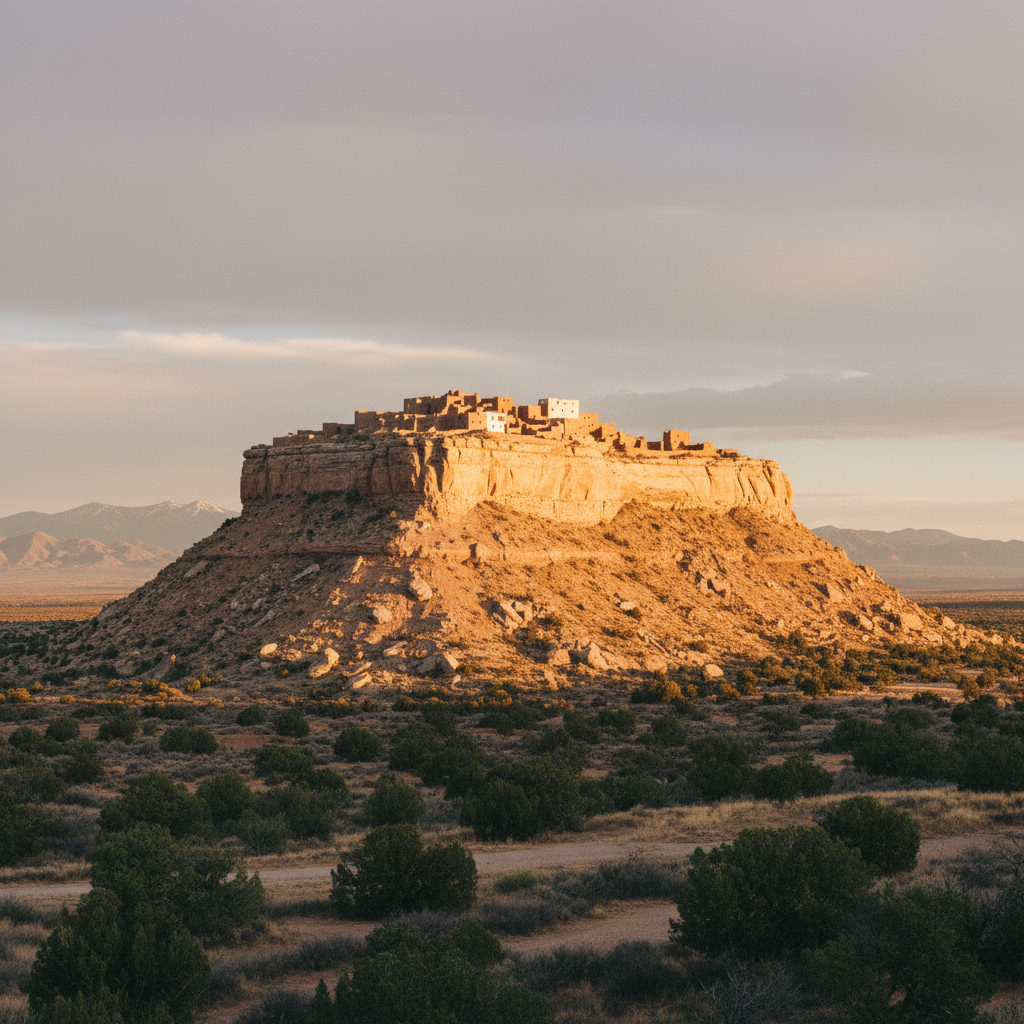
Acoma Pueblo, known as Sky City, sits atop a 367-foot sandstone mesa west of Albuquerque. Continuously inhabited since at least 1100 A.D., this ancestral Keresan homeland features multi-story adobe homes and the monumental 17th-century San Esteban del Rey Mission.
Acoma Pueblo, known in the Keresan language as Haak'u, sits atop a sheer 367-foot sandstone mesa, earning its Spanish moniker of Sky City. Located roughly 60 miles west of Albuquerque, it is recognized by historical research and archeological sources as one of the oldest continuously inhabited communities in North America, with settlements dating back to at least 1100 A.D. The mesa itself served as an impenetrable natural fortress, protecting the ancestral Puebloans from nomadic raiders like the Apache and Navajo. Traditionally, access to the mesa summit was limited to hand-and-toe holds carved directly into the sheer stone faces, a vertical ascent that kept the community isolated and secure for centuries. In 1540, members of Francisco Vásquez de Coronado's expedition became the first Europeans to encounter the pueblo, describing it as an incredibly strong and formidable citadel. The peaceful relations did not last, culminating in the tragic 1599 battle with Spanish conquistador Juan de Oñate, who ordered a devastating assault on the mesa that resulted in the destruction of much of the village and the brutal punishment of its survivors.
At the heart of the mesa-top village stands the San Esteban del Rey Mission, a monumental Spanish colonial church built between 1629 and 1641 under the direction of Franciscan friars. Constructing the massive adobe church was an extraordinary feat of forced labor, requiring the Acoma people to haul thousands of tons of earth, clay, and stone up the steep cliffs by hand. The massive roof beams, or vigas, were harvested from the slopes of Mount Taylor, located 25 miles to the north, and carried across the desert without ever touching the ground to avoid sacrilege. The mission church, measuring 150 feet in length with walls nearly ten feet thick, is the oldest surviving European church in New Mexico, uniquely surviving the Pueblo Revolt of 1680. Surrounding the mission are rows of traditional multi-story adobe homes, built from mud and straw, which were historically entered only through ladders leading to roof hatches. Today, only a small number of families live on the mesa year-round without running water or electricity, preserving the traditional ways of life, while the broader tribal community resides in nearby villages like Acomita and McCartys.
Visiting the pueblo is strictly managed to respect the privacy and cultural sovereignty of the Acoma people. Guided walking tours, led by tribal members who share oral histories passed down through generations, depart from the Sky City Cultural Center and Haak'u Museum at the base of the mesa. The museum showcases the tribe's renowned thin-walled pottery, characterized by intricate geometric patterns painted with natural mineral pigments and fired in traditional outdoor kilns. Visitors are shuttled up the 1950s-era access road to explore the historic plaza, the mission courtyard, and the cemetery, which was created by carrying soil up to the mesa over decades to form a sacred burial ground. Strict photography rules apply, with camera permits included in the admission fee, though video recording is strictly prohibited and certain ceremonial days are completely closed to the public. This careful stewardship ensures that the ancient citadel remains a living, breathing community rather than a static relic of the past.
Check the official Sky City Cultural Center website before departing, as the pueblo frequently closes to the public for unannounced religious ceremonies and cultural events. Always respect the strict photography guidelines: while still cameras are allowed with a permit, video recording, sketching, and audio recording are forbidden.