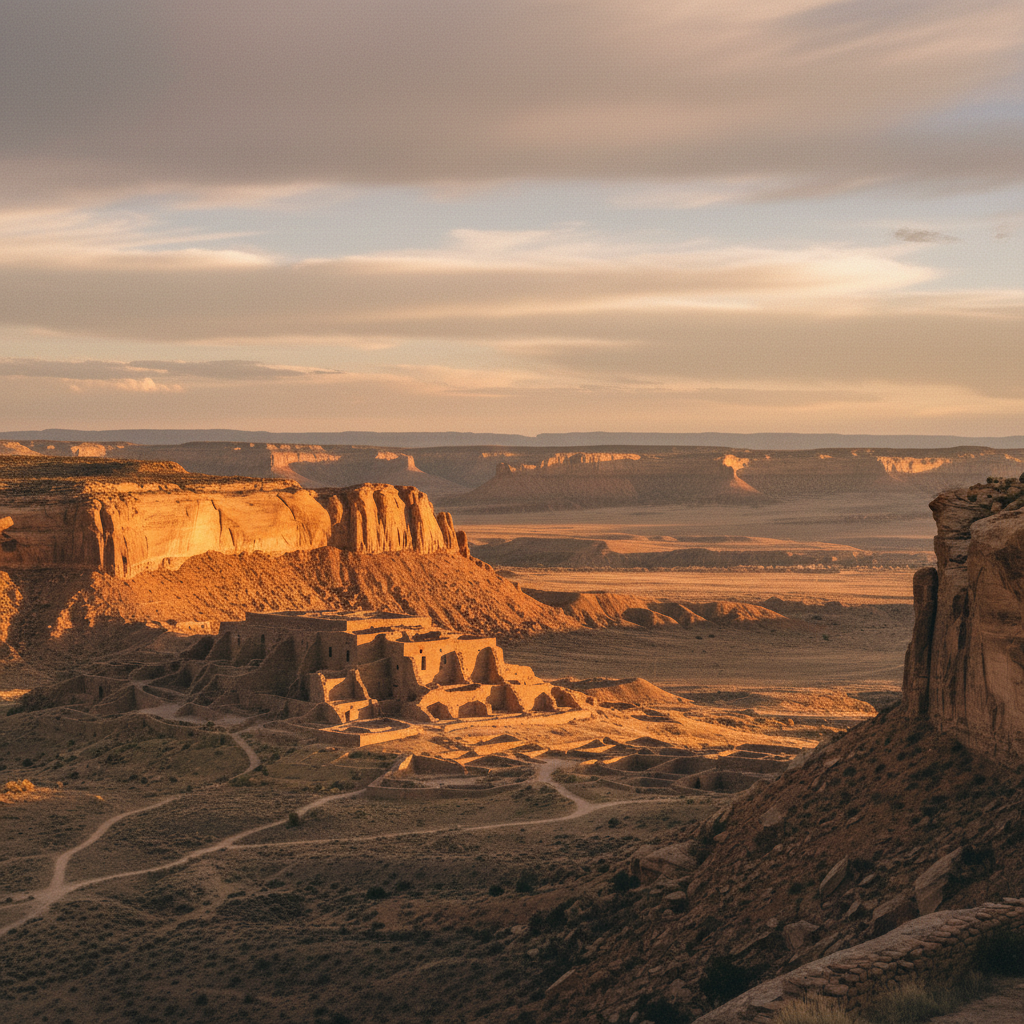
Explore the monumental stone ruins and ancient astronomical alignments of the grandest Ancestral Puebloan ceremonial center in the American Southwest.
Chaco Culture National Historical Park protects the monumental stone ruins of a massive ceremonial, political, and economic hub that flourished in northwestern New Mexico between AD 850 and 1150. This remote canyon, carved by the Chaco Wash, preserves the most sweeping collection of ancient ruins north of Mexico, representing a peak of Ancestral Puebloan architectural and engineering sophistication. The park features massive multi-story stone buildings, known as Great Houses, which were planned from their inception to contain hundreds of rooms and several subterranean kivas. Pueblo Bonito, the largest and most famous of these structures, spans three acres and once stood five stories tall with over 600 rooms arranged in a precise D-shape. The sheer scale of construction required an immense organized labor force, as builders utilized core-and-veneer masonry techniques to assemble sandstone blocks and mud mortar into walls that have stood for a millennium.
The construction of the Great Houses involved a monumental supply chain that operated without draft animals, wheeled vehicles, or navigable rivers. Recent scientific research utilizing tree-ring dating, or dendroprovenance, reveals that the Ancestral Puebloans harvested more than 240,000 trees over a 300-year span to serve as roofing beams, or vigas. Before AD 1020, the builders hauled these massive timbers, which averaged eight to ten inches in diameter and weighed around 200 pounds, from the Zuni Mountains over 50 miles to the south. Around AD 1060, as construction style and masonry techniques evolved, the wood source shifted to the Chuska Mountains, located roughly 50 miles to the west. These timbers were cut with stone axes, stripped of bark, and carried across the high desert using tumplines. Visitors walking through the ruins can still see these ancient beams protruding from the walls of structures like Chetro Ketl and Hungo Pavi, offering a tangible connection to the physical labor that shaped this desert metropolis.
Astronomical alignment is woven into the very geometry of Chaco Canyon, reflecting a deep connection to the cosmos. Many of the Great Houses are oriented to solar, lunar, and cardinal directions, serving as physical calendars that marked the changing seasons. Casa Rinconada, an isolated Great Kiva measuring over 60 feet in diameter, is aligned almost perfectly with the cardinal directions, and its subterranean chamber contains niches that some researchers suggest were designed to track celestial movements. Fajada Butte, rising abruptly from the canyon floor, once housed the famous "Sun Dagger" petroglyph, where daggers of light pierced spiral carvings during solstices and equinoxes. This ancient relationship with the sky continues today, as the park was designated an International Dark Sky Park in 2013. The lack of light pollution in this remote canyon allows visitors to experience the same brilliant celestial canopy that guided the original builders, complete with an on-site observatory that hosts public astronomy programs.
Accessing the canyon requires navigating rough, unpaved dirt roads, particularly County Roads 7900 and 7950, which can become impassable when wet. A high-clearance vehicle is highly recommended. To fully experience the park's International Dark Sky status, time your trip to coincide with a new moon and attend an evening presentation at the Chaco Observatory.