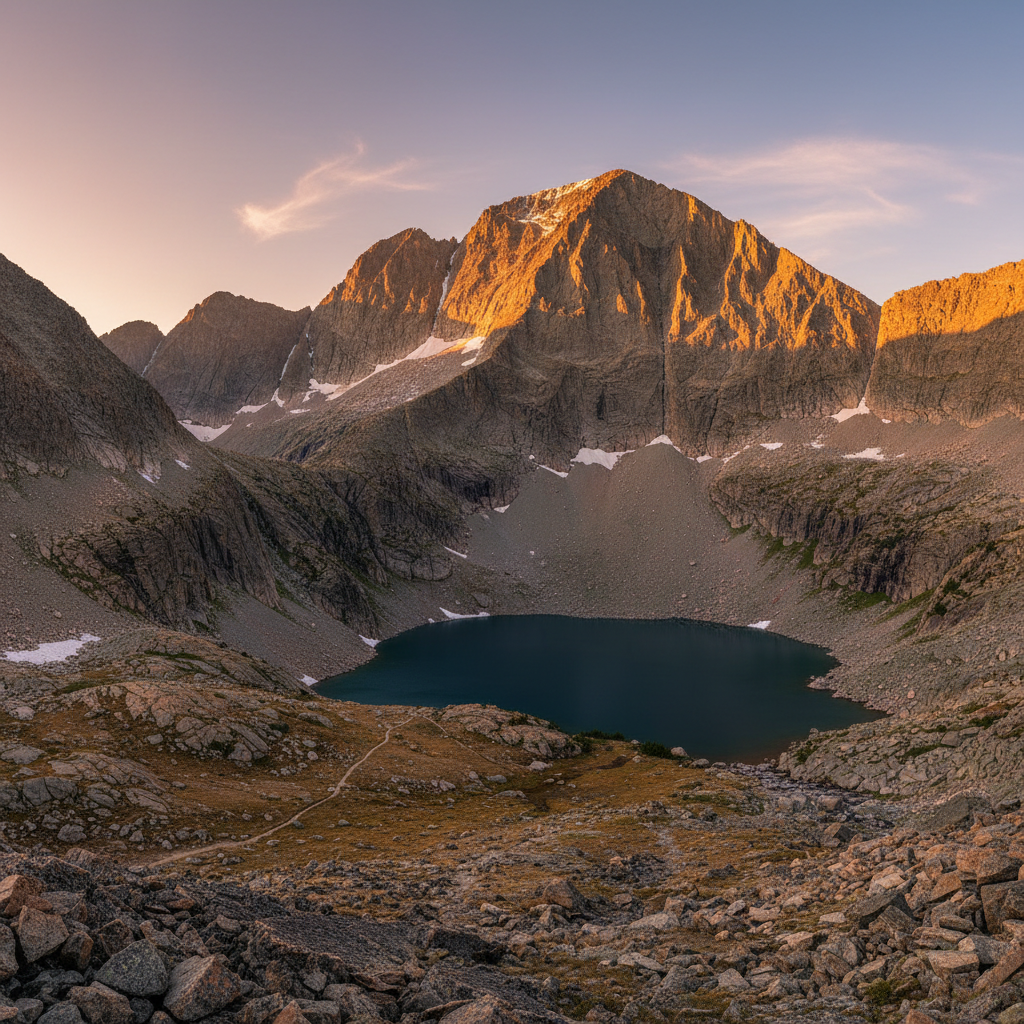
This deep alpine tarn sits directly beneath the sheer, 2,400-foot granite wall of Longs Peak's Diamond face.
Chasm Lake sits in a deep glacial bowl at 11,803 feet, positioned directly beneath the sheer, 1,000-foot vertical wall of the Diamond, the iconic east face of Longs Peak. The lake itself is a deep, cold, emerald-blue tarn, reflecting the massive granite amphitheater that rises nearly 2,400 feet above its shoreline. To the south, the rugged mass of Mount Meeker towers at 13,916 feet, while Mount Lady Washington guards the northern flank. Historically, the Arapaho people knew the twin summits of Longs Peak and Mount Meeker collectively as Neníisótoyóú'u, translating to "The Two Guides," a name reflecting how these towering peaks served as vital navigational landmarks from the eastern plains. Standing at the edge of this high-altitude pool, the sheer scale of the granite walls dominates the horizon, dwarfing everything else and creating a powerful sense of alpine isolation.
The geologic origin of Chasm Lake is a testament to the colossal forces of glaciation. The lake occupies a classic cirque basin, carved from the mountain's core by the ancient Mills Glacier during the last Ice Age. The surrounding rock is primarily Precambrian granite, a resilient crystalline formation dating back approximately 1.4 billion years. This durable rock has resisted erosion to form the formidable Diamond face, which remains a legendary arena for technical rock climbers. The route to the lake begins at the Longs Peak Trailhead, situated next to the historic ranger station at 9,405 feet. Over a distance of 4.2 miles, the trail climbs steadily, gaining roughly 2,400 feet of elevation. The path transitions from dense subalpine forests of lodgepole pine, Engelmann spruce, and subalpine fir into the wind-swept alpine tundra, where trees are reduced to twisted, stunted krummholz formations.
As the trail reaches Chasm Junction, it splits from the main East Longs Peak Trail and traverses a dramatic, exposed ledge. This section offers clear views down into a deep gorge where the waters of Peacock Pool lie, fed by the cascades of Columbine Falls spilling over the rocky cliffs. After crossing Chasm Meadow, the trail presents its most challenging obstacle: a steep, 100-foot headwall of loose rock and granite slabs. Hikers must scramble up this rocky barrier, using hands and feet to navigate the route. At the top of this final ridge, the trail opens directly onto the lake's edge. The environment here is raw and uncompromising, with snowfields frequently lingering into July. Pikas and yellow-bellied marmots scurry through the talus fields, their sharp warning whistles echoing off the immense stone walls of the cirque.
Aim to arrive at the Longs Peak Trailhead by 5:00 AM or earlier, as the parking lot fills up before dawn with climbers and hikers. Because the trail is highly exposed above treeline, plan to be heading back down by noon to avoid dangerous afternoon lightning storms. Bring trekking poles to help navigate the steep, 100-foot scramble just before the lake, and pack microspikes if hiking before mid-July, as steep snowfields often cover the final approach.