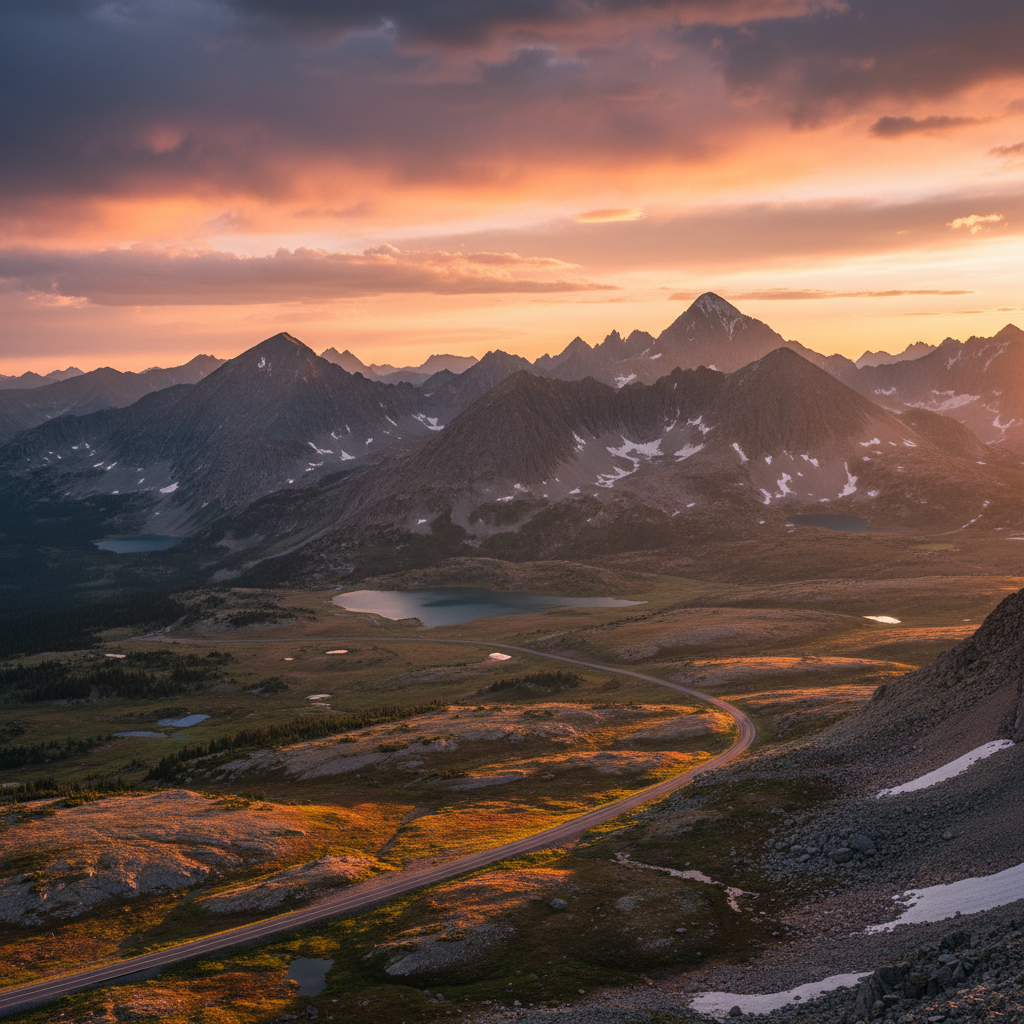
A high-altitude sanctuary of the Southern Rockies, where Trail Ridge Road crosses the Continental Divide at 12,183 feet amidst granite peaks, alpine tundra, and bugling elk.
Rocky Mountain National Park spans 415 square miles of high-altitude wilderness, where massive granite peaks rise directly from the edge of the Colorado plains. Encompassing a dramatic stretch of the Continental Divide, the park is defined by its verticality, rising from montane valleys at 7,860 feet to the windswept summit of Longs Peak at 14,259 feet. The Arapaho people, who traveled and hunted in these valleys for generations, called Longs Peak and its neighbor Mount Meeker "Neníisótoyóú'u," meaning "the two mountains," using them as essential navigational landmarks. Today, Trail Ridge Road serves as the park's high-altitude highway, crossing the Continental Divide at an elevation of 12,183 feet. Along this route, the dense montane forests of ponderosa pine and aspen give way to twisted, wind-battered krummholz trees at the treeline, eventually opening into a vast expanse of alpine tundra that resembles the Arctic Circle.
This landscape is ancient, shaped by 1.7-billion-year-old Precambrian granite and metamorphic rock that was uplifted during the Laramide Orogeny. During the last ice age, massive glaciers sculpted the terrain, carving out deep, U-shaped valleys like Moraine Park and leaving behind the moraines and alpine lakes that dot the Bear Lake area. The park protects three distinct ecosystems: the montane, the subalpine, and the alpine tundra. In the lower valleys, ponderosa pines and meadows provide habitat for herds of mule deer and Rocky Mountain elk. Higher up, subalpine forests of Engelmann spruce and subalpine fir frame pristine lakes like Dream Lake and Emerald Lake, both situated directly beneath the sheer, glaciated faces of Hallett Peak and Flattop Mountain. Above the treeline, a delicate tundra ecosystem supports resilient species like the yellow-bellied marmot, the American pika, and white-tailed ptarmigans, which survive in a world of cushion plants and intense solar radiation.
The establishment of the park in 1915 was largely the result of years of tireless advocacy by naturalist and author Enos Mills, who championed the preservation of these peaks from his homestead near the base of Longs Peak. Mills envisioned a place where visitors could connect deeply with the natural world, a legacy that continues through the park's extensive trail system. While scenic drives offer spectacular vistas, the true character of the park is experienced on foot. Early morning hikers at the Bear Lake Trailhead can witness the first light hitting the sheer rock walls of the Continental Divide, while autumn visitors to the Kawuneeche Valley or Horseshoe Park can hear the echoing, primeval bugle of bull elk during the annual rut. Exploring the quiet, lodgepole pine forests of the western slopes near Grand Lake or navigating the rugged Keyhole Route on Longs Peak reveals a sanctuary of wild, high-altitude beauty.
To visit between late May and mid-October, you must book a timed entry permit on Recreation.gov. Choose the 'Timed Entry + Bear Lake Road' permit (required from 5 a.m. to 6 p.m.) if you want to access popular spots like Dream Lake or Sky Pond. Otherwise, the standard 'Timed Entry' permit (required from 9 a.m. to 2 p.m.) covers Trail Ridge Road and the rest of the park. To avoid altitude sickness, spend your first day below 8,500 feet and drink plenty of water.