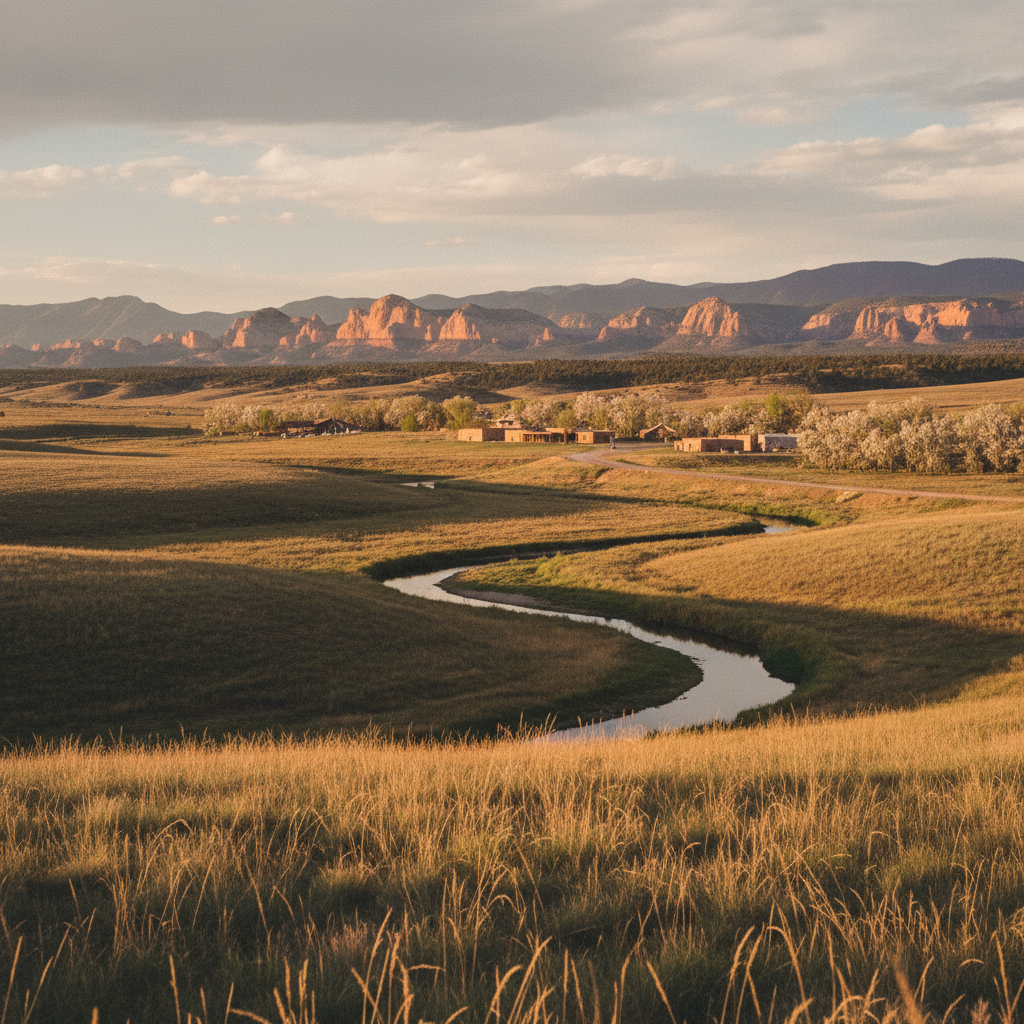
Find sanctuary beside a stocked trout stream in Guadalupita Canyon, where the Sangre de Cristo Mountains frame a quiet haven of ponderosa pines and dark mountain skies.
Coyote Creek State Park occupies 462 acres of a narrow riparian canyon in the eastern foothills of the Sangre de Cristo Mountains, situated 17 miles north of the historic village of Mora. Sitting at an elevation of 7,700 feet, the park is defined by Coyote Creek, a tributary of the Mora River that flows south through the center of the property. This small waterway is celebrated as one of the most densely stocked trout streams in New Mexico, drawing fly fishermen who cast for rainbow and brown trout in its shaded pools. The landscape is a rich tapestry of ponderosa pine, Douglas fir, spruce, and oak, with summer bringing blooms of wild iris and autumn painting the canyon walls with the gold of changing aspen leaves.
The human and geological history of the canyon adds a layer of depth to the natural scenery. Geologists trace the park's oldest exposed rocks, including limestone, sandstone, and shale, back 250 to 320 million years to the Late Pennsylvanian and Early Permian periods, later tilted by the Laramide orogeny. Centuries after Indigenous peoples used the canyon, European and Hispanic settlers arrived in 1837 under a Mexican land grant. The state park was eventually established in 1969, protecting both the recreational waters and critical habitats, such as the riparian zones required by the endangered New Mexico meadow jumping mouse. Beaver activity along the creek historically created deep, placid pools, though water levels fluctuate depending on seasonal snowpack in the surrounding Rincon subrange.
In March 2026, the park introduced a historic upgrade with the opening of the Aserradero Loop, Spanish for sawmill, which introduced the first cabin accommodations in the 93-year history of the New Mexico State Parks system. This newly developed campground features five rustic yet modern cabins, including one fully accessible ADA cabin, equipped with electricity, wood-burning stoves, interior lighting, and outdoor water hydrants. The loop also adds five new recreational vehicle sites with modern shelters, electricity, and water hookups. When night falls over the canyon, the lack of light pollution reveals a Bortle Class 2 night sky. While not officially certified by DarkSky International, the park remains a premier destination for amateur astronomers, who gather for seasonal star parties to view the Milky Way arching over the dark mountain ridges.
Book one of the brand-new cabins in the Aserradero Loop for a comfortable, wood-stove-warmed stay, or pitch a tent in the lower loop for direct creekside access. For stargazing, walk to the open meadow near the park entrance where the lack of tree canopy offers a clear, unobstructed view of the Bortle Class 2 night sky.