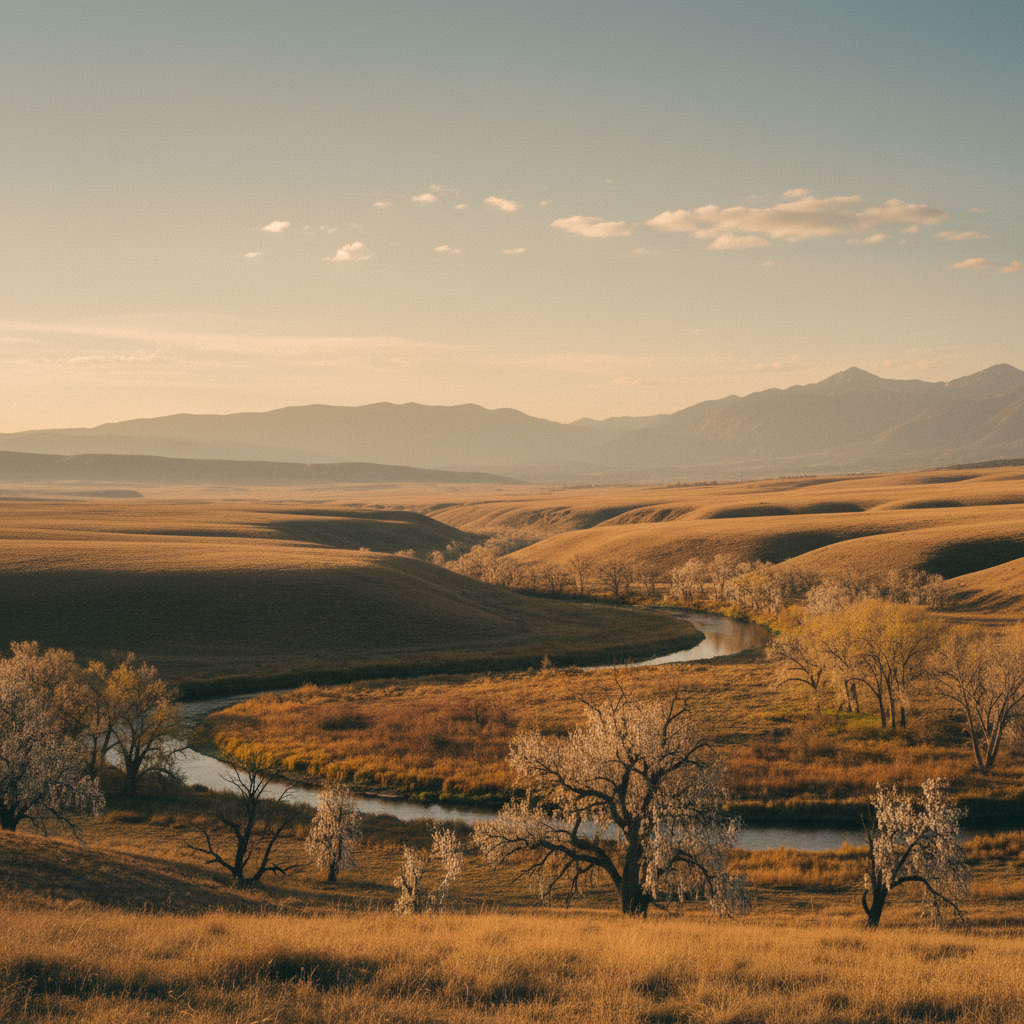
Explore the historic Mora Valley, an alpine agricultural basin defined by centuries-old acequias, historic gristmills, and the high meadows of the Sangre de Cristo Mountains.
Mora Valley is a high-altitude agricultural basin on the eastern slopes of northern New Mexico’s Sangre de Cristo Mountains, where subalpine forests give way to irrigated meadows. Centered around the winding Mora River at an elevation of approximately 7,180 feet, the valley comprises a series of historic plazas and settlements: Mora proper (originally Santa Gertrudis de lo de Mora), Cleveland (once San Antonio), Holman (formerly Agua Negra), and Chacón. Originally utilized by Ute, Navajo, and Apache tribes, the valley was colonized by Indo-Hispano families in 1816 under the leadership of Antonio Olguín, who crossed the mountains from Picuris Pueblo. In 1835, the Mexican government formally established the Santa Gertrudis de Mora land grant, distributing over 800,000 acres to 25 families. The valley's history is deeply etched with stories of resistance and rebuilding: during the 1847 Taos Revolt, U.S. troops engaged in two fierce battles here, ultimately using artillery to level the original adobe settlements of Upper and Lower Mora, forcing the community to rebuild from its foundations. Today, the scent of woodsmoke and piñon drifts across a landscape defined by traditional adobe homes, historic plazas, and the quiet hum of rural life.
The lifeblood of the valley is its intricate water system, an engineering marvel constructed over two centuries. Because the Mora River alone could not support the growing agricultural colony, early settlers negotiated with Picuris Pueblo to divert water from the western slopes of the mountains. This resulted in the Trans-Basin Acequias of the Mora Valley, also known as the Acequias de la Sierra. These gravity-powered ditches, including the Rito Alamitos (constructed between 1819 and 1835) and the Rito Angostura (built between 1879 and 1882), move water across the mountain divide from the Jicarita watershed to the Mora Valley. Managed by local mayordomos (water custodians), these hand-dug canals irrigate fields of hay, alfalfa, and orchards. The resilience of this system was tested in 2022 when the Calf Canyon/Hermits Peak fire, the largest wildfire in state history, scorched the high country, causing subsequent floods that choked the historic acequias with ash and debris. Local community members and mayordomos have worked tirelessly to clear and restore these channels, preserving a communal water-sharing tradition that has sustained the valley for generations.
This reliable water supply once earned the valley a reputation as the "bread basket of New Mexico," supporting seven wheat mills within a seven-mile stretch. Three of these historic gristmills still stand today as architectural monuments to the valley's agricultural golden age. The Cleveland Roller Mill, located at the junction of NM 518 and NM 434, operated as a flour mill in the late 1800s and now serves as a museum, hosting the annual Labor Day Millfest and displaying historic milling machinery. Further down the valley, the stone-walled St. Vrain Mill, built in 1855 by pioneer Ceran St. Vrain, stands as a testament to early industrial trade. At the La Cueva Historic District, the 1850s La Cueva Mill and the nearby Salman Ranch offer a connection to this milling heritage. Visitors to the ranch can pick fresh raspberries from mid-August through mid-October, or visit the historic ranch store for raspberry jam, vinegar, and dried herbs. Nearby, the 1870s San Rafael Church and the historic St. Gertrude Parish in Mora proper showcase traditional northern New Mexican ecclesiastical architecture, anchoring a valley where the past remains an active part of the present.
Plan a visit between mid-August and mid-October to pick fresh raspberries at Salman Ranch and catch the Labor Day Millfest at the Cleveland Roller Mill. Cell service is highly unreliable in the valley, so download maps offline before departing Las Vegas or Taos.