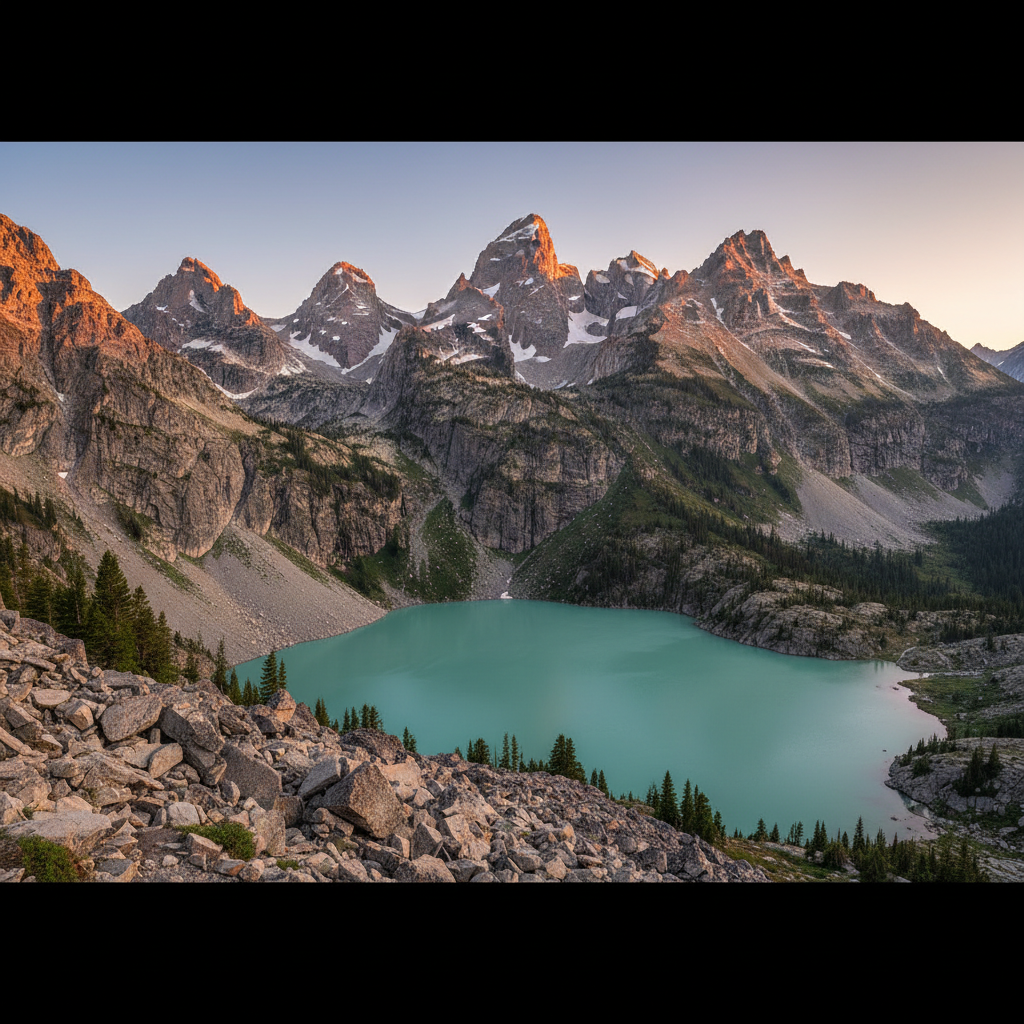
Once a quiet climber's secret, this high-alpine tarn beneath the Grand Teton is now a highly coveted destination, requiring a steep, unmaintained scramble to reach its milky, glacial-blue waters.
Delta Lake sits at 9,016 feet in the sheer granite embrace of Glacier Gulch, directly beneath the massive eastern face of the Grand Teton. Unlike the easily accessed lakes on the valley floor of Jackson Hole, this high-alpine pool requires a demanding journey that has transitioned from a mountaineer's secret to one of the most sought-after hikes in the Teton Range. The lake itself is relatively small, measuring roughly 250 yards in length, but its visual impact is monumental. The water is a striking, milky turquoise, a vivid robin's egg blue that owes its coloration to rock flour. This fine glacial silt, ground down by the heavy, scraping mass of the Teton Glacier directly above, remains suspended in the water and refracts light to create the lake's signature hue. Framed by the jagged profiles of Grand Teton, Mount Owen, and Teewinot, which means "many pinnacles" in the Shoshone language, the lake represents a classic geological cirque, carved out by ancient ice and dammed by a terminal moraine.
Reaching this high-mountain basin requires navigating an unmaintained and unsigned route that branches off the official park trail system. The journey begins at the Lupine Meadows Trailhead at 6,730 feet, following the well-graded path toward Surprise and Amphitheater Lakes. Hikers must climb through a series of steep switchbacks, gaining steady elevation through lodgepole pine forests and open slopes that look down on Bradley and Taggart Lakes. The critical transition occurs at the sixth switchback, roughly three miles into the hike, where an unofficial climber's trail departs to the right. From this point, the character of the hike changes dramatically. The path plunges into a rugged, unmaintained corridor where hikers must negotiate a maze of fallen timber, traverse two massive, unstable boulder fields of granite talus, and ascend a steep, loose dirt gully that demands careful footing and physical stamina.
The physical toll of the 2,300-foot climb over an 8.1-mile round trip is rewarded by the immediate, intimate view of the Grand Teton's north ridge and the Teepee Pillar. In the early morning, before the mountain winds ripple the surface, the lake acts as a mirror for the 13,775-foot peak towering directly overhead. Because of the lake's high elevation and deep mountain shadows, ice often clings to the shoreline well into July, and the water temperature rarely rises above freezing. While the explosion of interest via social media has stripped the location of its historic solitude, arriving at the shoreline at dawn still offers a profound encounter with the raw, active geology of the Tetons. The sound of shifting rock on the scree slopes and the distant rush of Glacier Falls, a 300-foot intermittent waterfall plunging down the gulch below, serve as constant reminders of the erosive forces still shaping this alpine sanctuary.
Arrive at the Lupine Meadows parking lot by 5:00 AM on summer weekends to secure a spot and beat the crowds. Bring bear spray, trekking poles for the steep boulder fields, and a headlamp if starting in the dark. The final 0.8-mile unmaintained section requires careful route-finding: look for the faint trail leaving the main path at the sixth switchback.