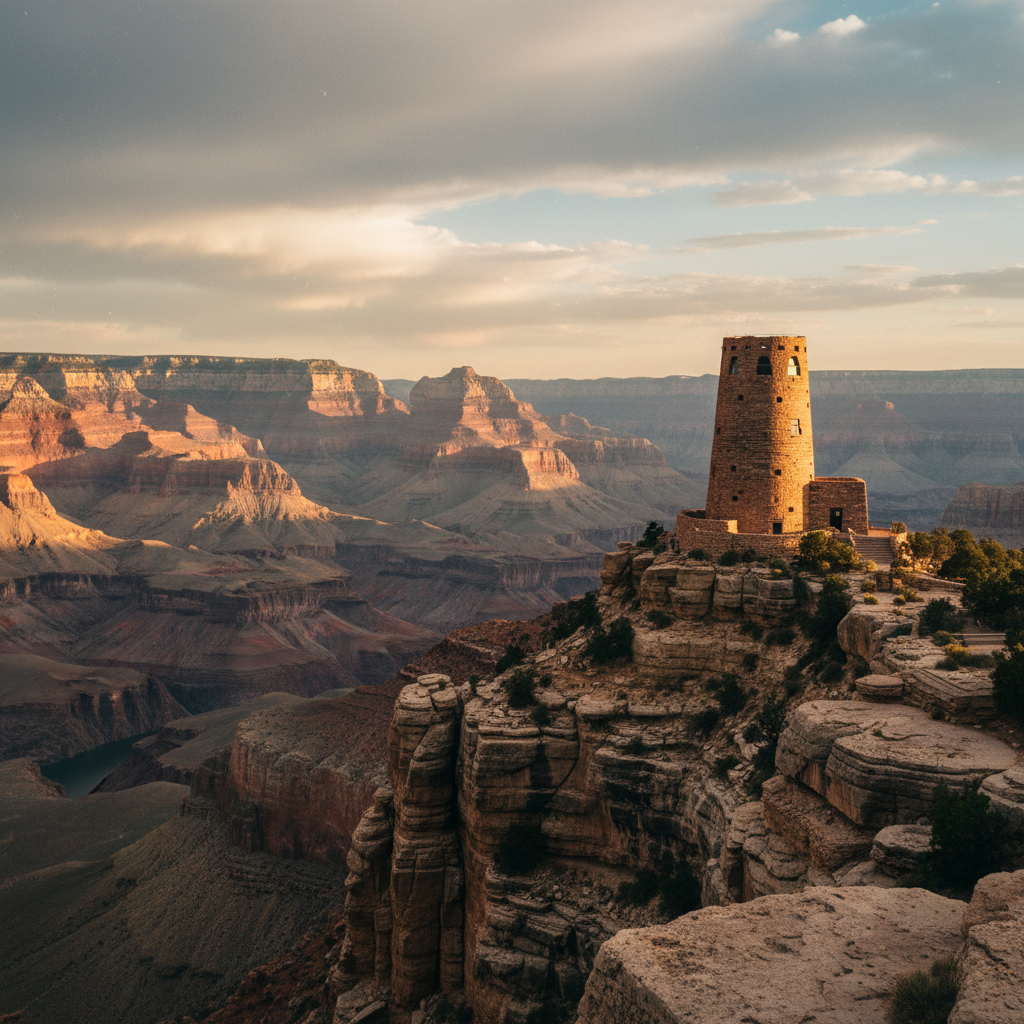
Designed by Mary Colter in 1932, the 70-foot Desert View Watchtower rises from the Grand Canyon's South Rim, blending Ancestral Puebloan-inspired stonework with murals by Hopi artist Fred Kabotie.
The Desert View Watchtower stands as a 70-foot-tall stone structure at the easternmost point of the South Rim, situated at an elevation of 7,360 feet. Designed by pioneering architect Mary Elizabeth Jane Colter and completed in 1932 for the Fred Harvey Company and the Santa Fe Railway, the tower was envisioned as a re-creation of prehistoric Ancestral Puebloan towers, specifically drawing inspiration from structures at Hovenweep and the Round Tower of Mesa Verde. Colter went to great lengths to ensure the building appeared organic to the landscape, insisting that the local stones remain uncut and weathered to preserve their natural surfaces. The internal structure relies on a hidden steel frame designed by the bridge builders of the Santa Fe Railway Company, while the exterior features deliberate built-in cracks and petroglyphs brought from near Ash Fork to evoke ancient age. Near the top, a pattern of white decorative stones, inspired by ruins in Chaco Canyon, breaks the monotony of the masonry.
Inside, the tower functions as both an architectural marvel and a canvas for Indigenous art. The ground floor, known as the View Room, is designed to replicate a traditional Native American kiva. This space now serves as a Grand Canyon Conservancy park store and hosts seasonal cultural demonstrations by Indigenous artists. Rising from the kiva is an 85-step spiral staircase that leads visitors upward through a series of circular balconies. The interior walls are adorned with murals painted by Hopi artist Fred Kabotie, who was commissioned by Colter to depict Hopi history, cosmology, and daily life. Among his works is a large circular painting of the Hopi Snake Legend, telling the story of the chief's son who first navigated the Colorado River, and representations of the God of the Clouds. Other rock art reproductions throughout the tower were painted by Fred Geary. Following a multi-year conservation project completed in recent years, these historic murals have been meticulously restored to their original vibrant hues.
The climb culminates at the enclosed upper observation deck, where large glass windows provide views stretching up to 100 miles on clear days. From this vantage point, visitors can see the Colorado River make a sharp bend as it transitions from Marble Canyon into the wider expanse of the Grand Canyon, with the Painted Desert extending eastward toward Hopi and Navajo lands. Today, the entire Desert View area has transitioned into an Inter-Tribal Cultural Heritage Site, a collaborative effort between the National Park Service and the 11 traditionally associated tribes of the Grand Canyon to highlight Indigenous voices and histories. Access to the upper floors of the tower is free but managed via a first-come, first-served ticket system when staffing allows, limiting capacity to 25 people at a time for 20-minute intervals to preserve the historic structure and ensure a quiet, contemplative experience.
To climb the tower, secure a free, same-day timed-entry ticket at the ground-level park store, as capacity is capped at 25 people at a time to protect the historic space.