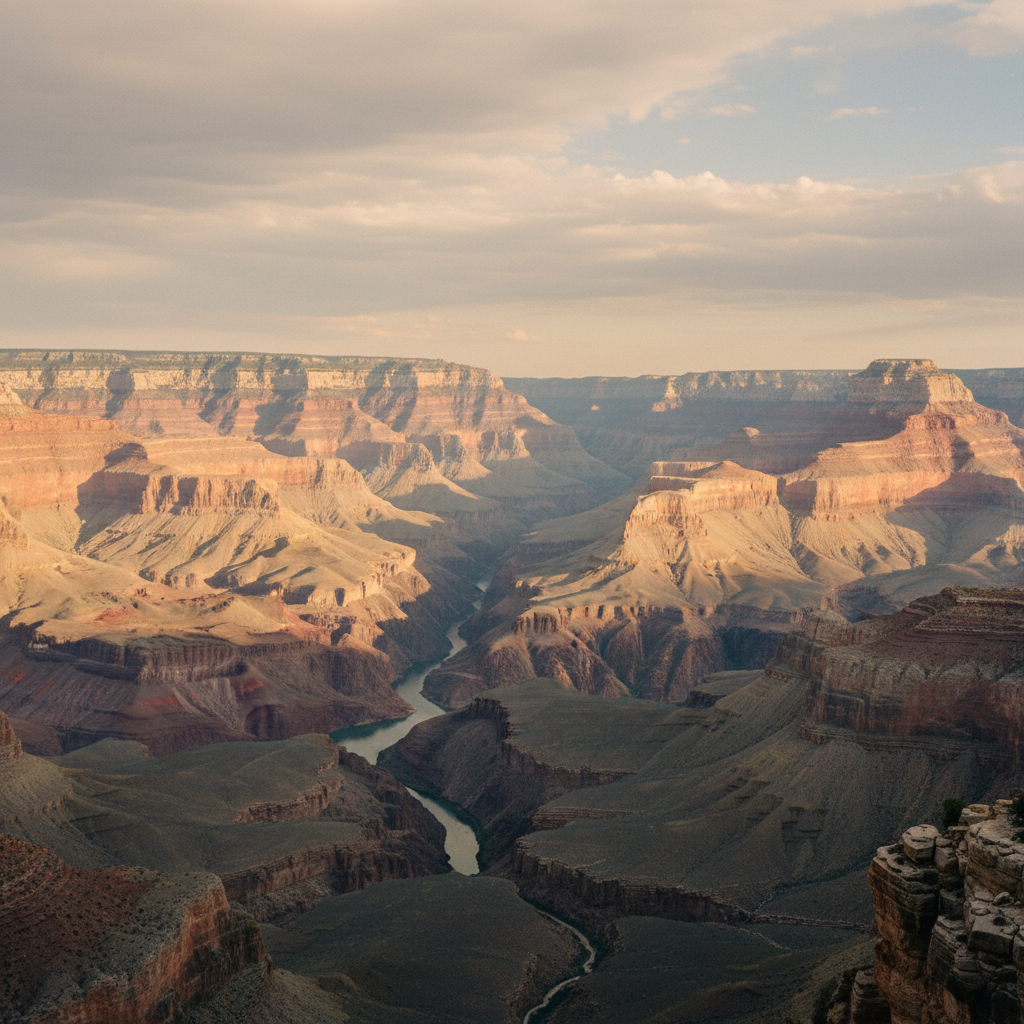
As the highest overlook on the South Rim, Navajo Point reveals a sweeping bend of the Colorado River and panoramic views of the Painted Desert stretching east.
At 7,461 feet, Navajo Point is the highest overlook on the Grand Canyon’s South Rim, a high-altitude perch where the wind carries the sharp, resinous scent of pinyon pine and Utah juniper. Stepping out to the edge, the immediate sensation is one of immense exposure. Unlike the enclosed feel of the inner canyon, here the sky dominates, a vast dome of Arizona blue that meets a horizon stretching fifty miles to the east. Below, the canyon steps down in massive, colored giant-steps. The Colorado River is visible far below, a green ribbon making a sharp, sweeping turn to the west. The sound of the river is lost to the height, replaced by the rush of the wind through the low branches of the scrub oaks clinging to the limestone rim.
This high vantage point offers an unparalleled lesson in the region's deep time. Because Navajo Point stands higher than its neighbors, you look down upon the entire geologic column of the Grand Canyon. The topmost layer under your boots is the Kaibab Limestone, rich with marine fossils from an ancient sea. Below it, the sheer cliffs of Coconino Sandstone preserve the frozen ripples of prehistoric desert dunes, while the deep reds of the Supai Group and Hermit Shale glow in the afternoon sun. Looking east, the view opens toward the Painted Desert and the Navajo Nation, lands that have been home to the Diné (Navajo) and Hopi peoples for generations. The point serves as a reminder of these enduring indigenous connections to the canyon, which remains a sacred place of emergence and ancestral history.
Visiting Navajo Point is best done with patience. While most visitors crowd the nearby Desert View Watchtower, this overlook offers a quieter space to watch the play of light across the stone. As the afternoon wanes, the shadows of the North Rim reach across the canyon floor, turning the inner gorges into deep, violet chasms while the upper cliffs of the Palisades of the Desert burn with a fiery orange. You can sit on the limestone ledges, watching California condors ride the thermal updrafts rising from the depths, their massive wingspans steady against the wind. It is a place to linger until the sun slips below the horizon, leaving the canyon in a cool, blue twilight that makes the ancient rock feel silent and infinitely old.
Because Navajo Point is the highest spot on the South Rim, it is one of the premier locations for sunset photography, especially looking east toward the Painted Desert. Bring a windbreaker, as the high elevation means it gets surprisingly cold as soon as the sun drops. Skip the midday crowds and arrive an hour before dusk.