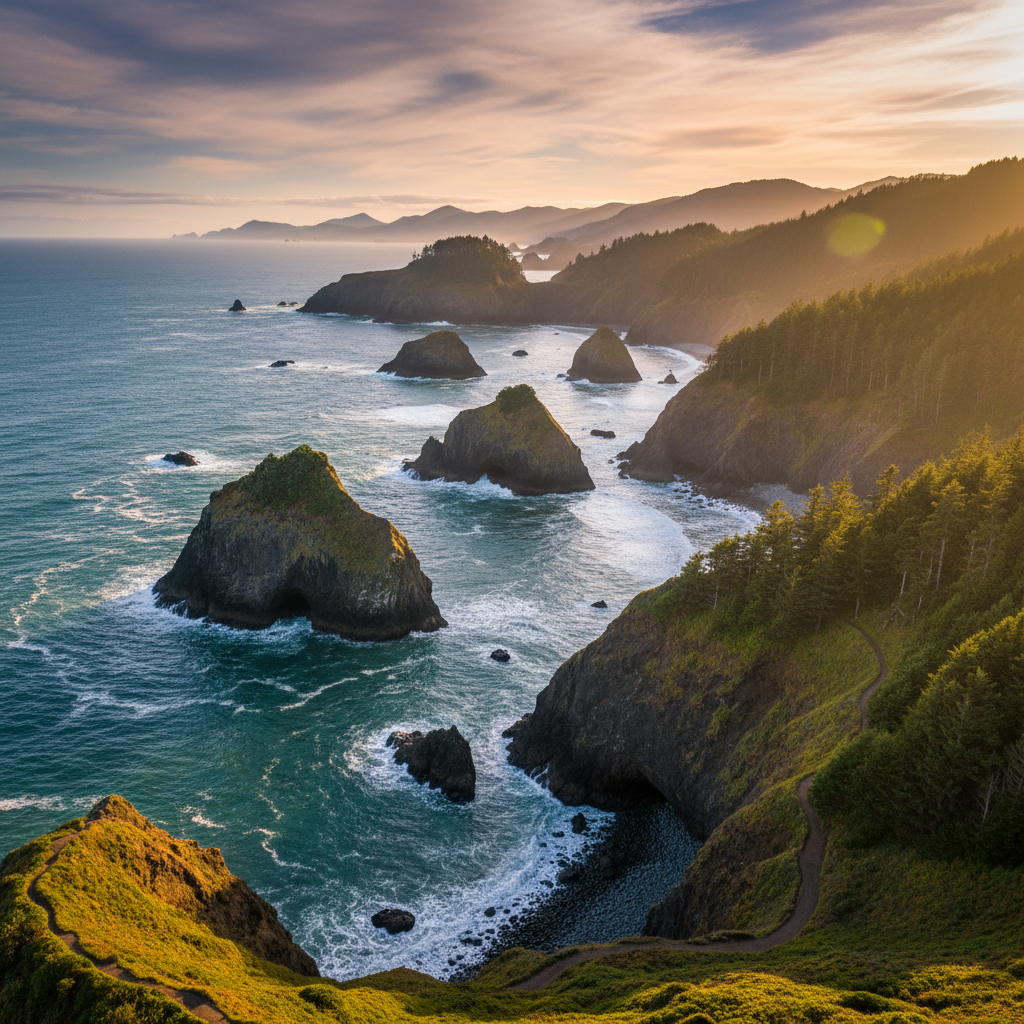
Encompassing nine miles of rugged headlands between Cannon Beach and Seaside, this coastal park blends ancient Sitka spruce rainforests with dramatic volcanic cliffs, historic trails, and views of the lonely Tillamook Rock Lighthouse.
Ecola State Park spans nine miles of dramatic, wave-battered coastline on the edge of Tillamook Head, positioned between Seaside and Cannon Beach. This 1,023-acre state park preserves a striking meeting of land and sea, where old-growth Sitka spruce, western hemlock, and Douglas fir forests grow directly to the edge of sheer basalt cliffs. Established in 1932 through the advocacy of Oregon’s first state parks superintendent, Samuel Boardman, and expanded by donations from prominent local families, the park protects a highly active geological landscape. The dark cliffs and offshore sea stacks are composed of 15-million-year-old basalt flows, remnants of ancient volcanic activity from the Columbia River basalt group. These headlands are constantly shaped by the Pacific Ocean, resulting in a dynamic environment prone to dramatic shifts, such as the major landslide of 1961 and the winter landslide of December 2025 that closed the park for months of engineering repairs before its reopening in April 2026.
The park's human history runs deep, rooted in the ancestral lands of the Tillamook and Clatsop peoples who inhabited these shores for millennia before European contact. In January 1806, Captain William Clark, Sacagawea, and members of the Corps of Discovery crossed Tillamook Head to trade with local tribes for blubber from a beached whale, an event that gave the park its name: 'ecola' derives from the Chinook word 'ekoli', meaning whale. Today, hikers can follow in their footsteps along the Clatsop Loop Trail, a 2.5-mile interpretive route, or traverse an eight-mile segment of the Oregon Coast Trail that winds through the dense, moss-draped forest canopy. From the grassy bluffs of Ecola Point, visitors look out over the vast ocean and can spot the Tillamook Rock Lighthouse, a lonely stone structure built on a basalt islet more than a mile offshore, affectionately known as 'Terrible Tilly' for the punishing storms that battered its keepers until its decommissioning in 1957.
Descending from the high bluffs leads to Indian Beach, a secluded sandy cove that is a favored haven for local surfers, beachcombers, and tidepoolers. At low tide, the exposed basalt shelves at Indian Beach reveal a complex intertidal ecosystem teeming with ochre sea stars, green giant anemones, and hermit crabs. Roosevelt elk are frequently seen grazing in the park’s coastal meadows, while bald eagles patrol the thermal drafts above the cliffs, and migrating gray whales can be spotted offshore during their winter and spring journeys. Visitors should note that access to the park requires a day-use parking fee, and the narrow park roads can become congested on summer weekends, making early morning visits the best way to experience the quiet majesty of this coastal sanctuary.
Arrive early in the morning to secure parking at Ecola Point or Indian Beach, particularly on summer weekends. A $10 day-use permit is required (payable by credit card at the automated kiosks). Be sure to check the Oregon State Parks website before visiting, as coastal landslides can occasionally cause temporary trail or road closures.