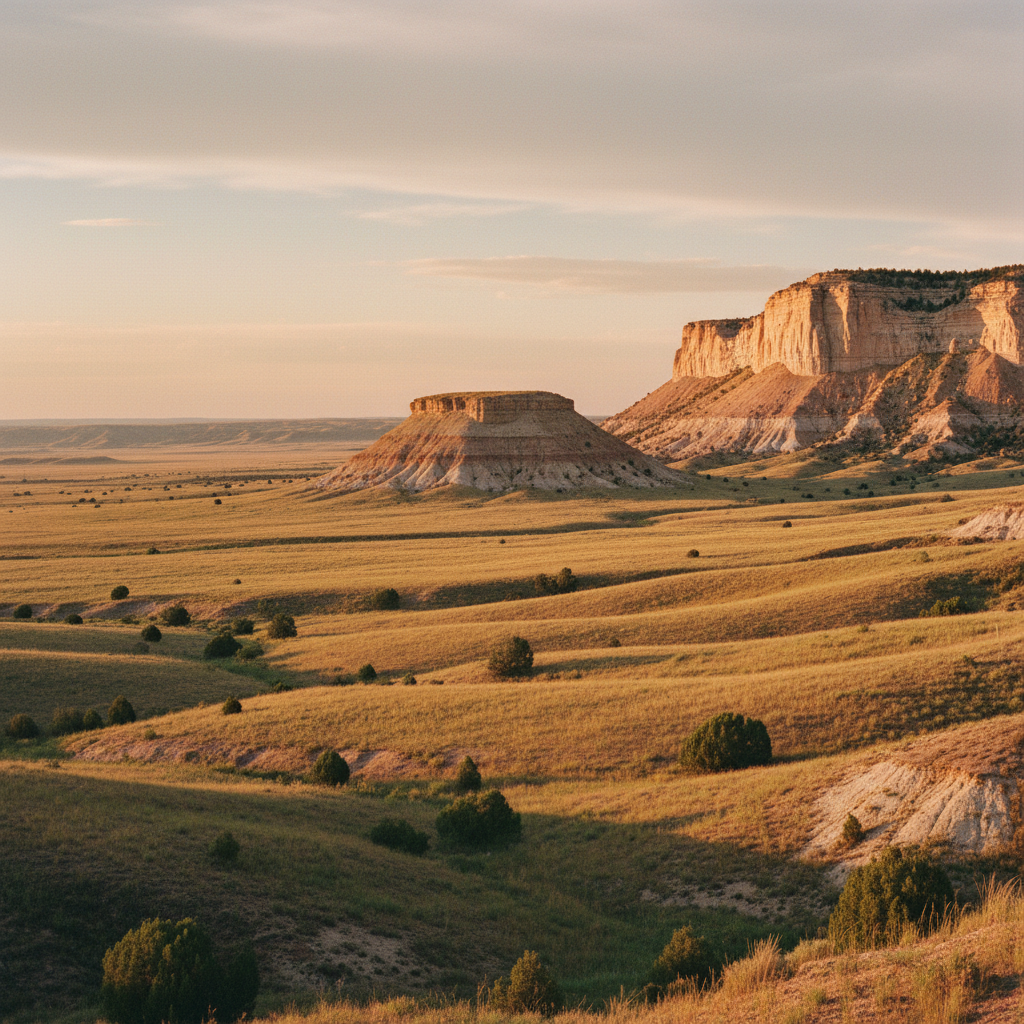
A National Historic Landmark near Great Falls preserving North America's largest bison cliff jump, complete with a mile-long sandstone cliff, ancient drive lines, and an interactive cultural visitor center.
First Peoples Buffalo Jump State Park, located just northwest of Ulm, Montana, preserves one of the largest and most heavily utilized bison cliff jumps in North America. Spanning 1,481 acres of high plains buttes and grasslands, the park is centered around a mile-long sandstone cliff that rises between 30 and 50 feet above the prairie. For at least two thousand years before the arrival of horses or firearms, numerous Indigenous nations, including the Blackfeet, Crow, Shoshone, Salish, Kootenai, and Gros Ventre, orchestrated complex communal hunts here. The site was historically known as the Ulm Pishkun, drawing from the Blackfeet word pis'kun, which translates to "deep kettle of blood" or "gathering place". Hunters strategically guided vast herds of bison across the upper plateau, utilizing elaborate stone drive lines to channel the animals toward the precipice.
The archaeological record preserved beneath the cliffs reveals the immense scale of these ancient hunts. Excavations have uncovered compacted bison remains reaching depths of up to 18 feet, alongside arrowheads, pottery, and stone tools. In the early twentieth century, the site faced industrial exploitation when stonecutters quarried the sandstone cliffs to construct buildings in Great Falls and Helena, and during the 1940s, a local family harvested tons of bison bones from the beds to sell as fertilizer. Recognition of its cultural and historical value led to its listing on the National Register of Historic Places in 1974. The park was officially established in 1972, and the state changed its name to First Peoples Buffalo Jump State Park on August 16, 2007, following extensive consultations with tribal nations to honor the 14 tribes that historically utilized the site. In August 2015, the park received designation as a National Historic Landmark, cementing its status as one of only three protected buffalo jumps in Montana.
Today, the park features a 6,000-square-foot visitor and education center that opened in May 1999. Inside, visitors can explore detailed buffalo culture exhibits, a storytelling circle, a gallery, and a bookstore, all designed to highlight the deep spiritual and practical connection between Plains tribes and the bison. Outside, interpretive trails wind from the visitor center up to the cliff summit, offering views of the Rocky Mountain Front to the west and the Missouri River Valley to the east. Along the trails, hikers can observe remnants of the ancient stone drive lines, tipi rings, and a protected black-tailed prairie dog town. An outdoor amphitheater and traditional games playing fields provide space for ongoing cultural education and community events, ensuring that the legacy of the First Peoples remains a living, respected history.
Allocate at least two hours to explore both the 6,000-square-foot visitor center and the interpretive trail leading to the cliff summit, where you can spot remnants of ancient stone drive lines and view the active black-tailed prairie dog town.