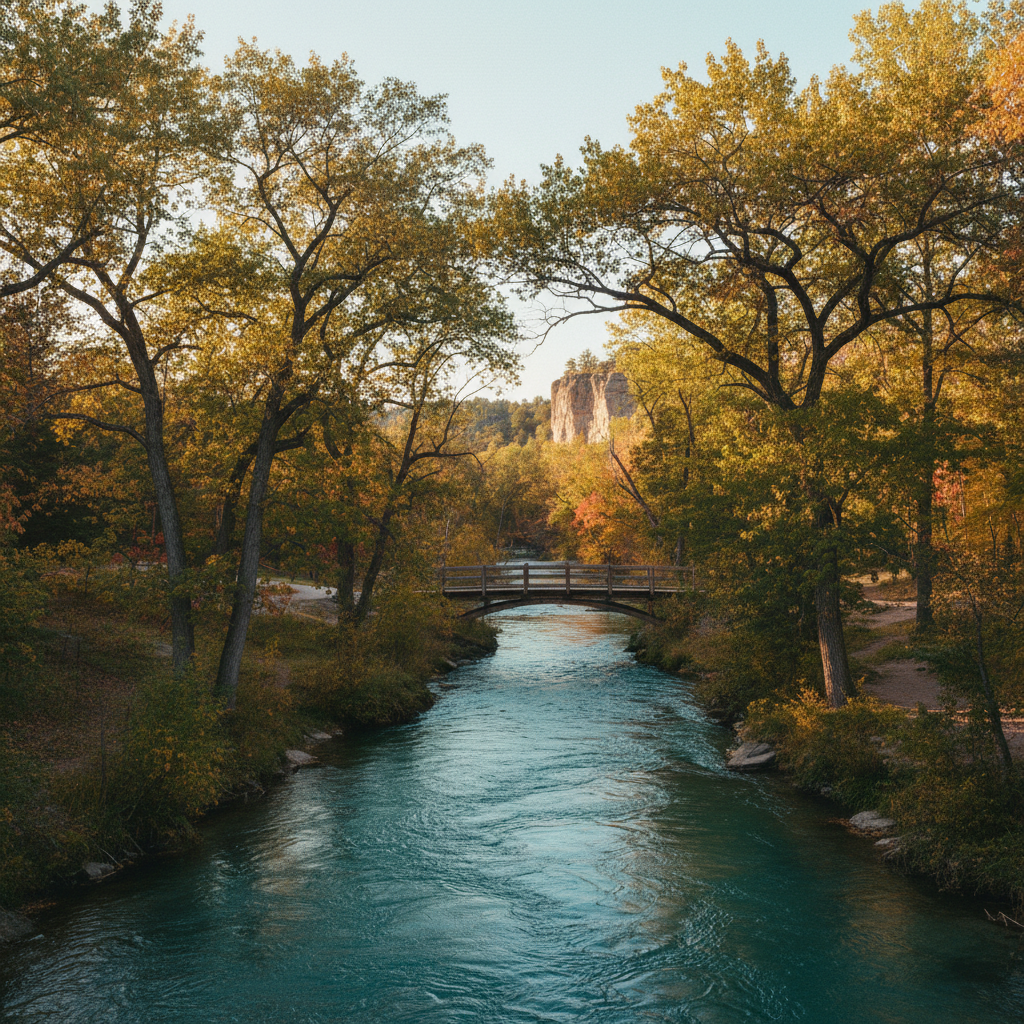
A historic state park in Great Falls, Montana, home to one of the country's largest freshwater springs and the 201-foot Roe River.
Giant Springs State Park, situated on the banks of the Missouri River in Great Falls, Montana, centers around one of the largest freshwater springs in the United States. This first-magnitude hydrological wonder discharges roughly 156 million gallons of water daily from the Madison Aquifer, maintaining a constant temperature of 54 degrees Fahrenheit year-round. The water begins its journey as snowmelt in the Little Belt Mountains, sixty miles to the southeast, traveling underground through Madison Limestone for years before bubbling up in a clear, turquoise basin. In the deep cold of Montana winters, the relatively warm water generates a thick mist that coats the surrounding cottonwoods and willows in a crystalline layer of ice.
The park holds a prominent place in the history of western exploration, having been documented by the Lewis and Clark Expedition in 1805. Meriwether Lewis described the site in his journals as a clift from which the most noble spring gushed, marvelling at the clarity and coldness of the water. Today, the spring's immediate outflow forms the Roe River, a 201-foot channel that flows directly into the Missouri River. The Roe was officially recognized by the Guinness Book of World Records as the world's shortest river before the organization retired the category. This creates a unique geographical trifecta where one of the world's shortest rivers flows from one of the largest natural springs directly into the Missouri, the longest river in North America.
Visitors can explore this aquatic landscape via the park's extensive trail network, which connects to the greater River's Edge Trail system. Paved walkways wind past the bubbling spring pool and lead to the Giant Springs State Fish Hatchery, established in 1922. The hatchery uses the clean, cold spring water to raise rainbow trout for stocking regional waters, and visitors can purchase feed to toss to the large trout in the outdoor show pond. The park also hosts the Lewis and Clark National Historic Trail Interpretive Center, managed by the U.S. Forest Service, which offers exhibits on the expedition's difficult portage around the five waterfalls of the Missouri. From the park overlooks, visitors can view the nearby Rainbow Dam and the remnants of the historic waterfalls that once challenged early explorers.
Bring a handful of quarters to purchase food pellets for the massive rainbow trout in the hatchery's show pond, then walk the short path along the Roe River to watch its clear, 54-degree water merge with the muddy flow of the Missouri River.