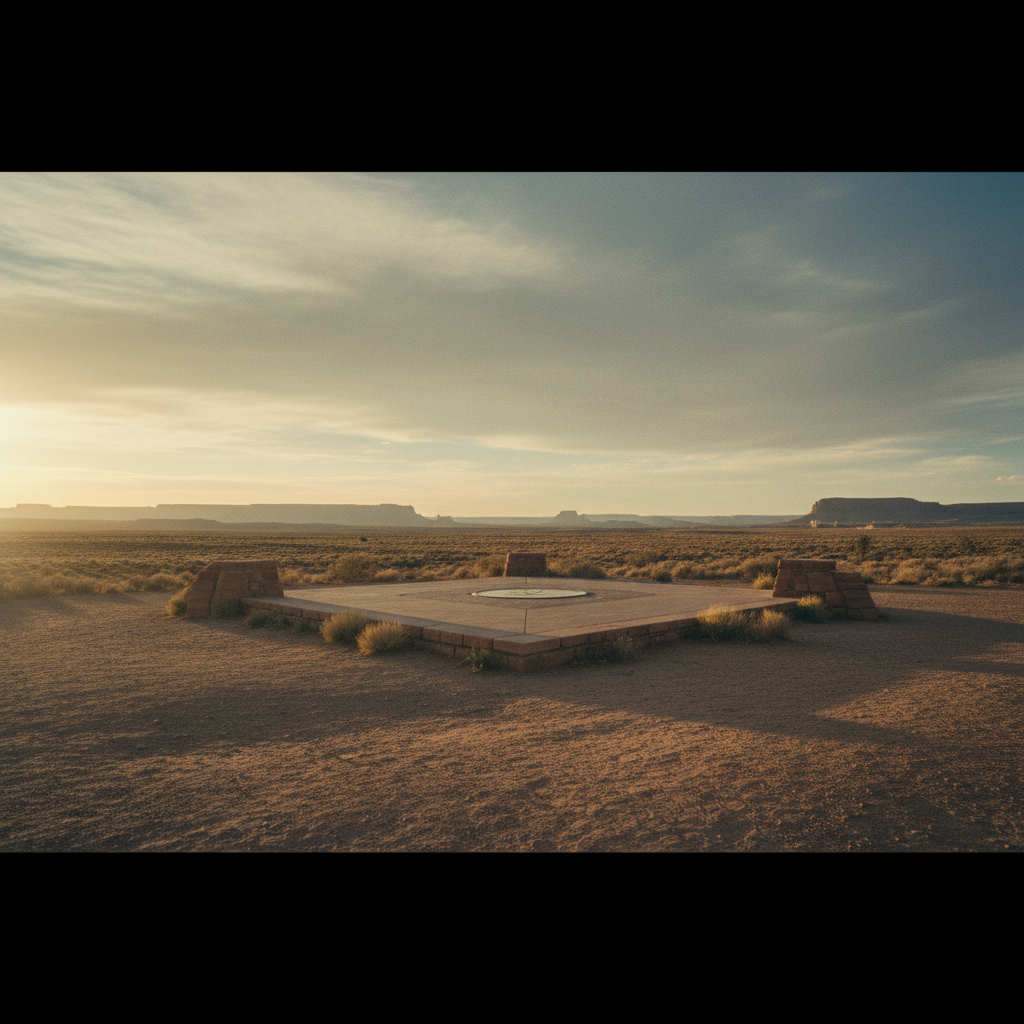
Stand at the only quadripoint in the United States at the Four Corners Monument, where the borders of Arizona, Utah, Colorado, and New Mexico meet on tribal land.
Four Corners Monument Navajo Tribal Park marks the only geographic quadripoint in the United States, where the borders of Arizona, Utah, Colorado, and New Mexico converge at a single point. Rather than a grand natural feature, the landmark is a carefully engineered plaza of granite and brass set against the open sky of the Colorado Plateau. At its center lies a bronze disk, placed during a 1992 cadastral survey, which is embedded in a larger granite slab. Radiating outward from this central marker are the official boundary lines of each state, along with their respective bronze state seals. Circling the disk is an inscription that reads differently depending on where a visitor stands: starting in Colorado, it reads "Here meet in freedom under God four states," while starting in Utah, it reads "Four states here meet in freedom under God". Flanking the plaza are the raised flags of all four states, alongside the flags of the Navajo Nation and the Ute Mountain Ute Tribe, both of whose sovereign lands meet at this exact junction.
The monument represents a complex legacy of human cartography and political demarcation dating back to the American Civil War. Between 1868 and 1875, surveyors E.N. Darling and Chandler Robbins mapped the 37th parallel north and the 109th meridian west using chains and astronomical observations. Although modern GPS technology reveals that these early surveys placed the intersection slightly off from the exact mathematical coordinates, the Supreme Court ruled that these historically established markers remain the legal, binding boundaries. The physical marker evolved from a simple stone post in 1899 to a basic cement pad in 1912. In 1931, the Navajo Tribal Council installed the first brass disk to withstand the harsh desert elements. The current layout is the result of a major joint tribal renovation completed in 2010, which transformed the once-dilapidated site into a durable, multi-tiered granite plaza with improved accessibility and permanent structures for local vendors.
Today, the monument is managed entirely by the Navajo Nation Parks and Recreation Department, serving as both a geographic curiosity and an active cultural marketplace. Surrounding the perimeter of the granite plaza are open-air vendor stalls where Navajo and Ute Mountain Ute artisans sell authentic, handmade crafts directly to travelers, including intricate silver and turquoise jewelry, hand-woven rugs, and traditional pottery. Nearby food stands serve freshly prepared Navajo tacos and traditional fry bread, a food that originated from mid-19th-century tribal displacement and has since become a staple of modern gatherings. Because the monument is located in an exceptionally remote high-desert environment, services are highly limited: there is no running water or electricity at the site, and the nearest fuel station is six miles away in Teec Nos Pos, Arizona. Entry to the tribal park requires an eight-dollar fee per person, which is payable by credit card only, and national park passes are not accepted.
Arrive with credit cards for the tribal park entry fee, but bring cash for the individual craft and food vendors, as cellular service is highly unreliable for digital payments in this remote area. To beat the intense high-desert heat and the midday tour buses, aim to visit during the early morning hours.