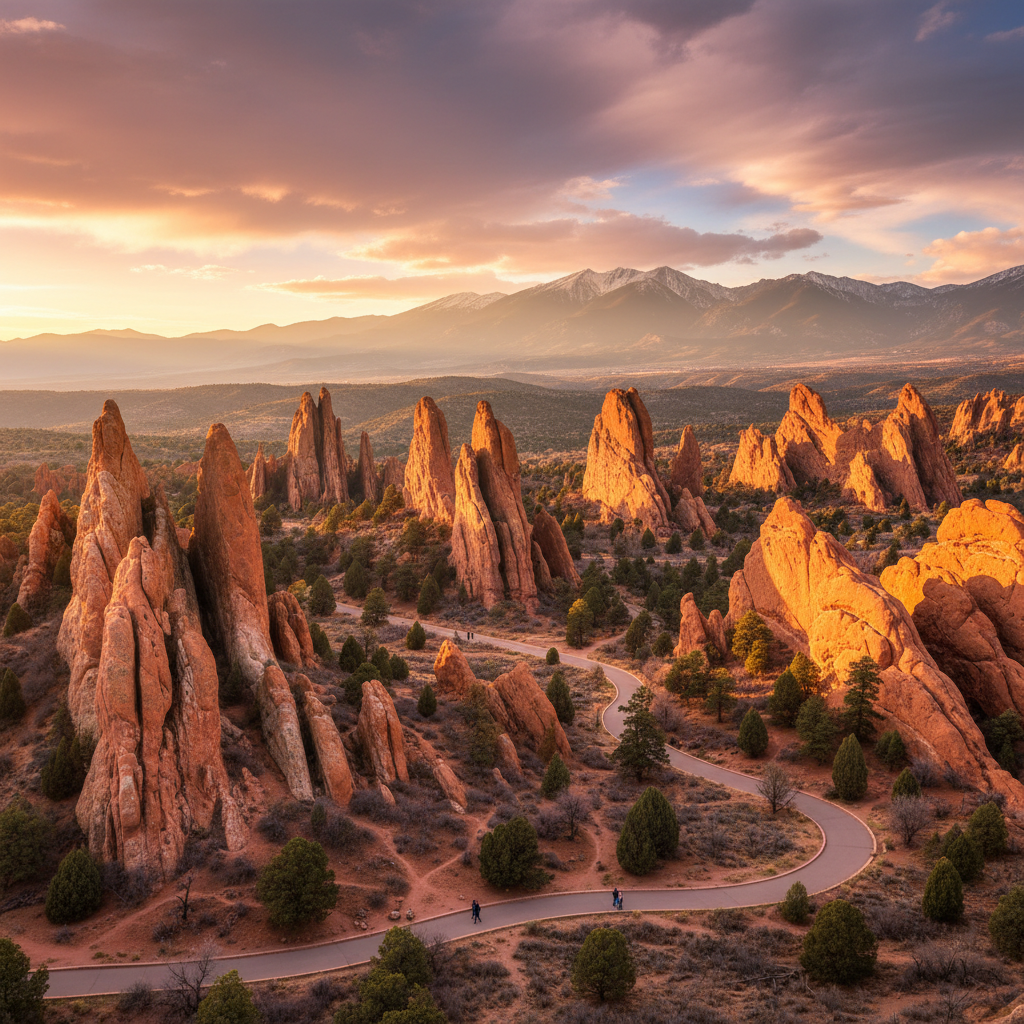
Free public park of 300-million-year-old red sandstone fins framed by Pikes Peak.
Garden of the Gods stands as a massive, public geological park on the western edge of Colorado Springs, where towering fins of red sandstone rise up to 300 feet against the backdrop of Pikes Peak. The park spans over 1,300 acres at a unique ecological crossroads where the Great Plains grasslands meet the piñon-juniper woodlands of the American Southwest and the montane forests of the Rocky Mountains. These vertical rock formations are primarily composed of Fountain Formation sandstone, conglomerates, and limestone. Deposited horizontally about 300 million years ago as ancient mountain ranges eroded, these sediment layers were later tilted nearly 90 degrees during the Laramide Orogeny, the tectonic upheaval that pushed up the modern Rocky Mountains. Over millennia, wind, rain, and freezing water sculpted the soft rock into iconic shapes, including North Gateway Rock, the Three Graces, the Kissing Camels, and the precariously balanced Balanced Rock at the south end of the park.
The human history of this red rock landscape stretches back thousands of years. The Nuu-ciu (Ute) people, specifically the Tabeguache and Mouache bands, are the original inhabitants of this region and spent winters sheltered among the sandstone formations, utilizing the local yucca, three-leaf sumac, and piñon pine. They held the nearby peak of tava (Sun Mountain, now known as Pikes Peak) sacred, and their oral traditions describe this area as a place of creation. Historically, the Garden served as a neutral ground where various nomadic tribes, including the Apache, Arapaho, Cheyenne, Comanche, Kiowa, and Pawnee, could gather, trade, and camp in peace, laying down their weapons upon entering. The modern name of the park originated in August 1859, when surveyors Melancthon Beach and Rufus Cable explored the area. Beach remarked that it would make a capital place for a beer garden, to which Cable poetically replied: "Beer garden! Why, it is a fit place for the gods to assemble. We will call it the Garden of the Gods."
Preservation of this landscape began in 1879 when Charles Elliott Perkins, president of the Burlington Railroad, purchased 240 acres of the central garden at the urging of his friend, Colorado Springs founder General William Jackson Palmer. Perkins eventually expanded his holdings to 480 acres, choosing to leave the land in its natural state for the public to enjoy. Following his death, his six children honored his wishes by donating the property to the City of Colorado Springs on Christmas Day in 1909, with the strict legal stipulation that the park remain forever free and open to the public. Beyond its cultural and geological significance, the park is also a paleontological site. In 1878, Colorado College student James Hutchinson Kerr discovered a fossil skull here that was eventually identified in 2006 as a completely unique genus and species of herbivorous dinosaur: *Theiophytalia kerri*, meaning "belonging to the Garden of the Gods."
Visitors can explore the park through a network of trails that cater to different levels of activity. The Perkins Central Garden Trail is a paved, 1.5-mile wheelchair-accessible loop that winds through the base of the highest rock formations, offering close-up views of Gateway Rock and the Cathedral Spires. For a more rugged experience, the Siamese Twins Trail is a dirt path that leads to a natural sandstone window, which perfectly frames a view of Pikes Peak in the distance. Rock climbing is permitted on the sheer sandstone faces, though climbers must register for a free permit at the visitor center and use proper safety equipment. The changing angle of the sun throughout the day continually alters the appearance of the rocks, shifting their hues from pale pinks in the early morning to deep, fiery reds during the golden hour before sunset.
Arrive just after sunrise to catch the morning light hitting the east-facing rocks and to secure parking in the main lot before the crowds arrive. For a quieter experience, park at the smaller Siamese Twins lot on the south side of the park, which provides direct access to the Siamese Twins Trail and its natural sandstone window framing Pikes Peak.