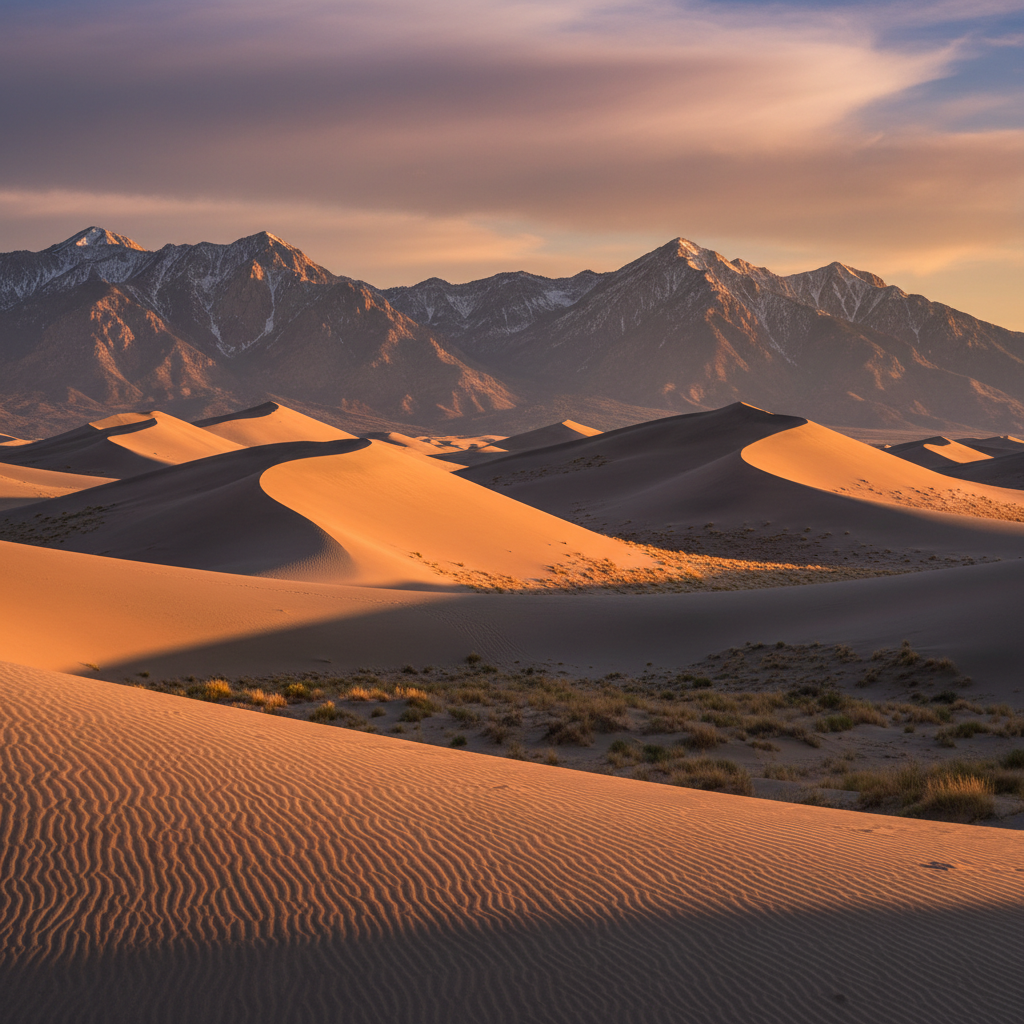
741-foot dunes against the Sangre de Cristo peaks. Sand sledding in the high Colorado desert.
Great Sand Dunes National Park and Preserve protects a vast, shifting sea of sand covering 30 square miles at the eastern edge of Colorado's high-altitude San Luis Valley. Long before President Herbert Hoover designated the area as a national monument in 1932, and decades before Congress elevated its status to a national park and preserve in 2004, Indigenous peoples held deep ties to this surreal landscape. The Ute people, who seasonally trained their horses on the steep slopes to build muscle for bison hunts, called the dunes sowapophe-uvehe, meaning 'the land that moves back and forth'. The Jicarilla Apache named them ei-anyedi, translating to 'it goes up and down'. Today, this massive dunefield rests at an elevation of 8,200 feet, creating an improbable coastal-looking desert framed by the jagged, snow-dusted peaks of the Sangre de Cristo Mountains.
The existence of these massive dunes is the result of a closed geological basin where wind and water work in a continuous, slow-motion cycle. Over hundreds of thousands of years, sediment from the eroding San Juan and Sangre de Cristo ranges washed into ancient Lake Alamosa. When the lake dried up due to prehistoric climate shifts, it left behind vast deposits of sand. Prevailing southwesterly winds swept these grains across the valley floor, only to be trapped against the formidable wall of the Sangre de Cristos. Opposing storm winds blowing from the northeast through Medano, Music, and Mosca passes push the sand back toward the valley, forcing it to pile vertically. This meteorological tug-of-war has created the tallest dunes in North America. Star Dune and Hidden Dune stand as the undisputed giants of the field, both rising approximately 741 feet from their bases. Medano Creek and Sand Creek complete the loop by capturing sand from the edges of the dunefield and washing it back to the valley floor, where the wind begins the process anew.
Exploring the dunefield requires charting your own course, as the persistent winds quickly erase any footprints or established trails. Hiking here is a demanding, high-altitude workout, where every step up the steep, yielding ridges of High Dune or Star Dune feels like taking two steps forward and one step back. Yet, the reward is an immersive sensory experience: the whisper of moving sand grains, the sight of dark magnetite streaks left by lightning strikes, and the sudden appearance of the Great Sand Dunes tiger beetle, an endemic insect found nowhere else on Earth. The sand is also home to the resilient Ord's kangaroo rat, a mammal capable of surviving its entire life on the dunefield without ever drinking water. In late spring, Medano Creek swells with snowmelt, creating a wide, shallow, pulsing stream where visitors can cool off and experience surge flow, a phenomenon where waves form and break over the sand. As daylight fades, the low sun carves the ridges into sharp, golden crests and deep shadows. After dark, the park, certified as an International Dark Sky Park in 2019, offers an exceptionally clear window into the cosmos, with the Milky Way arching brilliantly over the quiet, cold sands.
Visit in late May or early June to experience the peak flow of Medano Creek, which creates a wide, pulsing stream at the base of the dunes. If visiting during the summer, plan your hikes for the early morning or late evening, as the sand surface temperature can climb to 150°F by midday.