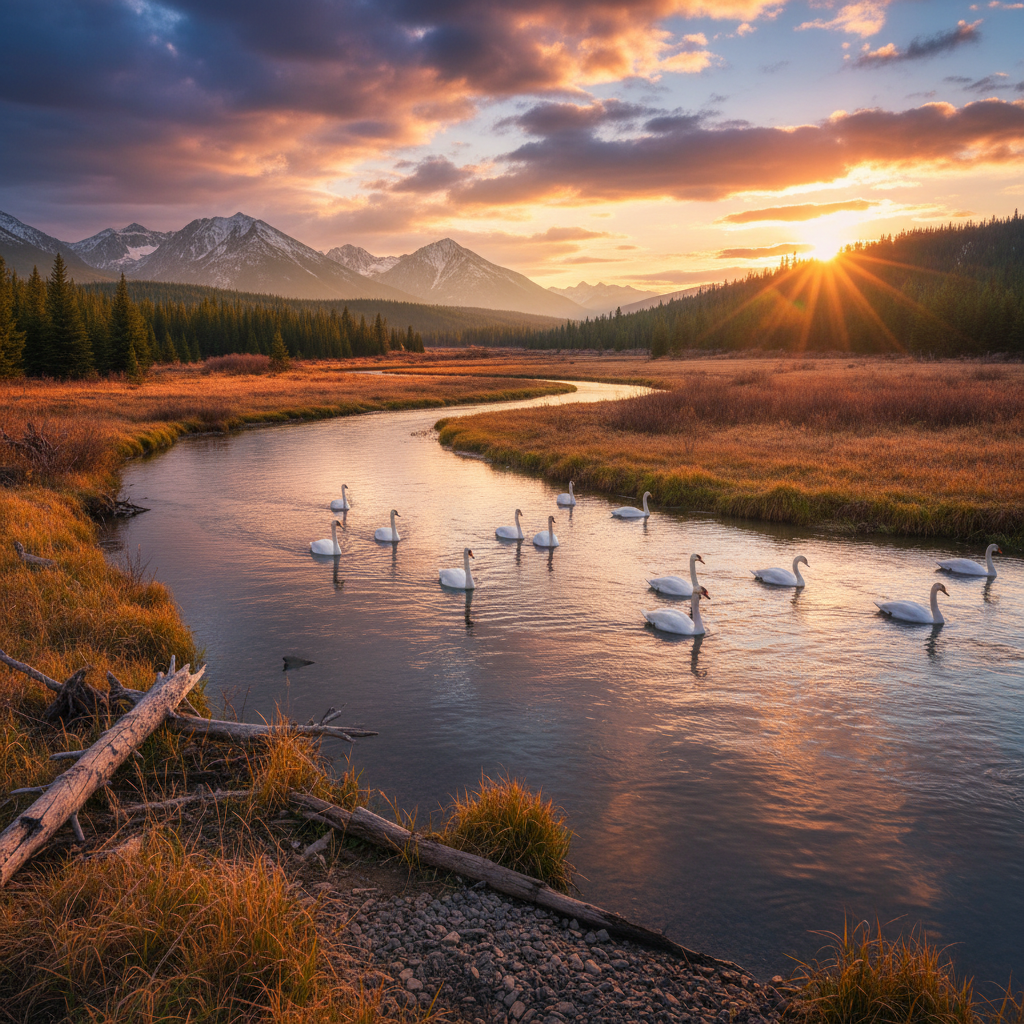
Once the private Railroad Ranch of the Harriman family, this vast caldera refuge is now a sanctuary where trumpeter swans winter and elk bugle along the Henry's Fork.
Harriman State Park of Idaho, historically known as the Railroad Ranch, spans 11,000 acres of meadows, lodgepole pine forests, and wetlands within the ancient Henry's Fork Caldera. This high-altitude refuge, situated at an elevation of 6,120 feet, serves as a critical sanctuary for the Greater Yellowstone Ecosystem's most famous wildlife. The slow, glassy waters of the Henry's Fork of the Snake River loop through the park for eight miles, creating a world-class fly-fishing destination known simply to anglers as "the Ranch." Rather than the jagged, dramatic peaks found further south in the Teton Range, Harriman presents a vast, horizontal landscape of quiet power. Here, the dominant sounds are the bugle of bull elk in autumn, the whistle of sandhill cranes, and the calls of trumpeter swans. In fact, two-thirds of the trumpeter swans wintering in the contiguous United States find safe harbor on these spring-fed waters.
The preservation of this landscape is deeply tied to its history as a private retreat. In 1902, investors from the Oregon Short Line Railroad purchased the land, and by 1908, Union Pacific Railroad chairman E.H. Harriman acquired it. For seventy-five years, the Harriman and Guggenheim families managed the property as a working cattle ranch and private wildlife refuge. Unlike the opulent estates of the Gilded Age, the family preferred rustic simplicity, building log-and-stone structures that still stand today. In 1977, Roland and W. Averell Harriman deeded the entire ranch to the State of Idaho for free, but with a strict caveat: the state had to establish a professional park management service to protect the land from development. This generous gift effectively catalyzed the creation of the Idaho Department of Parks and Recreation. Today, twenty-seven of the original ranch buildings are preserved, including the Dining Cottage, where guests once ate on china bearing the Union Pacific emblem, and the Honeymoon Hotel, which now serves as a junior ranger headquarters.
Exploring the park requires adopting a slower, more deliberate pace. Over twenty-two miles of trails wind along the riverbanks and through the lodgepole pines, open to hikers, mountain bikers, and horseback riders. Overnight visitors can skip traditional tent camping and instead book historic ranch quarters like the Cattle Foreman's House, the Ranch Manager's House, or one of the Mongolian-style yurts near Silver Lake. When winter blankets the caldera in deep snow, Harriman transforms into a premier Nordic skiing destination. The park grooms twenty-four miles of trails for classic cross-country skiing, skate skiing, and fat biking, while the historic Jones House serves as a cozy weekend warming hut overlooking the ice-rimmed river. Gliding past a flock of wintering swans, with only the squeak of cold snow underfoot, captures the timeless, preserved spirit of the old Railroad Ranch.
While the park rents snowshoes at the visitor center, you must bring your own cross-country skis or fat bike, or rent them from local shops in Ashton or Island Park. For a cozy winter break, ski out to the historic Jones House, which serves as a heated warming hut on weekends.