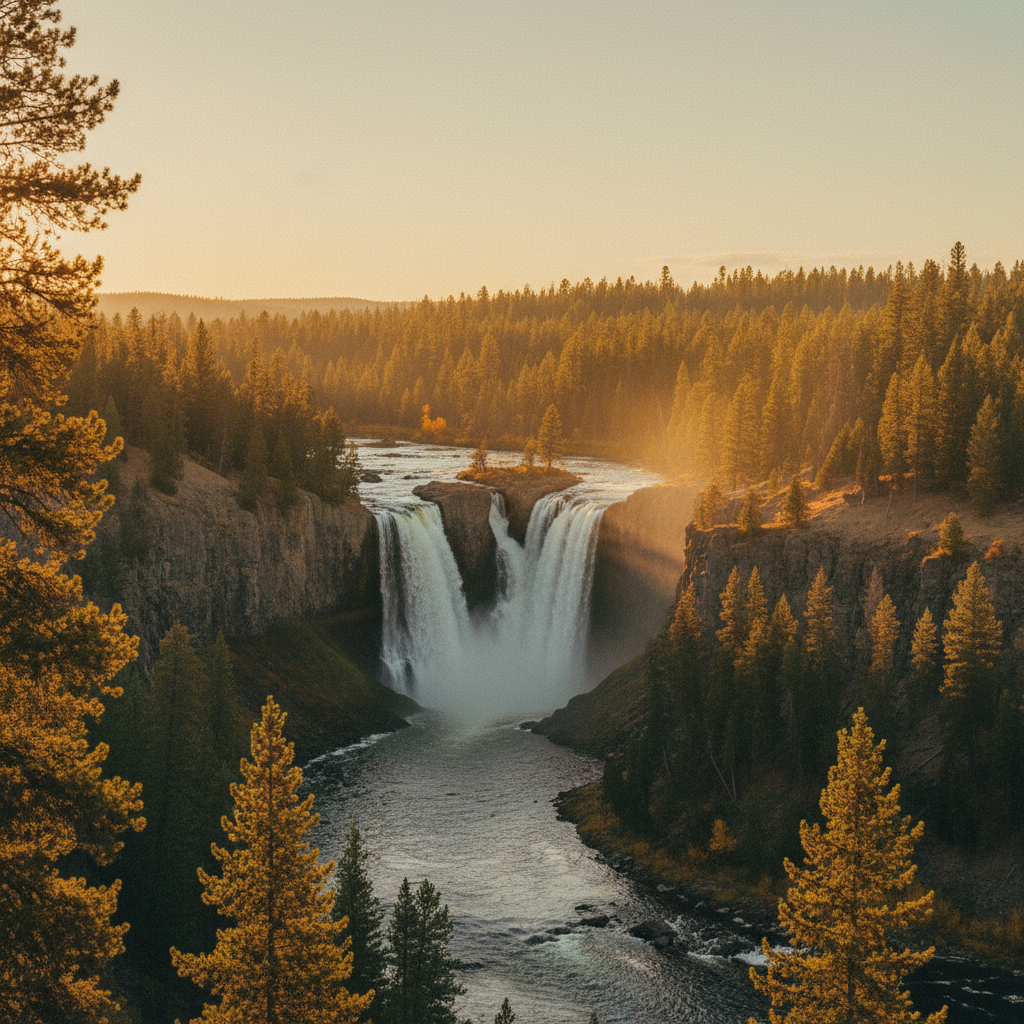
Upper and Lower Mesa Falls cascade over ancient volcanic rock along the Henry's Fork of the Snake River, offering one of the last major undammed waterfall experiences in the American West.
Mesa Falls represents the raw, unharnessed power of the Henry's Fork of the Snake River as it plunges over the remnants of an ancient volcanic super-eruption. Unlike almost every other major waterfall in Idaho, these cascades remain completely undammed and undiverted, flowing exactly as they have for millennia. Upper Mesa Falls is the dramatic centerpiece, a thunderous curtain of water measuring 114 feet high and over 200 feet wide. The river here drops over a massive ledge of Mesa Falls Tuff, a thick layer of compressed volcanic ash ejected 1.3 million years ago during the creation of the Henry's Fork Caldera. A series of universally accessible wooden boardwalks and viewing platforms allows visitors to step directly over the canyon rim, where the deep, low-frequency rumble of the water vibrates through the timber underfoot and coats the air in a cool, perpetual mist.
The historic Big Falls Inn stands just steps from the brink of the upper falls, now serving as the Mesa Falls Visitor Center. Built between 1907 and 1915 by the Snake River Electric Light and Power Company, this rustic, two-story peeled-log lodge was originally intended to capitalize on tourist traffic heading toward Yellowstone National Park. Over the decades, the building evolved into a lively community hub, hosting local ranchers, farmers, and travelers as a hotel, cafe, dance hall, and way station along the old Yellowstone Highway. After being acquired by the U.S. Forest Service in 1986, the historic structure underwent a meticulous restoration in partnership with the Idaho Department of Parks and Recreation, reopening to the public in 2000. Inside, the original log walls frame interpretive exhibits detailing the complex volcanic history of the Island Park caldera and the cultural legacy of the region.
A quieter encounter awaits along the Mesa Falls Nature Trail, which meanders for one mile through a peaceful forest of lodgepole pines and Douglas firs. This quiet path follows the canyon rim downstream to reveal Lower Mesa Falls, where the Henry's Fork drops another 65 feet. Here, the river is squeezed into a narrow gorge, carving through dark, vertical basalt columns. While the upper falls deliver raw scale, the lower falls offer a more secluded, atmospheric view, particularly from the overlook at Grandview Campground, a site constructed by the Civilian Conservation Corps in the 1930s. For centuries before these trails and lodges were built, bands of the Shoshone-Bannock and Eastern Shoshone tribes migrated through this canyon, fishing the fertile waters of the Henry's Fork and gathering obsidian from the surrounding volcanic plateau.
To view Lower Mesa Falls without the hike, drive a mile south of the main visitor center to the Grandview Overlook, which offers an unobstructed vantage point of the 65-foot drop framed by dark basalt columns.