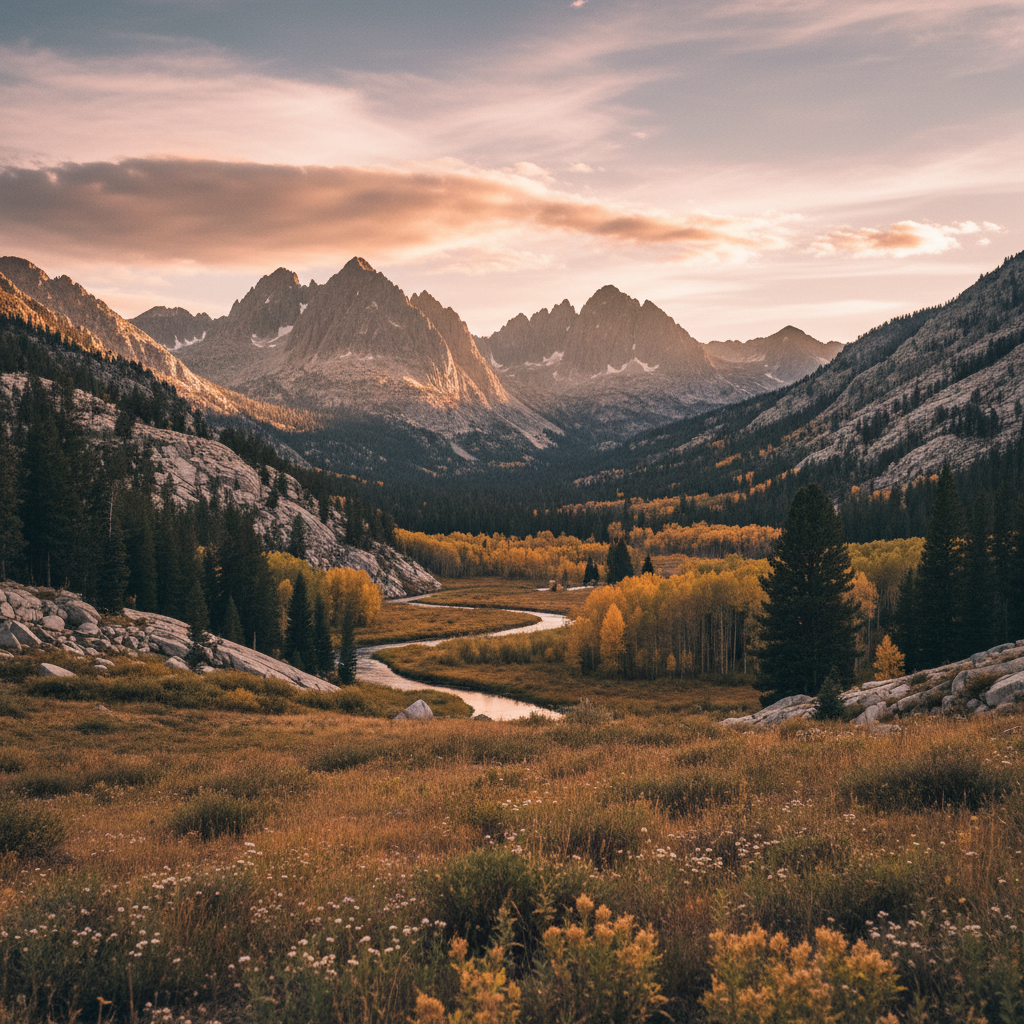
Jagged granite spires claw at the sky above a chain of sapphire lakes, a raw alpine sanctuary bordering Yosemite's eastern ramparts.
The Hoover Wilderness protects a starkly vertical landscape along the eastern boundary of Yosemite National Park, where the Sierra Nevada exchanges its familiar smooth granite domes for a crown of jagged daggers. Originally established as a Primitive Area in 1931 and later designated as a Wild Area in 1957, this 128,000-acre reserve became one of the charter members of the National Wilderness Preservation System under the 1964 Wilderness Act. Today, its management is shared between the Inyo National Forest, which oversees the southern 29,000 acres, and the Humboldt-Toiyabe National Forest, which manages the remaining 99,000 acres extending north toward Sonora Pass. What defines this high-altitude sanctuary is the dramatic contrast of color and form: dark, ancient metamorphic ridges rising abruptly from pale granite basins, their hollows cradling lakes of an intense, deep-water blue. The air at ten thousand feet is thin and cold, carrying the clean, resinous scent of whitebark pine and the dry smell of sun-warmed stone. Unlike the crowded corridors of the neighboring national park, a deep stillness hangs over these canyons, broken only by the rush of snowmelt streams or the sharp whistle of a marmot echoing off the scree.
The geology of this wilderness is a complex, ancient tapestry. While much of the Sierra Nevada is characterized by massive gray granite, this northern wedge preserves remnants of older, dark metamorphic rock that once topped the entire range. The highest point in the wilderness is Mount Conness, rising to 12,569 feet, which along with North Peak and the formidable spires of the Sawtooth Ridge, presents a jagged horizon carved by Pleistocene glaciers. These massive ice sheets scoured deep, U-shaped canyons like Lundy, Green Creek, and Robinson Creek, leaving behind more than two dozen alpine tarns. Ecologically, this is a harsh but resilient environment where hardy whitebark pines cling to wind-whipped ridges, while canyon bottoms support lush meadows. For centuries, the Kutzadika'a band of the Mono Lake Paiute traveled these high passes, trading with groups on the western slope, leaving a legacy of stewardship that still defines this protected wilderness.
Exploring the Hoover Wilderness is an exercise in alpine immersion, accessible via high-altitude trailheads at Virginia Lakes, Lundy Canyon, and Saddlebag Lake. A classic day journey is the loop through the Twenty Lakes Basin, accessed by a trail around Saddlebag Lake at over ten thousand feet. Here, the path winds through a barren, beautiful basin where wildflower meadows of lupine and paintbrush explode in a brief, brilliant summer display. By September, the summer crowds thin to almost nothing, and the aspens in Lundy Canyon ignite in a brilliant display of gold, a final warmth before the early Sierra winter reclaims the high peaks. Because of the fragile nature of this high-altitude ecosystem, wood fires are strictly prohibited in popular zones like the Twenty Lakes Basin, the Virginia and Green Creek drainages, and around Barney and Peeler Lakes. It is a place for slow, deliberate foot travel, where the reward is the quiet satisfaction of navigating a landscape that remains wild, rugged, and beautifully indifferent.
To beat the afternoon winds and thunderstorms, take the morning water taxi across Saddlebag Lake to access the Twenty Lakes Basin trailhead. Hiking the loop counter-clockwise provides the most dramatic, unfolding views of the Sawtooth Ridge. Be sure to carry a bear canister, as active black bears frequent these high-altitude lake basins.