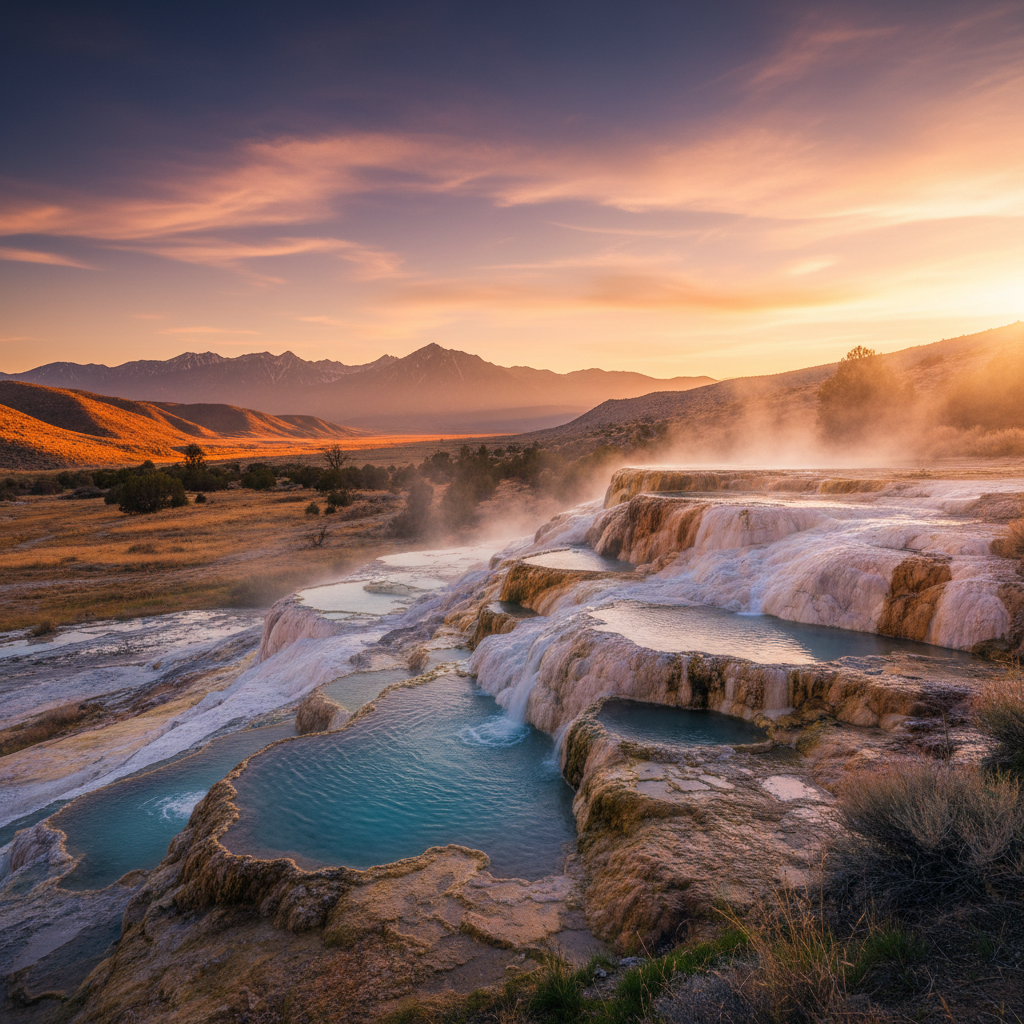
Free geothermal pools on mineral terraces with Sierra Nevada views near Bridgeport.
Travertine Hot Springs sits on a high-desert hillside just south of Bridgeport, California, where mineral-rich geothermal waters rise from deep fissures to form a series of terraced limestone pools. Managed by the Bureau of Land Management, this natural geothermal site overlooks the dramatic, often snow-capped peaks of the Sawtooth Ridge and the wider Sierra Nevada crest. The springs are named for the massive travertine terraces that have formed here over millennia: ridges of calcium carbonate that precipitate out of the superheated water as it meets the cool mountain air. The water emerges from the underground source at a scalding 180 degrees Fahrenheit, cooling as it trickles down natural rock channels into several primitive, rock-and-mud soaking pools that range from 90 to 105 degrees Fahrenheit.
The history of this geothermal site is deeply intertwined with both indigenous heritage and early California development. For thousands of years, the Northern Paiute people, who still reside on the nearby Bridgeport Indian Reservation, have held this land as sacred. According to tribal history, the creator figure Isha established these warm waters to provide comfort, healing, and cleansing for the people. In the late 19th century, the site attracted commercial interest: in the mid-1890s, miners quarried approximately 60 tons of the colorful, mineral-banded travertine rock from these terraces to construct the elegant interior facings of San Francisco City Hall. Today, the remnants of this quarrying history blend with the natural formations, and the site is protected as a critical area of environmental concern to preserve its fragile geology.
Soaking at the springs is a rustic, clothing-optional experience that requires a slow approach and a commitment to preservation. Visitors reach the pools via Jack Sawyer Road, a dirt road off Highway 395 that can be heavily washboarded and rough, ending at a parking area equipped with a vault toilet. From there, a short trail leads past a decommissioned concrete tub to the main natural pools, where mineral mud lines the bottoms and algae creates vibrant ribbons of orange, green, and yellow along the rock walls. Because of the fragile nature of the travertine terraces and the high volume of visitors, the Bureau of Land Management strictly prohibits overnight camping directly at the springs, though dispersed camping is permitted on surrounding public lands. Soaking at dawn or dusk offers the quietest experience, when the steam rises thick into the cool air and the peaks of the Sierra Nevada glow in the changing light.
Drive slowly down the washboarded Jack Sawyer Road to avoid bottoming out. Since overnight camping is prohibited directly at the springs, look for dispersed BLM campsites along the access road, and always pack out all trash to respect this sacred Northern Paiute site.