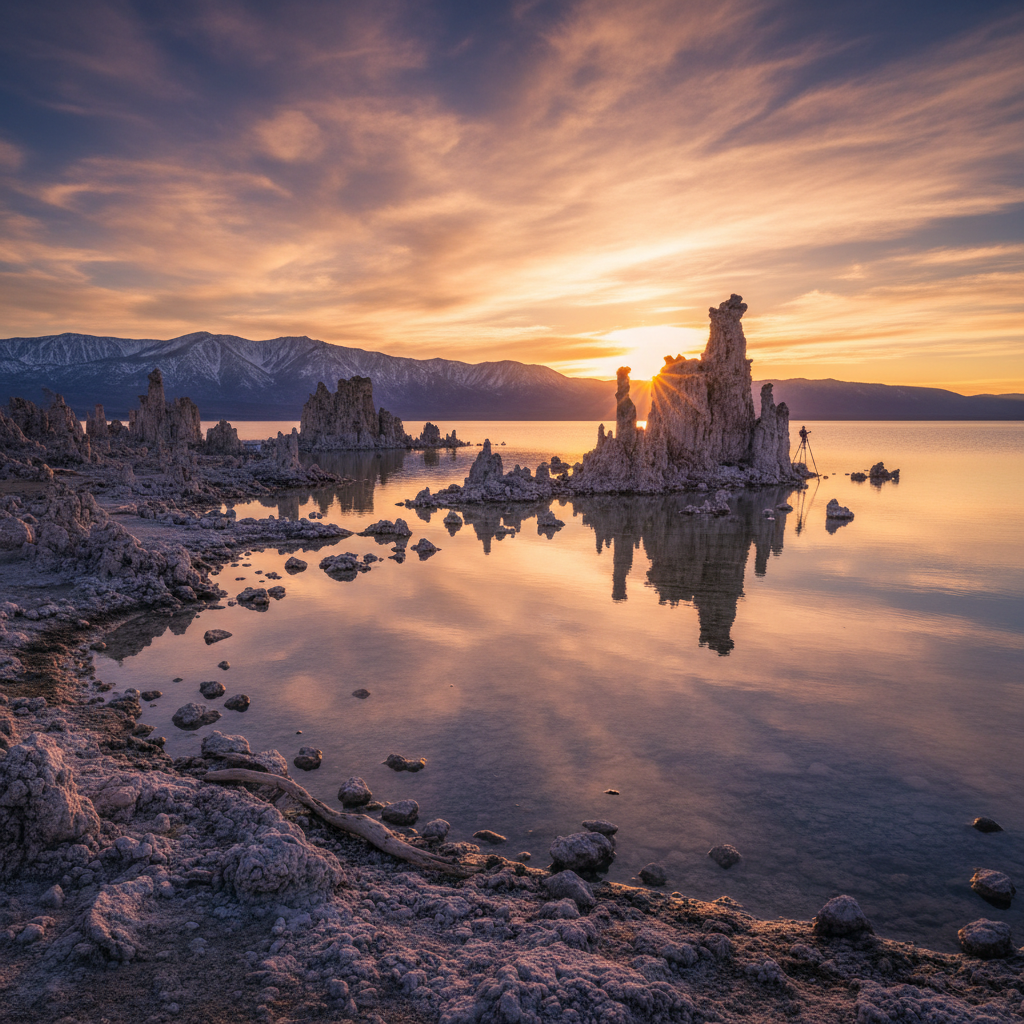
An ancient, highly alkaline soda lake defined by ghostly tufa towers, trillions of brine shrimp, and a rich conservation history.
Mono Lake is an ancient saline soda lake that has occupied its closed basin at the western edge of the Great Basin for at least 760,000 years. Lacking any natural outlet, the lake collects snowmelt and fresh water from Sierra Nevada streams like Rush Creek and Lee Vining Creek, but loses water only through evaporation. This process leaves behind a concentrated mineral soup with a pH of roughly 10, making the water more than twice as salty as the ocean and eighty times more alkaline. Underneath the heavy, soapy water, calcium-rich freshwater springs react with the carbonate-rich lake water to precipitate limestone. This chemical reaction builds the famous tufa towers, which were slowly exposed to the air after 1941, when the Los Angeles Department of Water and Power began diverting the lake's tributary streams into the Los Angeles Aqueduct.
The extreme water chemistry prevents fish from surviving, but it fuels a remarkably productive food web. Trillions of endemic brine shrimp (Artemia monica) and billions of alkali flies (Ephydra hians) thrive in the saline waters, providing a feast for over a million migratory birds along the Pacific Flyway. Eared grebes, Wilson's phalaropes, red-necked phalaropes, and California gulls arrive in staggering numbers, with the gulls nesting on the volcanic soils of Negit Island and Paoha Island. For thousands of years, the lake was nurtured by its original human stewards, the Kootzaduka'a Paiute people. Their name, which translates to 'fly eaters,' reflects their traditional seasonal harvest of the highly nutritious alkali fly pupae, or kutsavi, which they dried and stored as a staple food.
The modern history of the lake is defined by one of the most significant environmental battles in American history. As water diversions caused the lake level to drop by over forty vertical feet, exposing dusty alkali flats and creating a land bridge to the gull nesting grounds on Negit Island, a group of young researchers founded the Mono Lake Committee in 1978. Led by David Gaines, the grassroots campaign utilized the Public Trust Doctrine to argue that the state must protect public resources. This resulted in a historic 1994 decision by the California State Water Resources Control Board, which set a target management level of 6,392 feet above sea level to restore and protect the lake's delicate ecosystem. Today, visitors can walk the interpretive trails at the South Tufa Area or visit the Mono Basin National Forest Scenic Area Visitor Center in Lee Vining to witness a landscape in the slow, deliberate process of recovery.
Visit the South Tufa Area at sunrise for the best light on the towers, and bring goggles if you plan to swim: the heavy, soapy water is incredibly buoyant but stings the eyes.