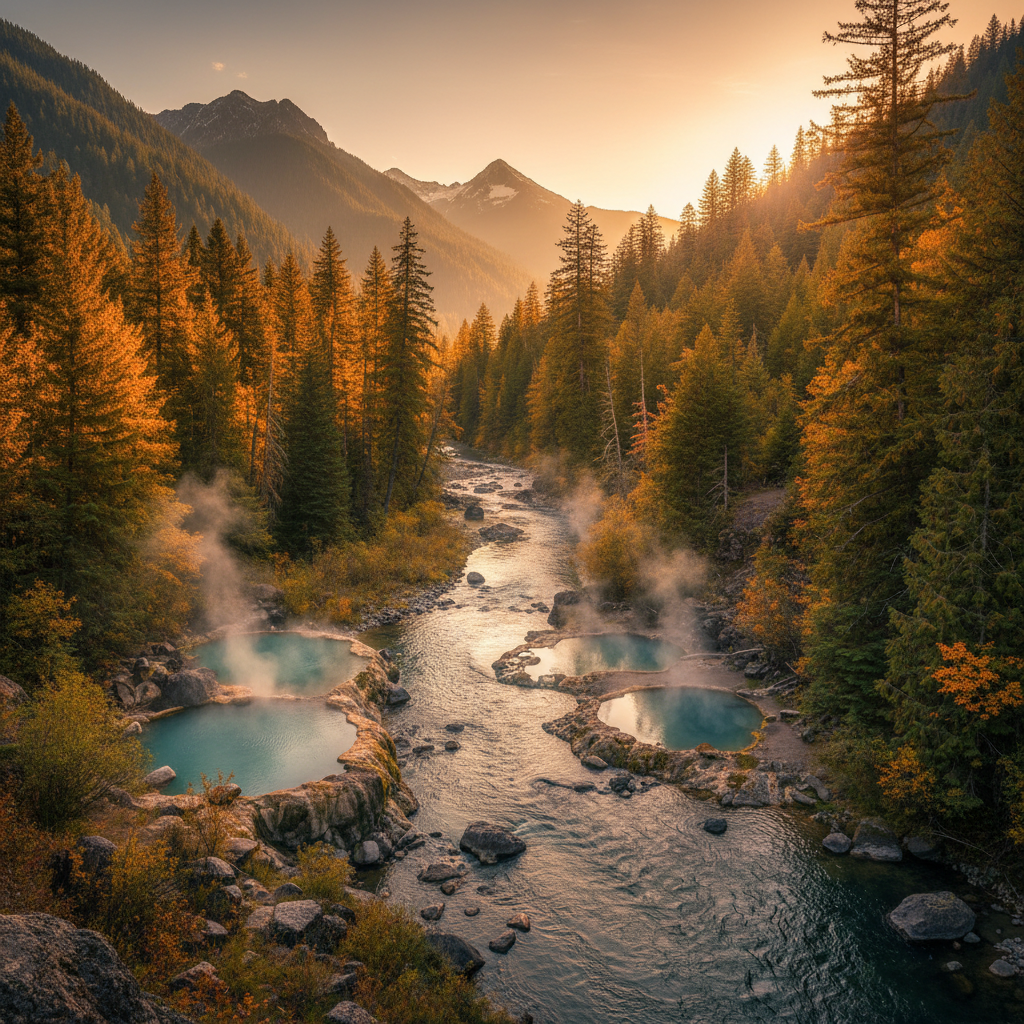
Riverside pools near Oregon's Willamette Pass, where hot water from the banks mixes with the cold currents of Salt Creek.
McCredie Hot Springs, located in the Willamette National Forest along the banks of Salt Creek, offers a raw, geothermal experience with a surprisingly storied past. The springs flow from both the north and south banks of the creek, with the north side situated just a short walk from a paved parking lot off Oregon Route 58, about eleven miles east of Oakridge. Here, superheated water emerges from the earth at temperatures reaching up to 160 degrees Fahrenheit, requiring visitors to carefully channel the flow using river rocks, sand, and silt. By constructing these makeshift rock walls, soakers can mix the scalding mineral water with the icy, snowmelt-fed currents of Salt Creek to create custom pools. The setting is deeply rustic, framed by old-growth Douglas firs and Western hemlocks, where the constant rush of the creek provides a steady soundtrack to a clothing-optional soaking culture.
While the site appears wild and undeveloped today, McCredie Hot Springs has a rich and colorful history of human development that dates back to the late nineteenth century. In 1878, a trapper named Frank Warner discovered the thermal waters and built a cabin nearby, living there until he was evicted by the newly established United States Forest Service in the early 1900s. In 1911, John Hardin claimed the land, ostensibly for its salt deposits, but with the actual intent of building a resort. He leased the property and opened the Winino Springs hotel in 1914. Two years later, Judge William Wallace McCredie, co-owner of the Portland Beavers baseball team, purchased a share of the resort and transformed it into a spring training camp for his players. During its heyday in the 1930s, the resort, renamed McCredie Springs, was a bustling destination featuring a hotel, cabins, a post office, and even a bordello, with five daily passenger trains on the Southern Pacific Railroad's Cascade Line stopping to deliver visitors.
The resort's era of bustling activity came to an abrupt end in the mid-twentieth century due to a series of natural and accidental disasters. In 1958, the historic hotel burned to the ground, and a catastrophic flood in 1964 destroyed the bridge across Salt Creek that provided access to the lodge. Following these events, the Forest Service reclaimed the lease, dismantled the remaining structures, and burned what was left, allowing the forest to slowly reclaim the land. Today, remnants of this past are still visible, particularly on the more secluded south bank, where warm water at around 125 degrees Fahrenheit emerges from the base of a concrete-and-rock wall that once belonged to the old resort. Soakers who wade across the creek, or access the south bank via a separate route, will find larger, deeper pools that typically hover at a comfortable 100 to 105 degrees Fahrenheit. Because the pools are subject to seasonal flooding and high runoff from May to June, the shape and temperature of the basins change constantly, making each visit a unique interaction with the shifting forces of Salt Creek.
Visit on a weekday morning or during the cooler months for more solitude, and bring sturdy water shoes to navigate the rocky creek bed. While vault toilets are available at the day-use parking area, there are no trash cans at the pools, so pack out everything you bring in.