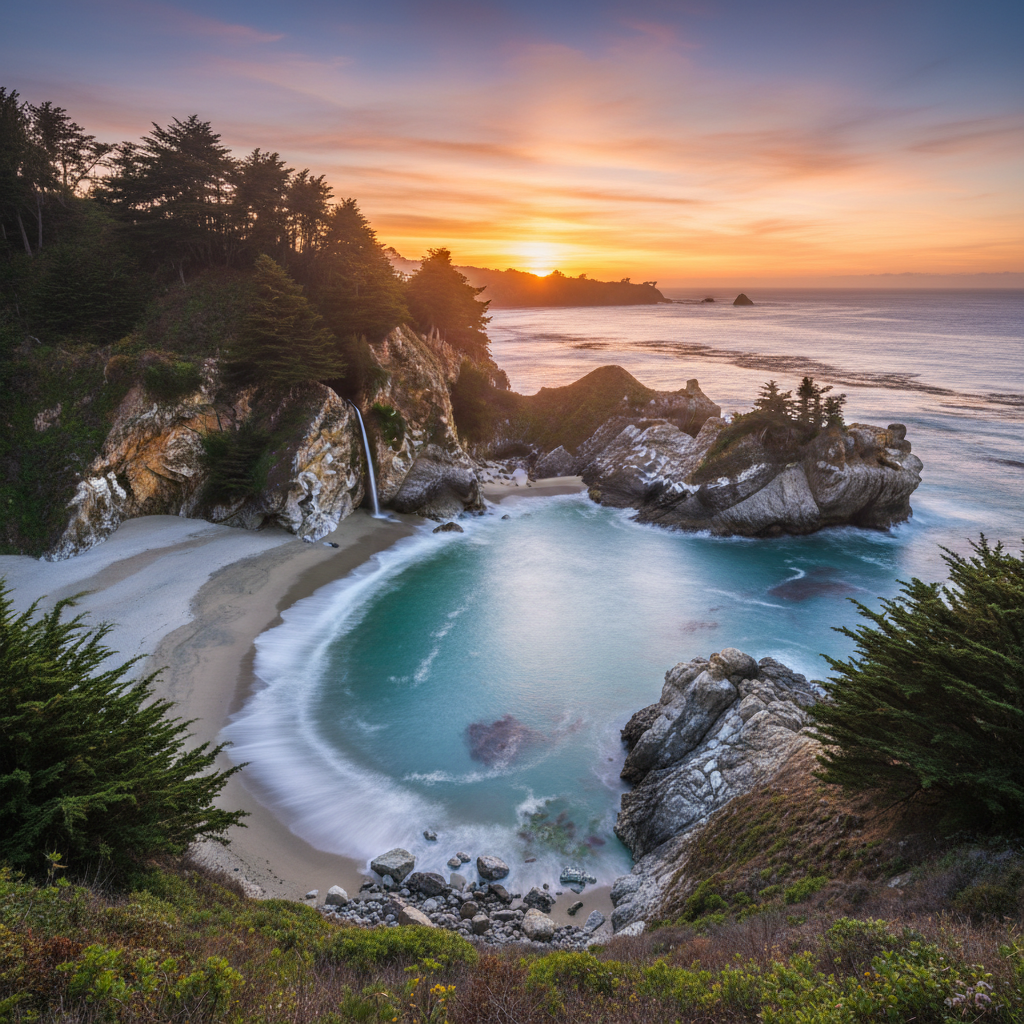
An 80-foot freshwater tidefall plunging from granite cliffs into a pristine Pacific cove.
McWay Falls is the visual signature of the Big Sur coast, an 80-foot ribbon of fresh water that plunges down a granite cliff directly into a pristine cove. Located within Julia Pfeiffer Burns State Park, this rare tidefall is fed year-round by McWay Creek. Historically, the water tumbled straight into the swells of the Pacific Ocean. However, a massive landslide in 1983, combined with highway reconstruction debris, forever altered the geography of the cove, creating a sandy beach that now catches the waterfall at low tide. During high tide, the ocean still rushes in to meet the cascade, churning the turquoise water into a froth of white foam. The sand itself carries a subtle, purple hue, a geological quirk caused by the erosion of manganese garnet washed down from the Santa Lucia Mountains.
The human history of this dramatic cliffside runs deep, beginning with the Esselen people who lived in harmony with this rugged coastline for thousands of years. In the modern era, pioneer Christopher McWay homesteaded the land before selling the 1,600-acre property, then known as Saddle Rock Ranch, to wealthy U.S. Congressman Lathrop Brown and his wife Hélène Hooper Brown in 1924. The Browns constructed a rustic redwood cabin on the cliffs directly opposite the falls, which they replaced in 1940 with a spectacular, two-story modern mansion called the Waterfall House. This residence featured an entryway inlaid with a brass fish, a gold octopus, and a compass rose, with a massive picture window designed specifically to frame the waterfall. To power the estate, ranch foreman Hans Ewoldsen constructed a Pelton wheel on McWay Creek in 1932 using hand-split redwood and highway construction tools, bringing the very first electricity to the Big Sur region. This system powered three homes, a blacksmith shop, and a funicular railway that hauled cargo up the steep cliffs. After her husband's death, Hélène donated the land to the state of California in memory of her close friend, pioneer rancher Julia Pfeiffer Burns, stipulating that the mansion be demolished to return the cliffs to their wild state.
Today, the stone foundations and terraced gardens of the old Waterfall House are still visible to those who look closely at the cliffs. Experiencing McWay Falls requires no strenuous hiking, though visitors must navigate ongoing conservation efforts. The Waterfall Overlook Trail, which typically leads through a short tunnel under Highway 1, is closed for a long-term retaining wall repair project. Consequently, the primary vantage point for viewing the falls is from a designated roadside viewing area on the west side of Highway 1. From this elevated perch, the view remains spectacular, framed by gnarled Monterey cypress and coastal scrub. Access to the beach and the cove below is strictly prohibited, a rule enforced to protect the fragile ecosystem and to prevent dangerous cliff rescues. Observing the falls from above, where the steady murmur of McWay Creek blends with the rhythmic crash of the Pacific, offers a profound encounter with the raw, geological forces of the Central Coast.
With the Overlook Trail closed for retaining wall repairs, park in the pullouts along Highway 1 to view the falls from the roadside. Bring binoculars to spot nesting seabirds or sea otters in the cove, and never attempt to climb down to the beach, which is strictly prohibited and highly dangerous.