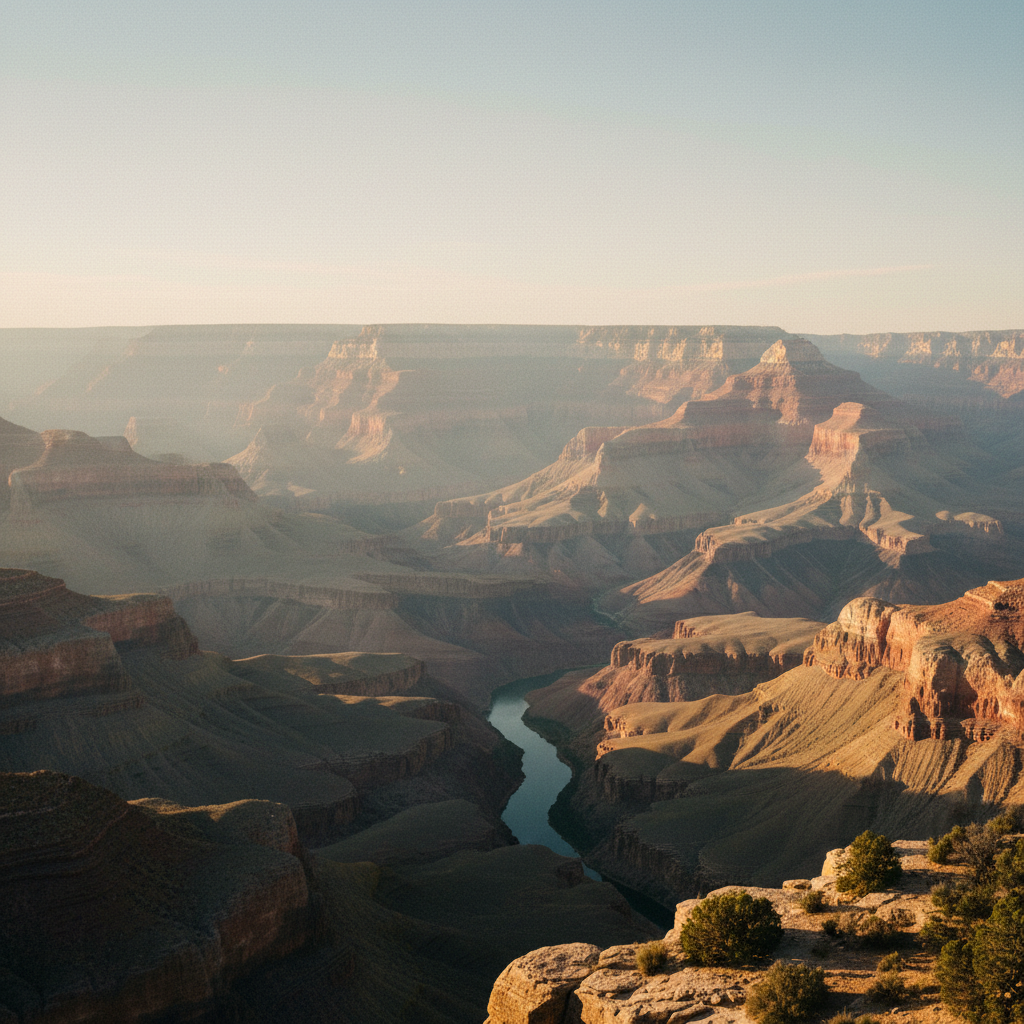
Looking out from Moran Point, the Grand Canyon reveals its deepest secrets: the brilliant red Hakatai Shale of the Supergroup and the dark, ancient basement rocks of the inner gorge.
Standing on the edge of Moran Point, the canyon does not just drop away; it seems to split open to reveal its very bones. While other South Rim viewpoints offer sweeping, horizontal vistas, here the eye is pulled sharply downward into the dark, jagged depths of the Inner Gorge. The Colorado River, glinting like a ribbon of hammered copper, cuts through the basement of the continent. The air is dry and carries the scent of sun-baked pinyon pine and Utah juniper. Unlike the crowded plazas of Mather or Yavapai, Moran Point feels exposed and wind-scoured, jutting out into the abyss like the prow of a stone ship. The sheer verticality is dizzying, a direct confrontation with two billion years of missing time.
This specific overlook is a geologist's Rosetta Stone. Directly opposite sits the Red Canyon, where the bright orange-red Hakatai Shale of the Grand Canyon Supergroup stands out in brilliant contrast to the dark Vishnu Schist below. This tilted block of sedimentary rock is incredibly rare, preserved only in a few places along the canyon where it escaped tectonic destruction. The point bears the name of Thomas Moran, the 19th-century landscape painter whose sweeping, romantic canvases of the American West helped convince Congress to preserve the Yellowstone and Grand Canyon regions. Moran spent winters here, capturing the shifting light and complex geometry of these cliffs. Long before Moran or the tourists arrived, this high point served as a landmark for the Hopi, Navajo, and Havasupai, who navigated these rugged rim-to-river routes for trade and ceremony.
A visit here is best spent in quiet observation rather than constant movement. Find a seat on the flat Kaibab limestone ledges, away from the safety railings, where you can watch the shadows of late afternoon stretch across the canyon floor. The silence is profound, occasionally broken by the rush of wind or the dry croak of a common raven riding the thermals just feet from the rim. As the sun sinks, the pale limestones of the upper rim turn cream and gold, while the deep Hakatai Shale glows with a fiery, internal heat. It is a place to sit until the first stars appear in the desert sky, realizing that the view you are looking at is exactly what Thomas Moran saw over a century ago, unchanged and utterly indifferent to the passage of human time.
While sunset is spectacular, sunrise at Moran Point is the real insider secret. The morning light strikes the tilted red beds of the Hakatai Shale directly, making them burn with a brilliant crimson that fades by midday. Bring binoculars to spot the white-water rapids of Hance Rapid churning in the river gorge far below.