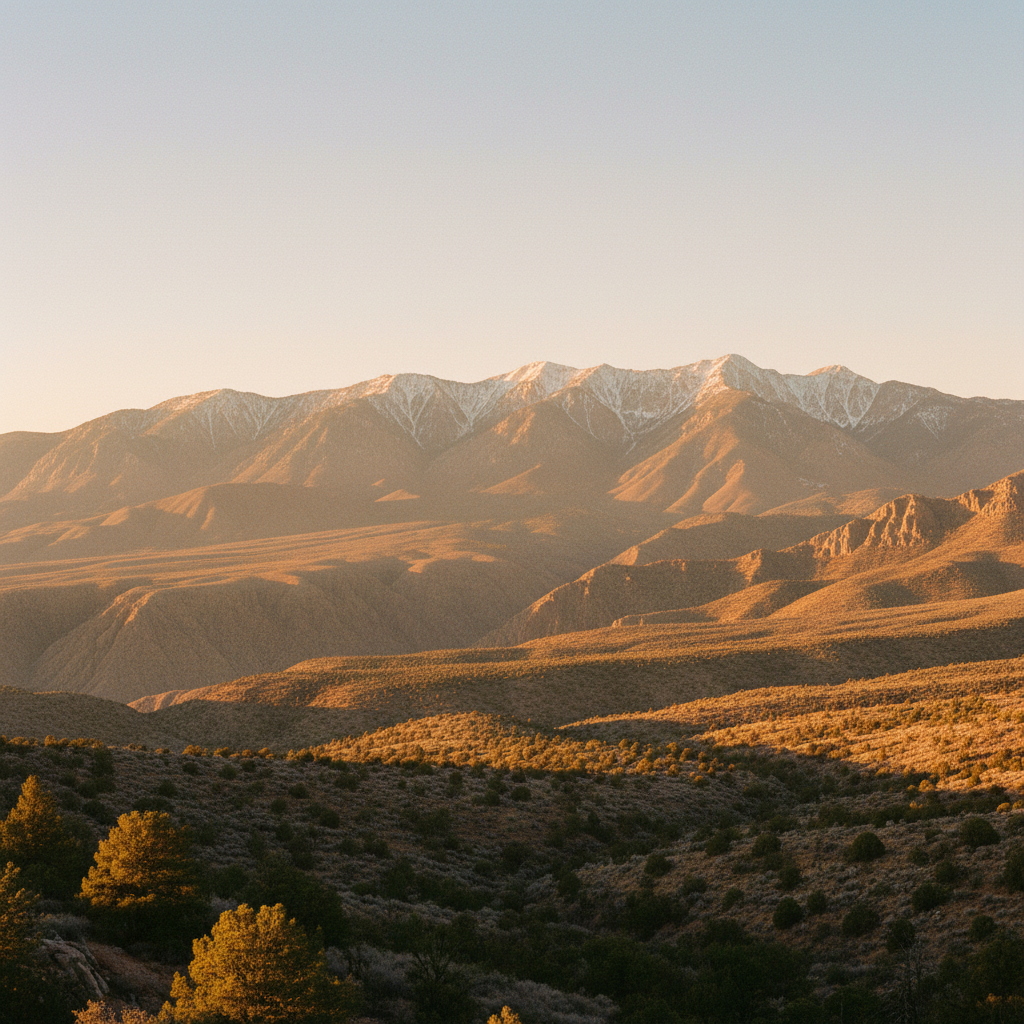
Towering limestone peaks and ancient bristlecone pines rise from the Mojave's edge, creating a cool, alpine sanctuary high above the shimmering heat of the desert floor.
Mount Charleston, known to the Southern Paiute, or Nuwuvi, as Nuvagantu (meaning "where snow sits"), dominates the Spring Mountains National Recreation Area at an elevation of 11,916 feet. This massive limestone peak rises as a dramatic sky-island sanctuary above the Mojave Desert, where temperatures can be thirty degrees cooler than the nearby Las Vegas Valley. Geologically, the mountain is a colossal block of Paleozoic limestone pushed upward by tectonic forces and carved by ancient glaciers, leaving behind sheer gray cliffs, steep avalanche chutes, and deep canyons. To the Nuwuvi, Nuvagantu is a sacred place of creation, a spiritual home meant for respectful visitation rather than permanent settlement. The scent of creosote on the desert floor quickly gives way to the sharp, sweet aroma of ponderosa pine, white fir, and damp earth as one ascends Kyle or Lee Canyon. Winter snow often lingers in the high-altitude chutes well into June, casting a stark white contrast against the brilliant blue Nevada sky.
This high-altitude oasis functions as an ecological island, completely isolated from other mountain ranges by vast seas of low-altitude desert scrub. Because of this geographic isolation, the Spring Mountains host dozens of endemic species found nowhere else on Earth. Among these unique residents are the delicate, endangered Mount Charleston blue butterfly, Palmer's chipmunk, and the Spring Mountains springsnail. High on the wind-scoured ridges near the tree line, ancient Great Basin bristlecone pines cling to the limestone soil. Some of these twisted, slow-growing trees have survived in this harsh environment for over three thousand years, making them some of the oldest living organisms on the planet. The lower slopes are covered in dense stands of singleleaf pinyon pine and Utah juniper, which transition to ponderosa pine and quaking aspen groves that turn a brilliant, shimmering gold each autumn.
Recreation on the mountain has adapted to significant landscape changes following the historic flooding caused by Tropical Storm Hilary in August 2023. While beloved routes like the Mary Jane Falls Trail and the Upper Bristlecone Trail sustained severe washouts and remain closed for extensive engineering and rerouting (with Mary Jane Falls projected to reopen in late 2027 and Upper Bristlecone in 2029), several classic trails are open to hikers. The popular Cathedral Rock Trail, which climbs to a towering limestone overlook, reopened in May 2025 after extensive repairs. Visitors can also explore Fletcher Canyon, where a trail leads into a dramatic slot canyon with polished limestone walls that narrow to just a few feet wide, offering deep shade and cool mountain air. For a shorter hike, Little Falls Trail leads to a seasonal waterfall in Kyle Canyon. In the winter months, Lee Canyon on the northern slopes of the mountain serves as a hub for skiing, snowboarding, and snow tubing, providing a stark contrast to the neon-lit desert floor below.
With the popular Mary Jane Falls Trail closed for storm repairs until late 2027, head to the newly reopened Cathedral Rock Trail for panoramic canyon views, or hike Fletcher Canyon to wander between towering, polished limestone slot walls. Always pack a windbreaker; temperatures on the mountain can be thirty degrees cooler than the Las Vegas Valley.