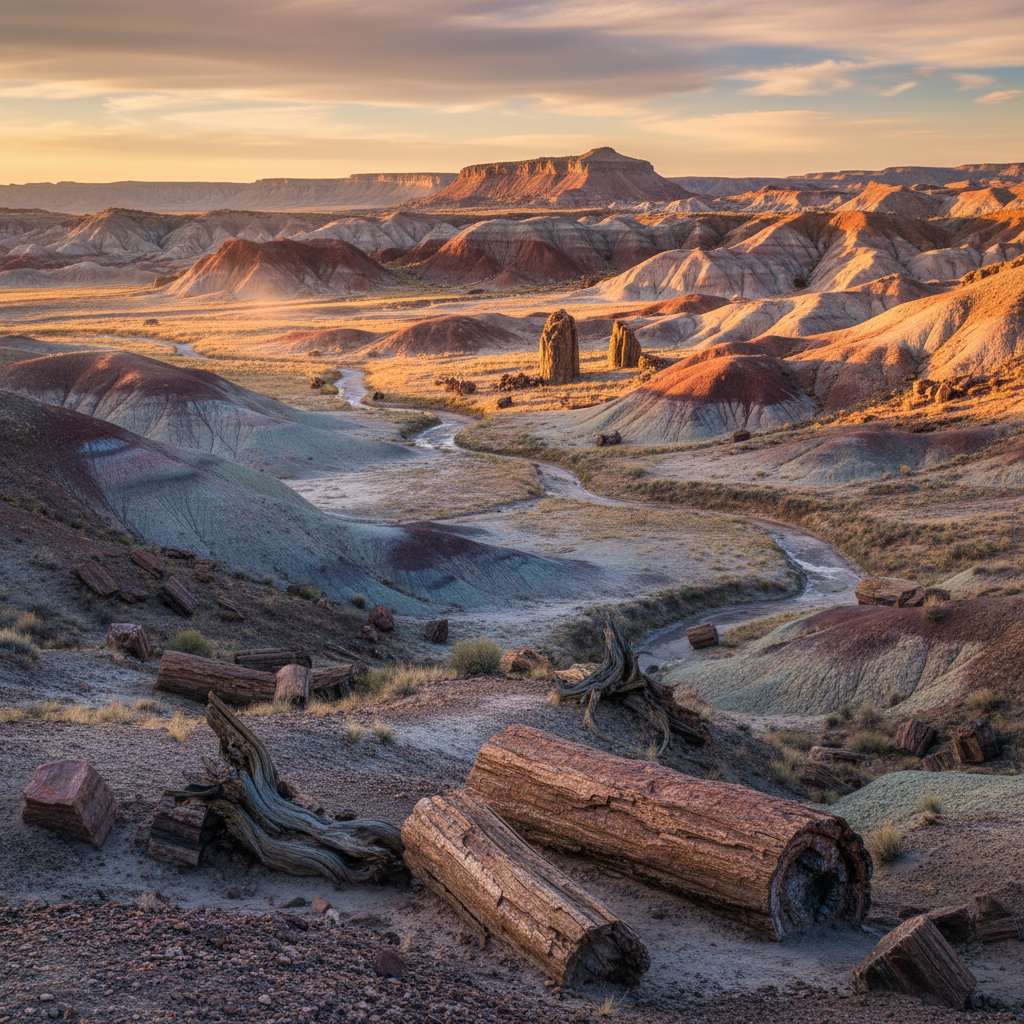
A high-desert expanse of rainbow-colored petrified logs scattered across the pastel badlands of the Painted Desert, preserving ancient trees turned to solid quartz.
Petrified Forest National Park preserves a vast, sun-bleached expanse of late Triassic history, where the glittering remains of ancient forests lie scattered across the multi-hued badlands of the Painted Desert. This is not a standing forest, but rather a graveyard of giants, where massive conifers fell more than 200 million years ago and were slowly replaced, molecule by molecule, by solid quartz. The park spans 346 square miles of semi-desert shrub steppe and highly eroded clay hills. In the northern reaches of the park, overlooks at Kachina Point and Tawa Point reveal a wide vista of the Chinle Formation, a geological sequence of mudstone and siltstone beds striped in pastel shades of lavender, rose, gray, and deep ochre. Moving south, the landscape transitions from these wide badland panoramas to dense concentrations of fossilized wood, where entire logs lie fractured on the pale earth, their growth rings and bark textures preserved in mineral-rich agate, jasper, and amethyst.
The geological story of this landscape began when the region was a lush, subtropical floodplain near the equator on the supercontinent of Pangaea. Rivers deposited massive logs of Araucarioxylon, Woodworthia, and Schilderia conifers, burying them in volcanic ash that dissolved to release silica, initiating the petrification process. Trace elements of iron, manganese, and cobalt in the groundwater infused the quartz with its signature rainbow coloration. Long before President Theodore Roosevelt designated the area a national monument in 1906, and before its elevation to a national park in 1962, this was a deeply human landscape. It is the ancestral homeland of the Hopi (Hopi Tutskwa), Diné (Navajo), and Zuni peoples. Ancestral Puebloans farmed the floodplains of the Puerco River, leaving behind the multi-room sandstone ruins of Puerco Pueblo and carving hundreds of petroglyphs into the dark desert varnish at Newspaper Rock. These sites continue to hold profound spiritual and cultural significance for descendant communities today.
Experiencing the park requires stepping away from the pavement to walk the quiet, wind-scoured trails. The Giant Logs Trail, located behind the Rainbow Forest Museum, features some of the largest and most colorful logs in the park, including the massive Old Faithful log. Nearby, the Crystal Forest trail winds through a high concentration of glittering wood fragments, while the Blue Mesa trail drops down into a sculpted basin of blue, gray, and white badlands where petrified logs are actively eroding out of the clay slopes. At the northern end of the park road, the historic Painted Desert Inn stands as a masterpiece of Pueblo Revival architecture. Originally built in the 1920s as the Stone Tree House using local petrified wood, it was redesigned in the late 1930s by National Park Service architect Lyle E. Bennett and constructed by the Civilian Conservation Corps. In 1947, architect Mary Colter renovated the interior for the Fred Harvey Company, commissioning Hopi artist Fred Kabotie to paint the murals that still adorn its thick adobe walls. Today, the inn serves as a museum, offering a quiet vantage point to watch the late afternoon sun ignite the colors of the badlands.
Plan your drive to enter as soon as the gates open at 8:00 AM, starting from the north entrance off Interstate 40 to catch the early morning light on the Painted Desert badlands. Because the park has strict operating hours and closes at dusk, arriving early ensures you can complete the 28-mile scenic drive, hike the Blue Mesa trail, and explore the historic Painted Desert Inn before the afternoon wind picks up.