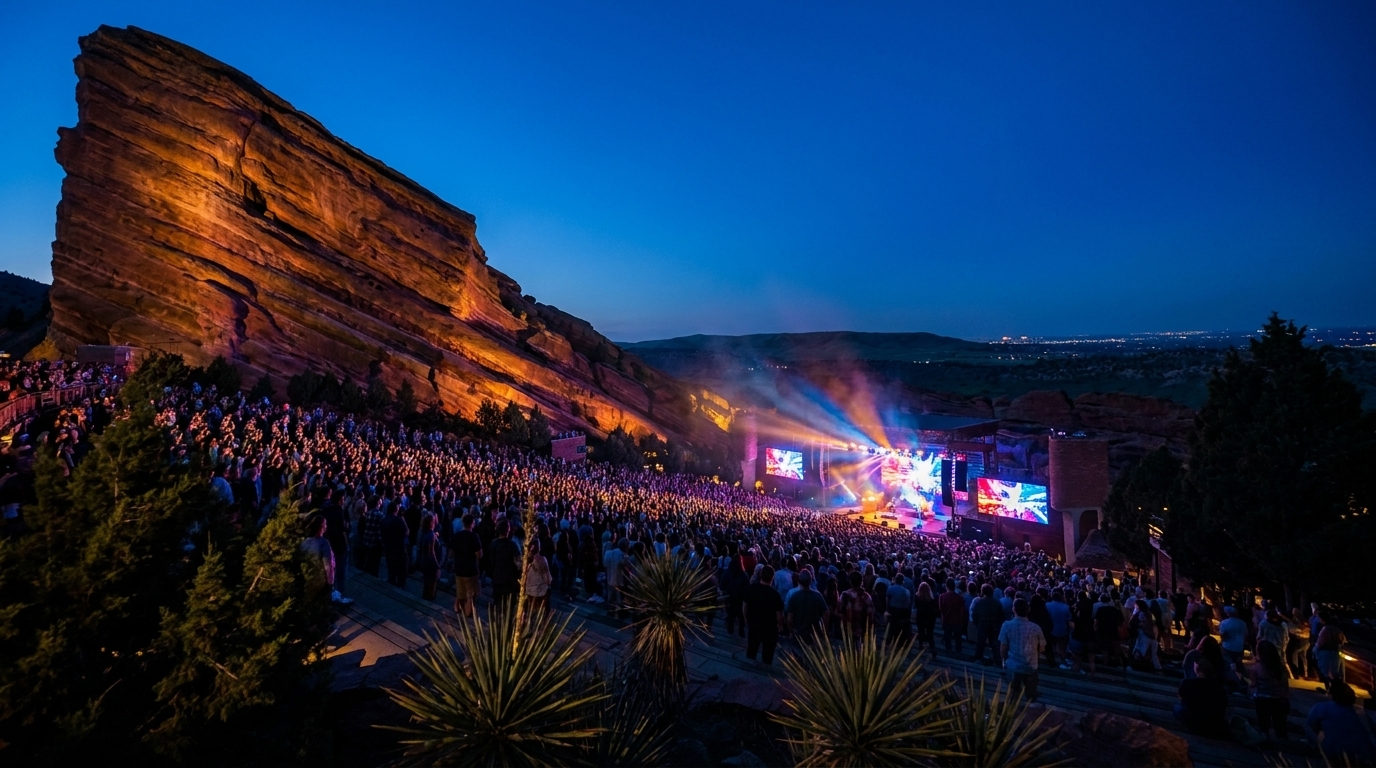
Two 300-foot sandstone monoliths frame a perfect natural acoustic funnel where U2, the Grateful Dead, and the Beatles all left their mark.
Red Rocks Amphitheatre is less a venue than a sandstone temple, a monumental collaboration between human architecture and geological time. The towering monoliths that flank the seating bowl are part of the Fountain Formation, a 300-million-year-old sedimentary deposit of iron-rich sandstone and conglomerate uplifted during the Laramide Orogeny. Two massive 300-foot walls, Creation Rock on the north and Ship Rock on the south, frame a natural acoustic funnel that tapers down to Stage Rock at the bottom. Long before the first modern stage was constructed, the natural acoustic properties of this canyon were recognized by the Ute, Cheyenne, and Arapahoe peoples, who held tribal councils in the nearby foothills and gathered beneath the Inspirational Tree on Dinosaur Ridge. When the formal amphitheatre was dedicated on June 15, 1941, the opening ceremony honored this heritage with a traditional Zuni melody and a ceremonial Eagle Dance.
The physical structure of the modern venue is the masterwork of Denver architect Burnham Hoyt, who spent years drafting more than 125 designs to integrate the seating rows seamlessly into the natural contours of the red sandstone. Built during the Great Depression by the young men of the Civilian Conservation Corps (CCC) and the Works Progress Administration (WPA), the 9,525-capacity amphitheatre was modeled after the ancient Theater of Dionysus at the Acropolis in Athens. It has since become a hallowed pilgrimage site for musicians and music lovers alike. The Beatles played their only non-sold-out show of their 1964 American tour on this stage, performing to a crowd of roughly 7,000. Decades later, the venue became synonymous with legendary live recordings, from U2's career-defining 1983 concert film Under a Blood Red Sky to the Grateful Dead's legendary July 8, 1978 performance, which was later officially released as the live album Red Rocks: 7/8/78. The venue's dominance in the live music industry is so absolute that in 1999, Pollstar magazine permanently renamed its Best Small Outdoor Venue award to the Red Rocks Award, removing the amphitheatre from future competition to give other venues a fighting chance.
Managing a show at 6,450 feet above sea level requires preparation, as the thin mountain air accelerates the effects of alcohol and tests the stamina of even seasoned concertgoers. Red Rocks Park encompasses 738 acres of rugged foothills, located roughly 15 miles southwest of Denver. While the park itself does not permit overnight camping, Indian Paintbrush Campground at nearby Bear Creek Lake Park in Lakewood provides the closest full-service campsites, yurts, and cabins just a 15-minute drive away. For those seeking hotel accommodations, Origin Hotel Red Rocks in Golden serves as the official partner property, offering shuttle services and a design tailored to visiting music fans, while The Eddy Taproom and Hotel offers a craft-beverage basecamp nearby. Tailgating is a celebrated ritual in the tiered dirt and paved parking lots, which open hours before showtime. Visitors are permitted to bring clear, personal-sized bags with factory-sealed, non-alcoholic beverages, but should prepare for the steep climb up from the lower parking lots.
Skip the lower lots. The hike up from South Lower at 6,450 feet is 193 brutal stair-steps that will steal your wind. Arrive ninety minutes early to lock down Upper North; the walk down is forgiving and you keep your legs for dancing.