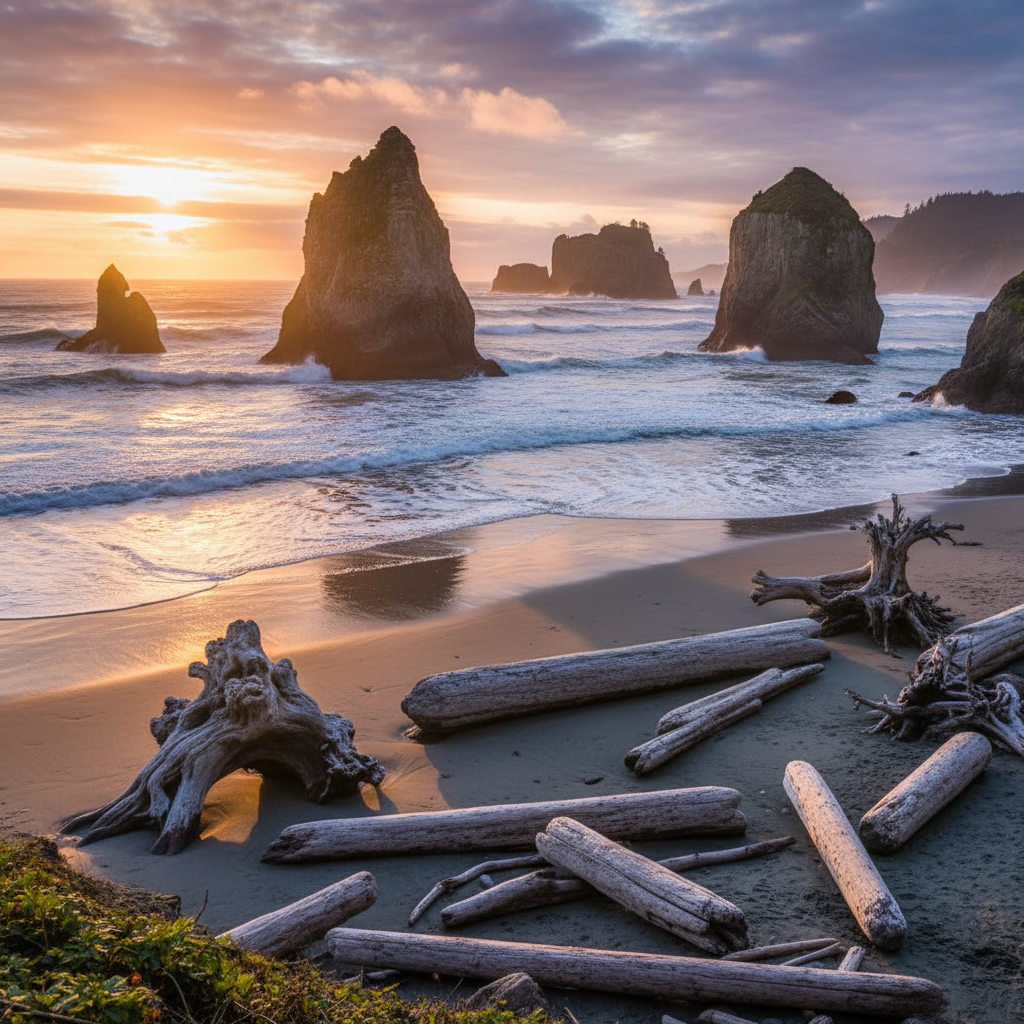
A wild stretch of the Olympic Peninsula coast defined by garnet-tinted sands, massive driftwood piles, and the towering silhouette of Abbey Island.
Ruby Beach is one of the most geologically striking stretches of the Olympic Peninsula coastline, defined by its massive sea stacks, dark gravel shores, and piles of silvered driftwood. Located within Olympic National Park along Highway 101, the beach derives its name from the distinct reddish patches of sand that appear along the high-tide line. These red bands are composed of tiny, heavy grains of almandite garnet, a mineral that erodes from the metamorphic rocks of the Olympic Mountains and travels down coastal rivers before being sorted and concentrated by the relentless action of the Pacific waves. Visitors access the shoreline via a short, quarter-mile trail that descends from a bluff-top parking area. This access point was extensively renovated in 2022 to improve drainage and accessibility, leading down to the mouth of Cedar Creek, which meanders across the dark sand to meet the ocean.
The northern horizon of the beach is dominated by Abbey Island, a massive, flat-topped sea stack that stands as a testament to the region's complex geologic history. Unlike the surrounding cliffs of Pleistocene sand and gravel, Abbey Island and the nearby beach stacks are composed of Hoh rock assemblages, specifically a durable volcanic breccia welded together by heat and pressure. These ancient rocks are crisscrossed with thin, white veins of calcite that filled fractures over millions of years of tectonic deformation. At low tide, the base of Abbey Island and the surrounding rocky outcroppings become accessible, revealing thriving intertidal ecosystems. Bright ochre sea stars, giant green anemones, mussels, and barnacles cling to the dark stone, surviving in the harsh zone between the crashing surf and the open air. Just offshore, the wider expanse of the Quillayute Needles National Wildlife Refuge protects these rocks as critical nesting grounds for seabirds like common murres, tufted puffins, and gulls.
Navigating the beach requires climbing over a formidable barrier of driftwood logs, primarily massive trunks of Sitka spruce, Douglas fir, and Western redcedar that have been washed down from coastal rivers, stripped of their bark, and bleached to a pale grey by salt and sun. This natural seawall acts as a buffer against winter storms, protecting the delicate coastal forest that presses right to the edge of the high-tide line. This coastline is part of the ancestral homeland of the Hoh and Quinault tribes, who have utilized its rich marine resources, from shellfish to smelt, for thousands of years. Today, walking north past Cedar Creek toward the Hoh River estuary offers a quieter, more isolated experience, where bald eagles frequently perch in the high branches of the seaside forest and gray whales can occasionally be spotted spouting in the distance. When the sun sinks below the Pacific horizon, the towering silhouettes of the sea stacks cast long shadows across the wet, reflective sand, capturing the raw, elemental character of the Pacific Northwest coast.
Time your arrival for a receding tide to safely cross Cedar Creek and reach the tide pools at the base of Abbey Island. Wear sturdy, waterproof footwear with excellent grip, as scrambling over the slick, wet driftwood logs at the trail's end requires careful footing.