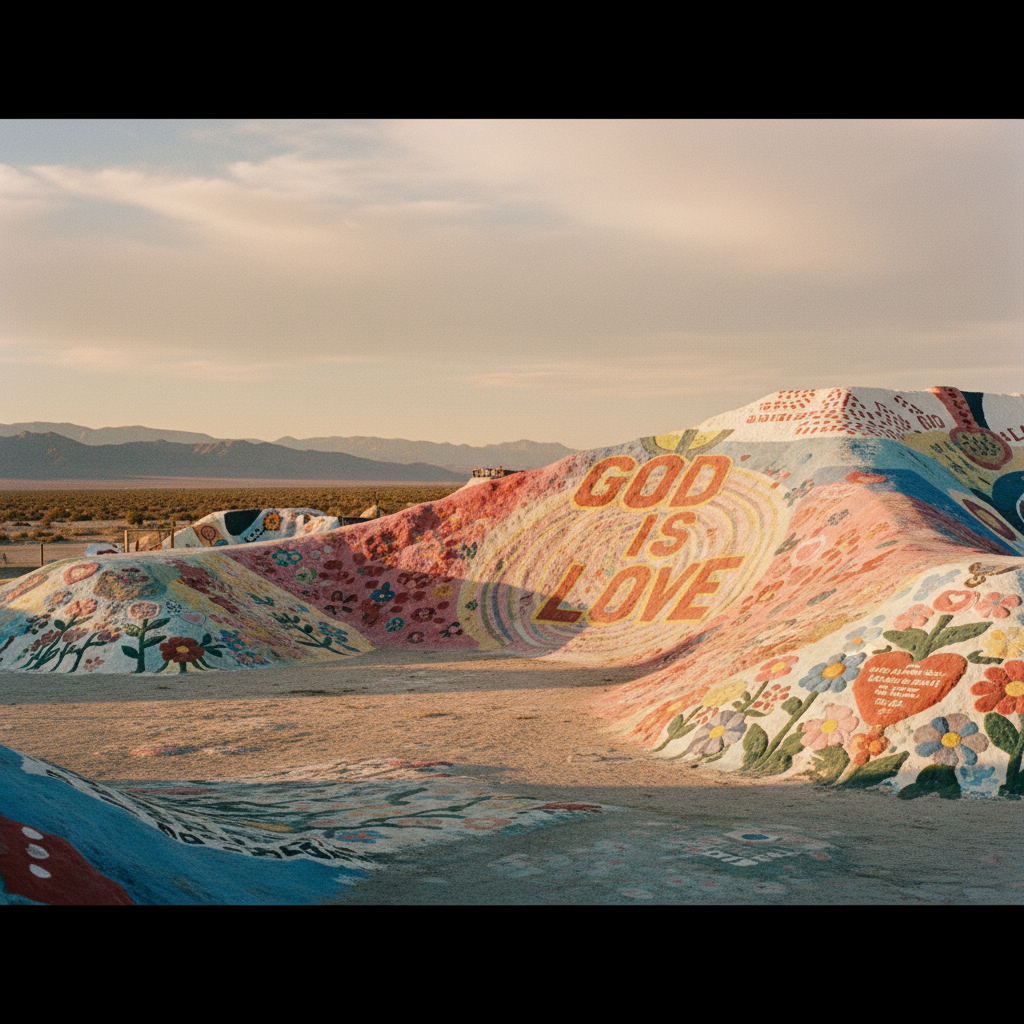
Layers of sun-baked adobe and salvaged paint erupt from the desert floor, forming a vibrant, technicolor testament to unwavering belief on the edge of the Salton Sea.
Salvation Mountain rises from the flat, salt-crust basin of the Imperial Valley as a towering, fifty-foot-tall monument of painted adobe, straw, and salvaged junk. Located just east of the Salton Sea and northeast of Niland, this vibrant hill of folk art stands as a physical manifestation of a singular man's devotion. Thousands of gallons of latex paint, baked by the intense desert sun into a thick, glossy shell, coat a labyrinth of hand-packed clay, discarded tractor tires, car windows, and dead native trees. The air at the site carries the scent of dry creosote, hot dust, and the faint, sulfurous tang of the nearby sea, grounding visitors in one of the most arid and isolated landscapes in North America. It is a monument of pure, unmediated visionary art, crowned by a massive white cross that cuts directly into the stark desert sky.
The mountain is the life's work of Leonard Knight, a Vermont-born veteran and visionary who spent nearly three decades building and rebuilding this monument in the Colorado Desert. After his first attempt, constructed primarily of sand and weak cement, collapsed into a heap of dust in the late 1980s, Knight did not abandon his mission. Instead, he pivoted to mixing local adobe clay with straw, packing it by hand over whatever discarded materials he could scavenge from the surrounding desert. Knight lived on-site in his truck without running water or electricity, surviving on donations of exterior latex paint and canned goods until failing health forced him to leave in 2011. He passed away in 2014, but his legacy persists through Salvation Mountain Inc., a non-profit organization of dedicated volunteer caretakers who fight the blistering desert heat and shifting sands to patch and repaint the fragile structure. In January 2024, the Imperial County Board of Supervisors unanimously designated the mountain a Historically Significant Property and Historic Resource, protecting Knight's masterpiece from future development and recognizing its cultural importance.
To explore the site is to navigate a tangible, three-dimensional prayer. Visitors follow a painted yellow brick road that winds up the face of the mountain, stepping carefully on designated pathways to protect the fragile, sun-baked adobe from crumbling underfoot. Adjacent to the main mountain sits the "Hogan" and a series of domed structures, where the temperature drops slightly beneath a canopy of painted tree branches, built-in alcoves, and hand-lettered scripture. Light filters through colored glass bottles embedded in the adobe walls, casting amber, blue, and green pools across the floor. There is no admission fee, no commercial gift shop, and no barrier between the public and the art. It remains a quiet, contemplative space where the harshness of the surrounding badlands meets Knight's simple, universal message that God is love, leaving a profound impression of what can be built out of nothing but determination, discarded materials, and donated paint.
Respect the rules and stay strictly on the painted yellow brick road; the adobe is fragile and easily crushed underfoot. Combine your visit with a trip to East Jesus, an experimental art garden just down the road in Slab City. Bring a gallon of water, wear closed-toe shoes, and consider bringing a donation of exterior latex paint for the caretakers.