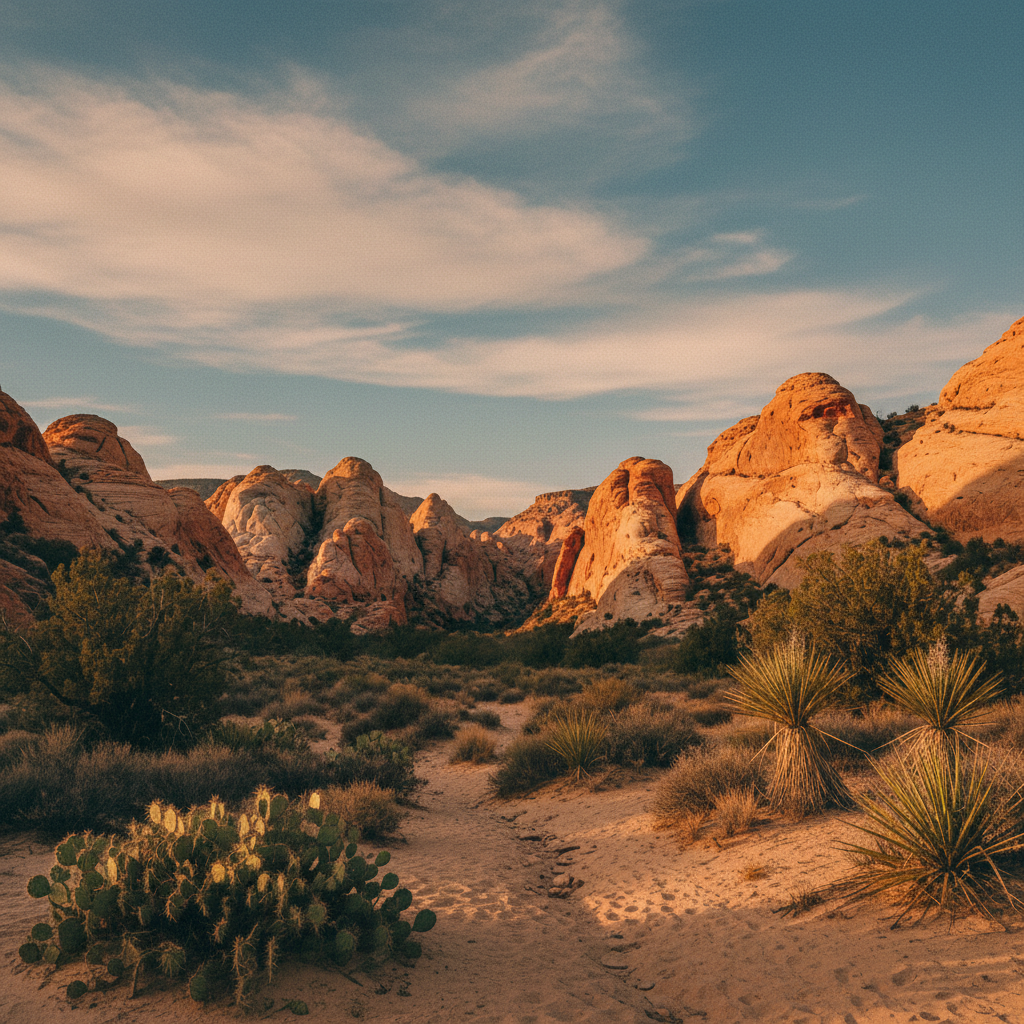
A geological sanctuary of towering red Navajo sandstone cliffs, ancient black lava flows, and historic pioneer graffiti in southwestern Utah.
Snow Canyon State Park commands attention with its dramatic geological contrast: towering cliffs of deep red and white Navajo sandstone, dark fields of basalt lava, and shifting dunes of fine orange sand. Established in 1958 as Dixie State Park, this 7,400-acre sanctuary was later renamed to honor early Utah pioneer leaders Lorenzo and Erastus Snow. The canyon itself is carved into the Red Mountains, sitting at a unique ecological crossroads where the Mojave Desert, the Great Basin, and the Colorado Plateau converge. Here, the dry, earthy aroma of creosote and big sagebrush hangs in the warm air, and the quiet of the canyon is punctuated only by the occasional rustle of a side-blotched lizard or the call of a canyon wren. As the late afternoon sun angles across the canyon walls, the Navajo sandstone deepens to a rich, glowing orange, while the black basalt flows take on a subtle, metallic sheen.
The geology of the park represents millions of years of dramatic environmental shifts. The dominant Navajo sandstone, which dates back to the Early Jurassic period about 190 million years ago, originated as a massive sea of windblown sand dunes known as the Navajo erg. Over eons, these dunes were buried, compacted, and cemented into stone, then uplifted by tectonic forces and sculpted by water and wind into towering cliffs and petrified mounds. Cutting directly through this ancient red rock are much younger, dark basalt flows and cinder cones, remnants of volcanic eruptions from the nearby Santa Clara Volcano that occurred between 1.4 million and 20,000 years ago. Long before Mormon pioneers arrived in the 1850s while searching for lost cattle, Indigenous peoples utilized the canyon. Ancestral Puebloans inhabited the region from approximately A.D. 200 to 1250, leaving behind petroglyphs, and were followed by the Southern Paiute (Nuwuvi), who used the sheltered canyon for hunting and gathering until the mid-19th century.
Exploring the park is best done on its diverse trail network, which showcases these contrasting geological chapters. The paved, multi-use Whiptail Trail runs 2.5 miles along the canyon floor, providing an accessible route for walkers and cyclists beneath the towering red cliffs. For those seeking to venture into the volcanic terrain, the Lava Flow Trail winds across rugged basalt fields, leading hikers to three distinct, cool lava tubes that can be carefully explored. The short, sandy path to Jenny's Canyon (named in memory of seventeen-year-old Jennifer Denise Patchett, who passed away in the park in 1994) leads into a narrow, sculpted slot canyon that terminates in a dramatic box wall, while the Pioneer Names Trail takes visitors to a shallow sandstone alcove where 19th-century settlers etched their names in dark axle grease, with some inscriptions dating back to 1881. Scrambling across the rolling mounds of the Petrified Dunes Trail or watching for protected desert tortoises and Gila monsters offers an intimate, slow-paced encounter with the raw forces of the earth.
If you plan to explore the park's three lava tubes along the Lava Flow Trail, pack a reliable headlamp rather than relying on a phone flashlight, as the interior chambers are pitch-black and require both hands free for scrambling over uneven basalt.