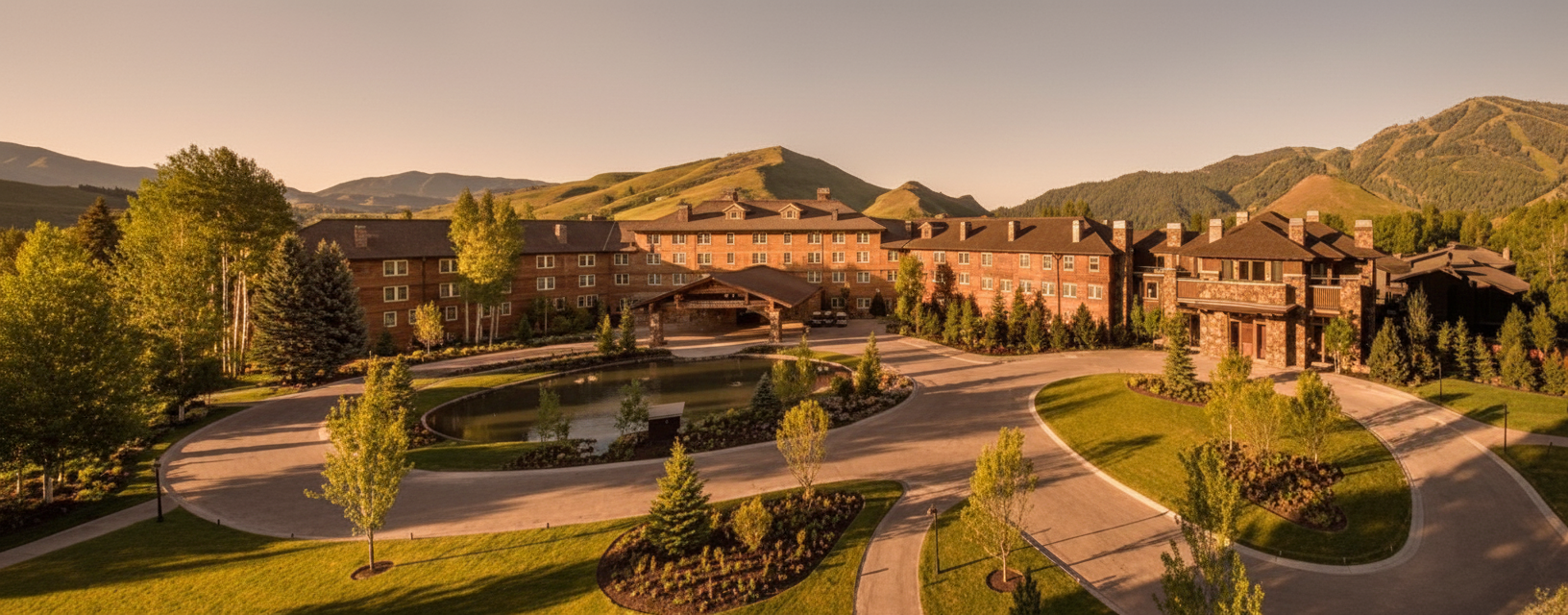
Built in 1936 as America's first destination ski resort, this historic lodge is where Ernest Hemingway wrote, Hollywood stars vacationed, and the chairlift was born.
Sun Valley Lodge opened on December 21, 1936, establishing itself as the centerpiece of America's first destination ski resort. Envisioned by Union Pacific Railroad chairman W. Averell Harriman, the resort was designed to bring passenger traffic to the rail lines of Idaho. Architect Gilbert Stanley Underwood drew up plans for a grand, four-story, X-shaped lodge. To prevent the fire hazards that had recently destroyed Underwood's previous design at the Grand Canyon Lodge, the building was constructed entirely of poured-in-place concrete. Workers poured the material into rough-sawn wooden forms to imprint a natural wood-grain texture, then stained and stenciled the exterior a deep brown to perfectly mimic rustic timber. This structural illusion is so convincing that visitors still walk up to the exterior walls and knock on them to test their density.
The lodge quickly became a magnet for the mid-century Hollywood elite and literary giants, drawn by Harriman's sophisticated marketing campaigns. Ernest Hemingway arrived in September 1939 as a promotional guest, moving into Suite 206, which he nicknamed "Glamour House". It was in this room that he finished writing "For Whom the Bell Tolls". Today, Suite 206 is preserved as the Hemingway Celebrity Suite, decorated with archival photographs, a library of his works, and a bronze statue of the author at his typewriter. Other legendary figures like Clark Gable, Gary Cooper, Marilyn Monroe, and Ingrid Bergman frequented the property, and their visits are documented in the black-and-white photographs that line the lodge's historic hallways.
A major renovation in 2015 meticulously modernized the lodge while preserving its historic footprint. The project reduced the room count from 148 to 108 to allow for significantly larger, more luxurious guest rooms and suites. These updated accommodations feature spacious granite-clad bathrooms with soaking tubs, walk-in showers, and fireplaces that divide the living and sleeping areas. The renovation also introduced a 20,000-square-foot full-service spa with fifteen treatment rooms, a state-of-the-art fitness center, and a yoga studio, while revitalizing the lodge's classic gathering spaces, including the elegant Duchin Lounge and Gretchen's restaurant.
The grounds of the lodge remain a hub of year-round activity. The famous year-round outdoor ice rink has hosted Olympic skaters like Peggy Fleming and Kristi Yamaguchi, and still features summer ice shows. Adjacent to the rink, the massive, glass-enclosed heated outdoor pool remains one of the lodge's most celebrated features, sending plumes of steam into the crisp mountain air. For dining, guests can stroll to The Ram, an Austrian-style restaurant that has welcomed diners since the resort's earliest seasons, offering classic alpine fare in a cozy, wood-beamed dining room that preserves the original European-inspired atmosphere of the resort's early days.
Book a stay in the Hemingway Suite (Suite 206) to sleep where 'For Whom the Bell Tolls' was completed, and spend an evening sipping a classic cocktail in the Duchin Lounge before walking over to The Ram for traditional alpine fondue.
Where to Stay — Curated accommodations hand-picked by Basecamp West. Glamping, boutique hotels, historic lodges, and unique stays across the American West.