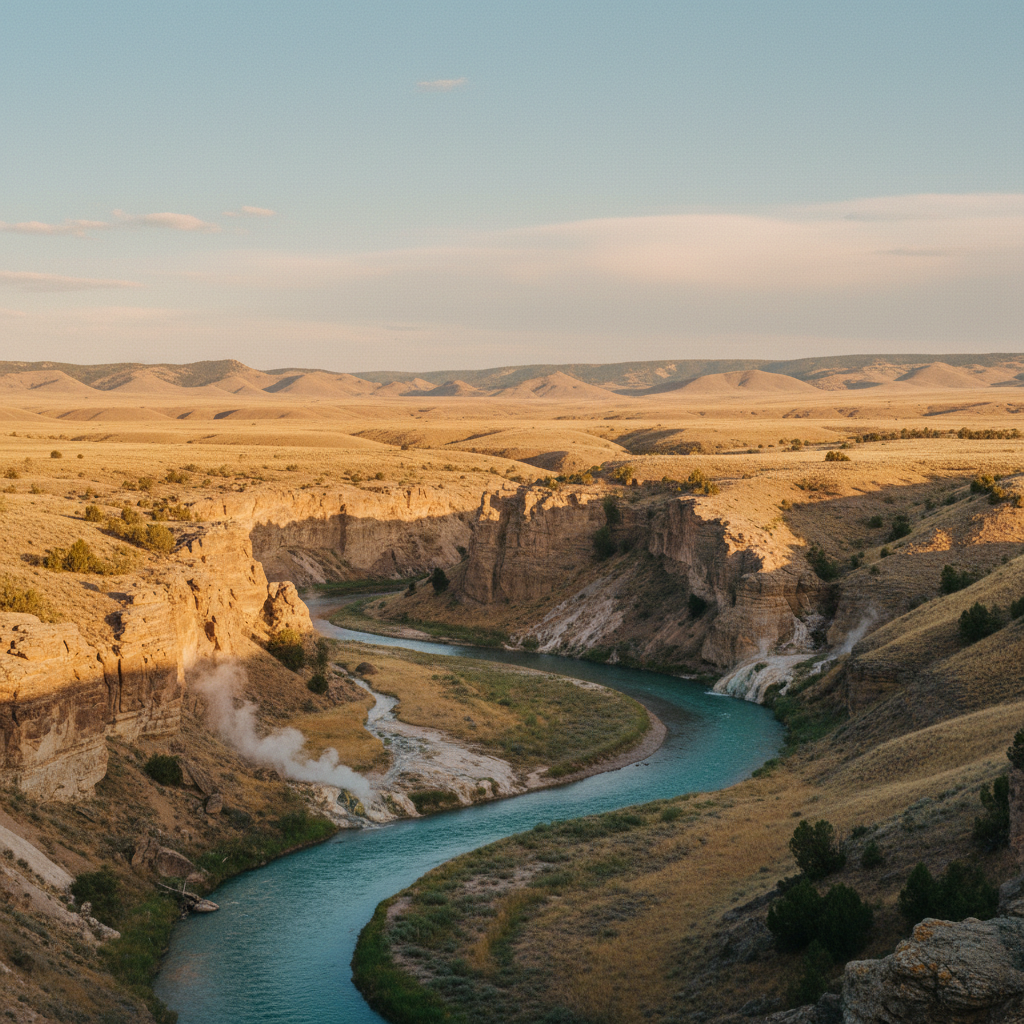
Soak in the mineral-rich warmth of Thermopolis, Wyoming, where millions of gallons of geothermal water flow daily from the Big Spring, preserved for free public use under an 1896 treaty.
Thermopolis, Wyoming, sits at the northern mouth of the Wind River Canyon, where geothermal heat and ancient geology converge to shape a landscape defined by water and deep time. The physical identity of the town centers on Hot Springs State Park, home to the Big Spring. This colossal geothermal feature releases roughly 3.6 million gallons of mineral-rich water every twenty-four hours at temperatures ranging from 127 to 135 degrees Fahrenheit. As the water emerges, it carries dissolved minerals such as bicarbonate and sulfate, which have built the massive, multi-hued travertine formations known as the Rainbow Terraces. These terraces cascade directly into the adjacent Bighorn River, creating a steaming, colorful landscape of turquoise pools and mineral crusts. Visitors can observe these formations from the Swinging Bridge, a suspension footbridge originally constructed in 1916 to connect the springs with historic sanitariums, then rebuilt in 1992 to span the river.
The human history of these waters is deeply intertwined with the Eastern Shoshone and Northern Arapaho tribes, who revered the springs as Bah-gue-wana, meaning smoking waters, and utilized them for healing and solace. In 1896, Eastern Shoshone Chief Washakie and Northern Arapaho Chief Sharp Nose negotiated a treaty ceding a ten-square-mile tract of land containing the springs to the federal government for 60,000 dollars in cash, cattle, and supplies. A vital condition of this agreement, insisted upon by the tribal leaders, was that a portion of the thermal waters must always remain free and accessible to the public. Today, this promise is honored at the Wyoming State Bath House, where the mineral-rich waters are cooled to a safe 104 degrees Fahrenheit for free, twenty-minute public soaks. The park also supports the state's central bison herd, which has roamed these pastures since 1916 and is fed daily by park rangers during the winter months.
Beyond the thermal waters, Thermopolis preserves a much older layer of history at the Wyoming Dinosaur Center, located on the Warm Springs Ranch just east of the town center. Established in 1995 after dinosaur bones were discovered in the nearby hills, the center is one of the few facilities in the world with active excavation sites located just minutes from the museum floor. The collection features over fifty mounted skeletons, including Jimbo, a 106-foot-long Supersaurus, and Stan, a 35-foot Tyrannosaurus rex. Most notably, the museum displays the Thermopolis Specimen of Archaeopteryx, a late Jurassic fossil showing detailed feather impressions that remains the only real Archaeopteryx specimen on public display in North America. To the south, the dramatic transition of the landscape is marked by the Wedding of the Waters, where the fast-flowing Wind River emerges from its ancient, 2,500-foot canyon walls and officially becomes the Bighorn River, completing the geological story of this thermal sanctuary.
Soak at the State Bath House in the early morning during the winter months, when the rising steam contrasts sharply with the cold air and crowds are sparse. If visiting the Wyoming Dinosaur Center, book a Dig for a Day spot in advance to work alongside paleontologists at an active Jurassic excavation site.