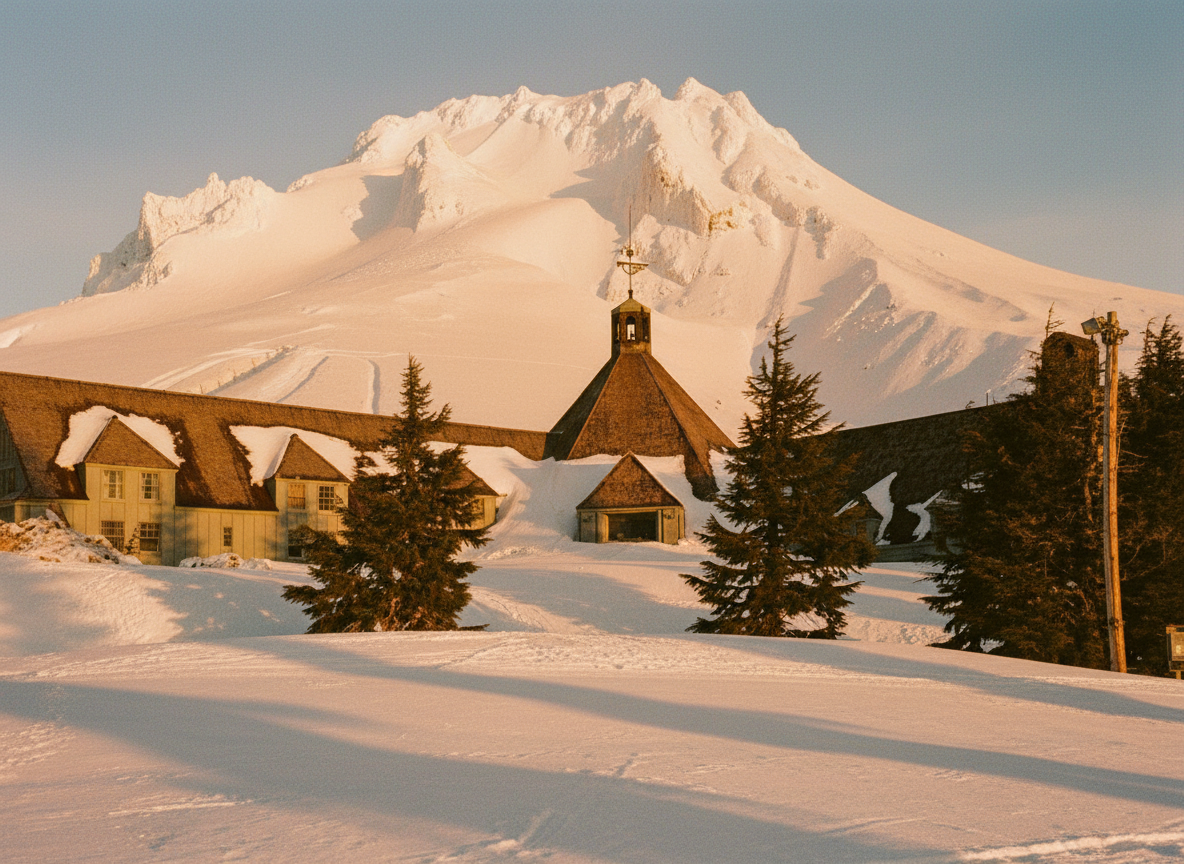
A historic WPA masterpiece on the high slopes of Wy'east, featuring hand-hewn timber, massive stone fireplaces, and a legendary cinematic legacy.
Timberline Lodge stands as a monument to Great Depression-era craftsmanship, rising from the south slope of Wy'east, the traditional Indigenous name for Mount Hood, at an elevation of 6,000 feet. Commissioned by the Works Progress Administration (WPA) and built in just 18 months, the lodge was dedicated by President Franklin D. Roosevelt on September 28, 1937, as a tribute to the skill of American workers. Consulting architect Gilbert Stanley Underwood, renowned for his rustic national park lodges, collaborated with Forest Service architects including W. I. Turner and Linn A. Forrest to design the massive, hexagonal head house. The building is constructed from local volcanic andesite stone and heavy timber, featuring a steep, geometric roofline built to withstand heavy alpine snows. Margery Hoffman Smith, the assistant state director of the Federal Art Project, supervised the interior design, orchestrating a cohesive Cascadian aesthetic that elevated raw materials into functional art. Her hand is visible from the hand-woven draperies to the iconic, 750-pound bronze snow goose weather vane that crowns the chimney stack.
Inside the lodge, the central head house features a massive 92-foot-tall stone chimney with three working fireplaces on the main floor, radiating a steady warmth and the scent of seasoned woodsmoke. Every corner of the interior showcases the handiwork of local artisans who were employed during the project. Master blacksmith Orion B. Dawson supervised the creation of the wrought-iron details, including the intricate coyote-head gates that secure the entrance to the Cascade Dining Room. Hand-carved newel posts, shaped from cedar telephone poles by woodworkers under Ray Neufer, depict native Cascade wildlife such as owls, bears, and badgers. On the second-floor mezzanine, which circles the great chimney, sits the Ram's Head Bar, featuring a massive Douglas fir table supported by hand-carved wooden ram's heads crafted by Melvin Keegan. Tucked away on the ground floor is the Blue Ox Bar, a cozy watering hole that was originally designed as a firewood storage closet. The intimate bar is decorated with vibrant glass mosaic murals depicting the legend of Paul Bunyan and Babe, his blue ox, offering a warm space to enjoy local microbrews from the Mt. Hood Brewing Company.
Today, the 55,000-square-foot lodge remains a fully functioning historic hotel and ski resort, operated by RLK and Company under a special use permit with the U.S. Forest Service. Richard L. Kohnstamm took over operations in 1955, rescuing the property from a period of severe neglect, and his family continues to steward the landmark today under the leadership of Jeff Kohnstamm. The lodge features 70 guest rooms, each uniquely laid out with original timber paneling, rustic furnishings, and historic-style textiles. Dining at the lodge centers around the Cascade Dining Room, where the culinary program highlights Pacific Northwest ingredients like wild salmon, local berries, and regional wines. Beyond its architectural and culinary significance, the lodge holds a permanent place in cinematic history, having served as the exterior of the fictional Overlook Hotel in Stanley Kubrick's 1980 horror classic, *The Shining*. Outside, guests can access the year-round heated swimming pool, outdoor hot tub, and miles of alpine trails, all while enjoying a front-row seat to the longest ski season in North America on the Palmer Glacier.
Look closely at the wrought-iron gates of the Cascade Dining Room to spot the hand-forged coyote heads, and find the animal motifs hand-carved into the cedar stairwell newel posts.
Where to Stay — Curated accommodations hand-picked by Basecamp West. Glamping, boutique hotels, historic lodges, and unique stays across the American West.