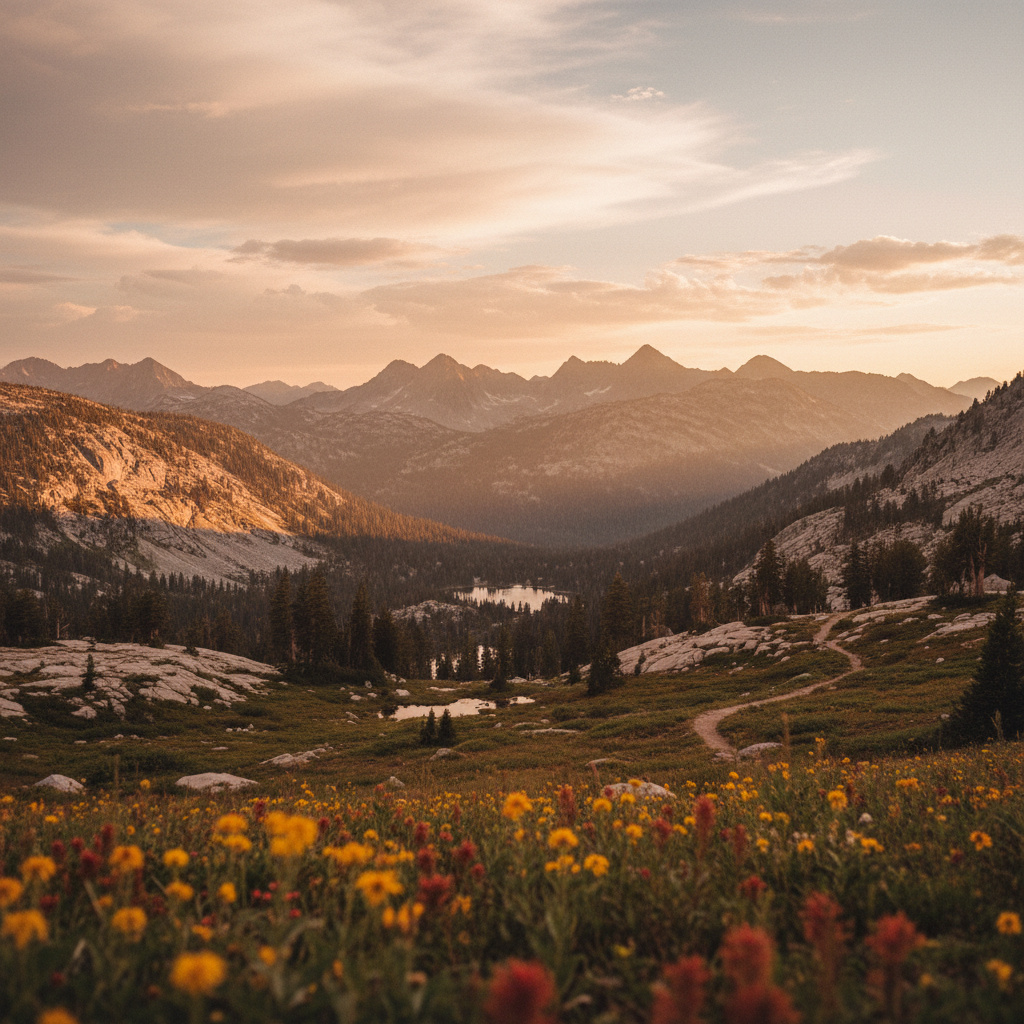
Hike through glacier-carved basins to find cold alpine lakes reflecting the jagged granite peaks of this remote Northern California wilderness.
Leave the damp coastal redwood forests behind and climb east into a sky of crystalline, high-altitude blue. The Trinity Alps rise as a jagged wall of granite and metamorphic rock, a half-million-acre wilderness in Northern California that feels entirely detached from the rest of the state. What hits you first is the scale of the silence, broken only by the rush of snowmelt plunging down steep-sided canyons. Here, ancient glaciers scoured deep U-shaped valleys and scooped out high-elevation basins that now cradle over a hundred alpine lakes. The air is thin, sharp, and carries the scent of sun-warmed mountain hemlock, white fir, and damp granite duff. It is a landscape of stark contrasts, where massive white peaks pierce the horizon and cold, clear water seems to seep from every fracture in the stone.
The geology of the Trinity Alps tells a complex story of tectonic collision and glacial carving. Geologists divide the wilderness into two distinct zones: the eastern "White Trinities," dominated by pale granodiorite that mimics the High Sierra, and the western "Red Trinities," characterized by ultramafic peridotite and serpentinite that weather to a rich, rusty red. This varied chemistry supports an extraordinary botanical diversity. The region is a vital refuge for rare conifers, including the weeping spruce and foxtail pine, which cling to rocky ridges. For thousands of years, the Chimariko, Wintu, and Matsut peoples traveled these valleys, harvesting acorns and fishing for salmon in the wild rivers. In the mid-nineteenth century, gold seekers rushed into these canyons, leaving behind stone foundations, tailing piles, and names like Weaverville and Canyon Creek that still anchor the wilderness boundaries.
To experience this wilderness is to commit to the trail. Backpackers head up the Canyon Creek Trail, where the water's roar is a constant companion as you climb past cascading waterfalls toward the massive granite cirque holding Upper and Lower Canyon Creek Lakes. For those seeking the high country, the strenuous climb to the Four Lakes Loop reveals a chain of jewel-toned waters, including Emerald and Sapphire Lakes, resting directly beneath the shadow of Thompson Peak. In July, the high meadows erupt in a brief, brilliant display of paintbrush, lupine, and mountain heather. By October, the summer crowds have gone, a crisp autumn chill settles over the granite basins, and the lakes become perfect, unruffled mirrors of the surrounding peaks before the first heavy snows of winter seal the passes until the spring thaw.
A wilderness permit and a California campfire permit are required for overnight stays. For an exceptional day hike, take the Swift Creek Trail to Granite Lake. It is an eight-mile round trip that climbs through mixed conifer forest to a deep, glacier-carved basin, offering a classic Trinity Alps experience without the heavy pack.