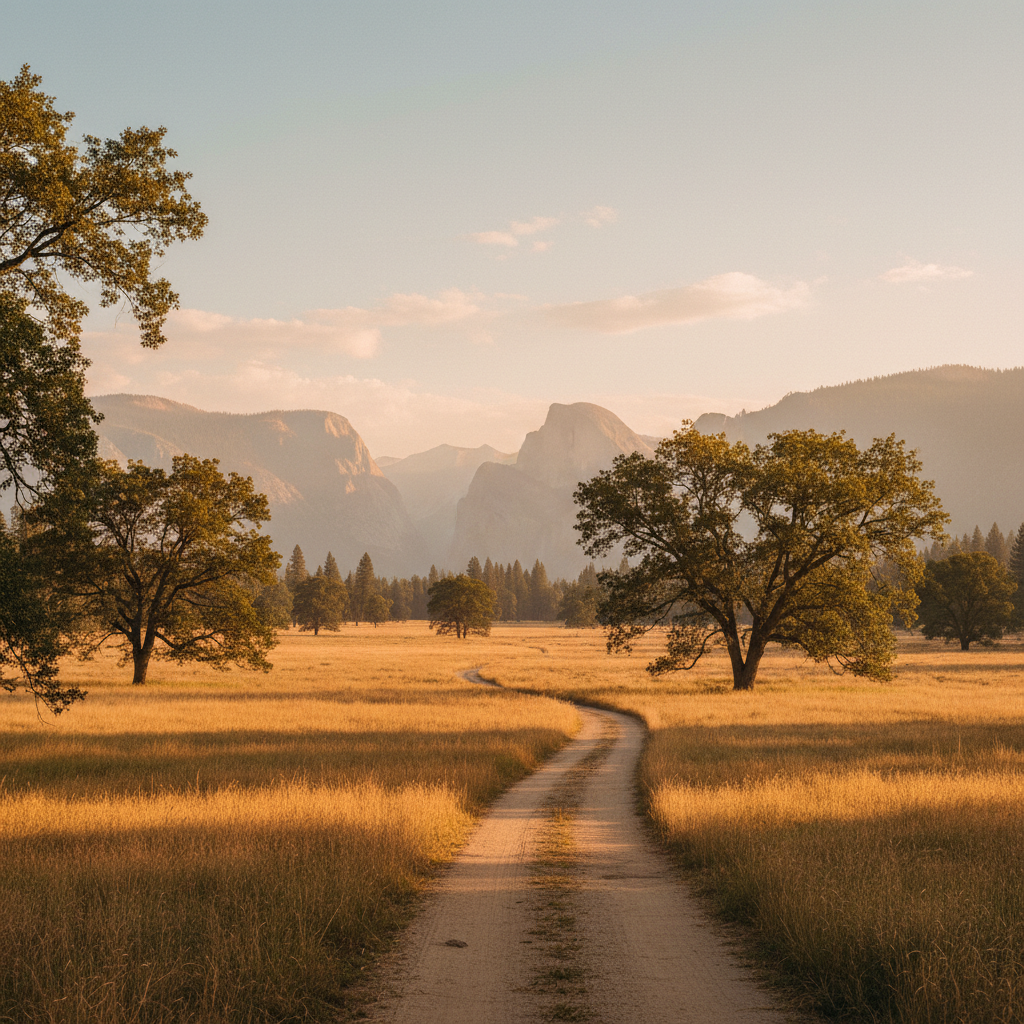
Wawona preserves a Victorian-era pace in Yosemite's southern reaches, where the South Fork of the Merced River winds past historic homesteads and giant sequoias.
Wawona, historically known to the Southern Sierra Miwok as Pallahchun, meaning "a good place to stop," sits in a wide forested basin in the southern reaches of Yosemite National Park. Long before Euro-American settlers arrived, Indigenous peoples gathered acorns from the black oak trees and fished the South Fork of the Merced River, leaving behind bedrock mortars visible in the river channel during late summer. In 1856, Galen Clark, seeking a dry climate to heal his failing lungs, became the first non-Native year-round resident, establishing a homestead and way station that travelers called Clark's Station. Clark constructed a horse trail to the nearby Mariposa Grove of Giant Sequoias, eventually becoming the first state-appointed guardian of the Yosemite Grant. His modest station was bought in 1874 by the Washburn brothers (Albert Henry, Edward, and John) who renamed it Wawona, a word derived from the Mono Indian word "Wah Who Nau" representing the hoot of the great horned owl, the guardian spirit of the giant sequoias.
The architectural heart of the basin is the Wawona Hotel, a National Historic Landmark consisting of a campus of white, Victorian-style buildings with wide, wraparound verandas. Although the hotel complex closed indefinitely in late 2024 for a comprehensive structural and condition assessment by the National Park Service, its historic presence remains central to the landscape. The oldest surviving structure on the grounds is Clark Cottage, built in 1876 and originally known as the "Long White" building. The main hotel building was constructed in 1879 after a devastating fire destroyed the original structures. Nearby, the Yosemite History Center (formerly the Pioneer Yosemite History Center) preserves a collection of historic structures relocated here in the 1950s and 1960s from across the park. The centerpiece is the Wawona Covered Bridge, originally built as an open timber bridge in the mid-19th century by Galen Clark and later covered by the Washburns in the style of their native Vermont. This bridge, one of only twelve remaining covered bridges in California, spans the South Fork of the Merced River and was meticulously restored using 19th-century tools after a devastating flood in 1955.
Beyond the historic structures, Wawona's landscape is defined by its gentle terrain and diverse trails. The Wawona Meadow Loop provides a flat, three-and-a-half-mile path through a lush meadow where wildflowers bloom in spring and mule deer graze at dusk. In contrast, the strenuous trail to Chilnualna Falls climbs steep granite ledges, passing cascades and creeks to offer views of the surrounding pine forest. Just five miles southeast of Wawona lies the Mariposa Grove of Giant Sequoias, the largest grove in Yosemite. Here, visitors can walk among ancient giants like the Grizzly Giant, estimated to be nearly three thousand years old, or walk through the living California Tunnel Tree, which was carved in 1895 to allow stagecoaches to pass through its trunk. Today, Wawona remains a quiet, historic sanctuary, preserving the slower, reflective pace of early California tourism away from the busy crowds of Yosemite Valley.
Stroll through the Yosemite History Center in the late afternoon to walk across the historic Wawona Covered Bridge when the low sun illuminates the hand-hewn timber, then peer through the windows of the Chinese Laundry and the Acting Superintendent's Office to read the interpretive signs detailing early park life.